

1 Gulden – ERR: NetherlandsandAustralia
Context
Years: 1795–1799
Issuer: ERR: NetherlandsandAustralia
Period:
(1795—1806)
Currency:
(1581—1817)
Demonetized: Yes
Total mintage: 54,400
Material
References
KM: #Click to copy to clipboard2.4
Numista: #355617
Value
Bullion value: $27.74
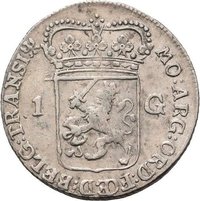
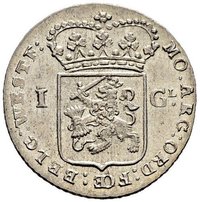
Obverse
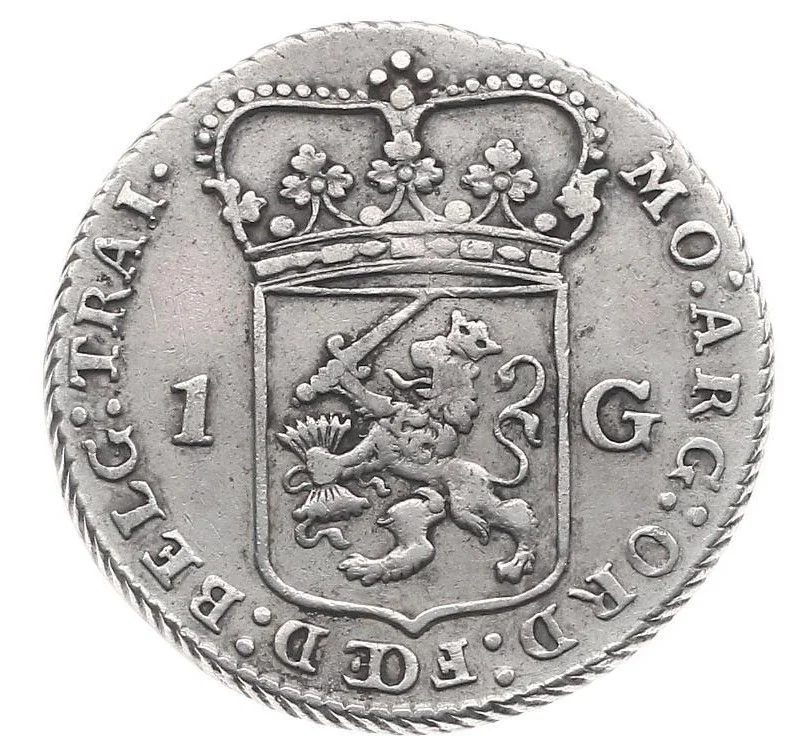
Description:
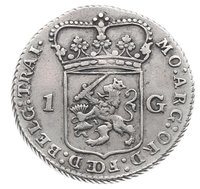
Crowned arms flank value.
Inscription:
MO : ARG : ORD : FŒD : BELG : TRAI ·
1 G
1 G
Script: Latin
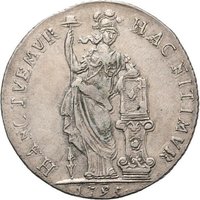
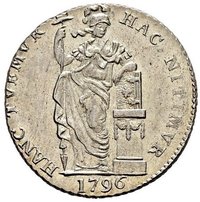
Reverse
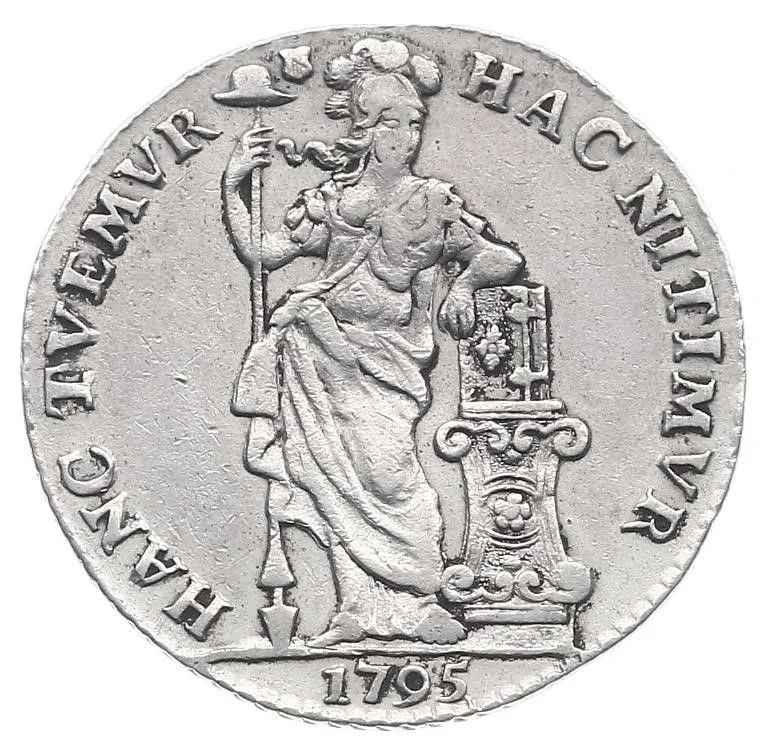
Description:
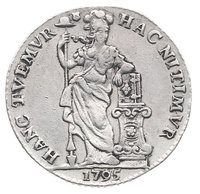
Figure leaning on book, holding spear with cap. Date below.
Inscription:
HAC NITIMVR HANC TVEMVR ⬕
1795
1795
Script: Latin
Edge
Cabled
Mints
| Name | Mark |
|---|---|
| Royal Dutch Mint | ⬕ |
Historical background
In 1795, the currency situations of the Netherlands and Australia presented a stark contrast, defined by one nation's political collapse and another's colonial nascency. The Netherlands was in the midst of the Batavian Revolution, which overthrew the old Dutch Republic and established the French-backed Batavian Republic. This political upheaval caused significant monetary instability. The economy relied on a complex system of provincial coins, bank money (the bankgulden of the Amsterdam Wisselbank), and circulating specie. The war with Britain and the French occupation disrupted trade and strained public finances, leading to inflationary pressures and uncertainty, though the famed gulden remained a recognized unit of account amidst the turmoil.
Conversely, in 1795, the European concept of "Australia" did not exist as a unified entity with its own currency. The continent was the continent of New Holland, with the British colony of New South Wales being its sole European settlement, established in 1788. The colony suffered from a severe lack of official coinage. The British government had not supplied sufficient sterling, leading to a chronic currency shortage. To facilitate trade, the economy operated on a makeshift system of barter, promissory notes (IOUs), and the use of foreign coins—most notably Spanish dollars (pieces of eight) and Dutch guilders brought by visiting traders.
This scarcity led to one of history's most peculiar monetary experiments. In 1795, Governor John Hunter attempted to address the crisis by promulgating official values for various foreign coins in circulation. More infamously, just a few years prior, Governor Philip Gidley King had taken the drastic step of punching holes in the center of Spanish dollars to create two separate currencies: the "holey dollar" (the outer ring) and the "dump" (the central plug). This 1790s solution, formalized in 1813, aimed to keep currency within the colony by creating a distinct, lower-valued local money, starkly illustrating the inventive, ad-hoc measures required in a penal colony, a world away from the established, if troubled, financial systems of Europe.
Conversely, in 1795, the European concept of "Australia" did not exist as a unified entity with its own currency. The continent was the continent of New Holland, with the British colony of New South Wales being its sole European settlement, established in 1788. The colony suffered from a severe lack of official coinage. The British government had not supplied sufficient sterling, leading to a chronic currency shortage. To facilitate trade, the economy operated on a makeshift system of barter, promissory notes (IOUs), and the use of foreign coins—most notably Spanish dollars (pieces of eight) and Dutch guilders brought by visiting traders.
This scarcity led to one of history's most peculiar monetary experiments. In 1795, Governor John Hunter attempted to address the crisis by promulgating official values for various foreign coins in circulation. More infamously, just a few years prior, Governor Philip Gidley King had taken the drastic step of punching holes in the center of Spanish dollars to create two separate currencies: the "holey dollar" (the outer ring) and the "dump" (the central plug). This 1790s solution, formalized in 1813, aimed to keep currency within the colony by creating a distinct, lower-valued local money, starkly illustrating the inventive, ad-hoc measures required in a penal colony, a world away from the established, if troubled, financial systems of Europe.
✨ Legendary