

1 Sovereign – Spanish Netherlands
Netherlands
Context
Years: 1666–1694
Country: Netherlands 
Issuer: Spanish Netherlands
Ruler: Charles II
Currency:
(1506—1713)
Demonetized: Yes
Total mintage: 23,420
Material
References
KM: #Click to copy to clipboard80
Numista: #355529
Value
Bullion value: $869.68
Obverse
Description:
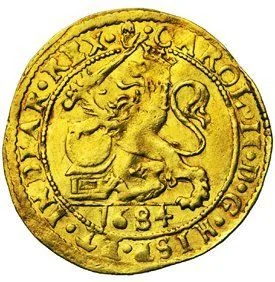
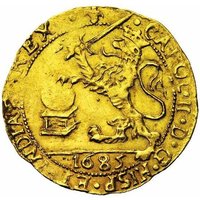
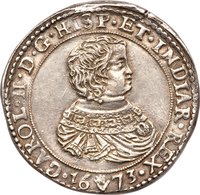
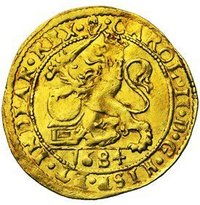
Crowned lion left, holding sword and resting paw on globe. Date below, mint mark above.
Inscription:
CAROL • II • D • G • HISP • ET • INDIAR • REX
1684
1684
Script: Latin
Reverse
Description:
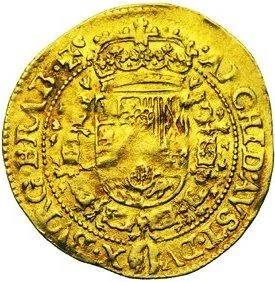
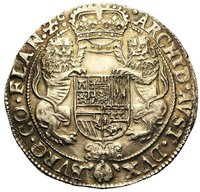
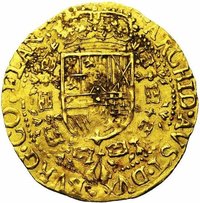
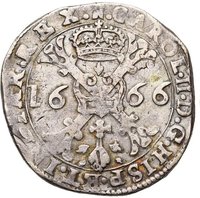
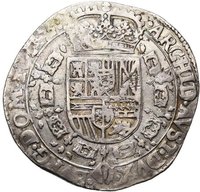
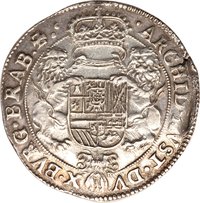
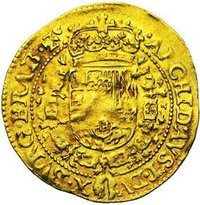
Arms crowned and encircled by the Golden Fleece collar.
Inscription:
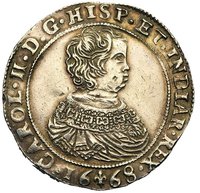
ARCHID • AVST • DVX • BURG BRAB Z
Script: Latin
Edge
Mints
| Name | Mark |
|---|---|
| Antwerp | Hand |
| Royal Mint of Belgium | Head |
Mintings
| Year | Mint Mark | Mintage | Quality | Collection |
|---|---|---|---|---|
| 1666 | — | 9,145 | ||
| 1667 | — | — | ||
| 1676 | — | 4,663 | ||
| 1681 | — | 4,631 | ||
| 1684 | — | 1,005 | ||
| 1694 | — | 3,976 |
Historical background
In 1666, the Spanish Netherlands was grappling with a severe and complex monetary crisis, a direct consequence of prolonged warfare and economic strain. The region, a battleground in the Franco-Spanish War and affected by the ongoing Second Anglo-Dutch War, faced immense fiscal pressure to fund its defenses. This led the authorities to repeatedly debase the coinage, notably the ubiquitous patagon (a silver coin), by reducing its precious metal content. The result was a classic "bad money drives out good" scenario, where older, full-weight coins were hoarded or melted down, leaving an unstable and depreciated currency in circulation, which crippled everyday commerce and eroded public trust.
Compounding this internal debasement was a flood of inferior foreign coins, particularly from the neighboring Dutch Republic. The Republic, a major economic power, was suspected of deliberately exporting lightweight coins to the Spanish Netherlands to gain economic advantage and extract silver. This "coin dumping" further polluted the money supply, making it nearly impossible for merchants and consumers to ascertain the true value of the mixed coinage in their hands. The chaotic multiplicity of coins of varying intrinsic worth created a paralyzing uncertainty for all transactions.
The crisis demanded urgent intervention. In response, the government in Brussels, under the rule of the Governor-General, the Marqués de Castel Rodrigo, enacted a drastic monetary ordinance in September 1666. This edict aimed to forcibly stabilize the situation by officially devaluing the current debased coinage and setting new, lower legal exchange rates. While intended to create a single, clear standard, the measure was economically painful, effectively wiping out a portion of the money's value overnight. It was a stark acknowledgment that the currency's integrity had been sacrificed to the immediate exigencies of war, with the burden falling heavily on the population of the already beleaguered Spanish Netherlands.
Compounding this internal debasement was a flood of inferior foreign coins, particularly from the neighboring Dutch Republic. The Republic, a major economic power, was suspected of deliberately exporting lightweight coins to the Spanish Netherlands to gain economic advantage and extract silver. This "coin dumping" further polluted the money supply, making it nearly impossible for merchants and consumers to ascertain the true value of the mixed coinage in their hands. The chaotic multiplicity of coins of varying intrinsic worth created a paralyzing uncertainty for all transactions.
The crisis demanded urgent intervention. In response, the government in Brussels, under the rule of the Governor-General, the Marqués de Castel Rodrigo, enacted a drastic monetary ordinance in September 1666. This edict aimed to forcibly stabilize the situation by officially devaluing the current debased coinage and setting new, lower legal exchange rates. While intended to create a single, clear standard, the measure was economically painful, effectively wiping out a portion of the money's value overnight. It was a stark acknowledgment that the currency's integrity had been sacrificed to the immediate exigencies of war, with the burden falling heavily on the population of the already beleaguered Spanish Netherlands.
✨ Legendary