

1 franc – France
Add to wishlist
France
Context
Years: 1866–1870
Issuer: France
Ruler: Napoleon III
Currency:
(1795—1959)
Demonetization: 22 March 1918
Total mintage: 66,029,842
Material
References
KM: #
Numista: #1172
Value
Bullion value: $10.41
Obverse
Description:
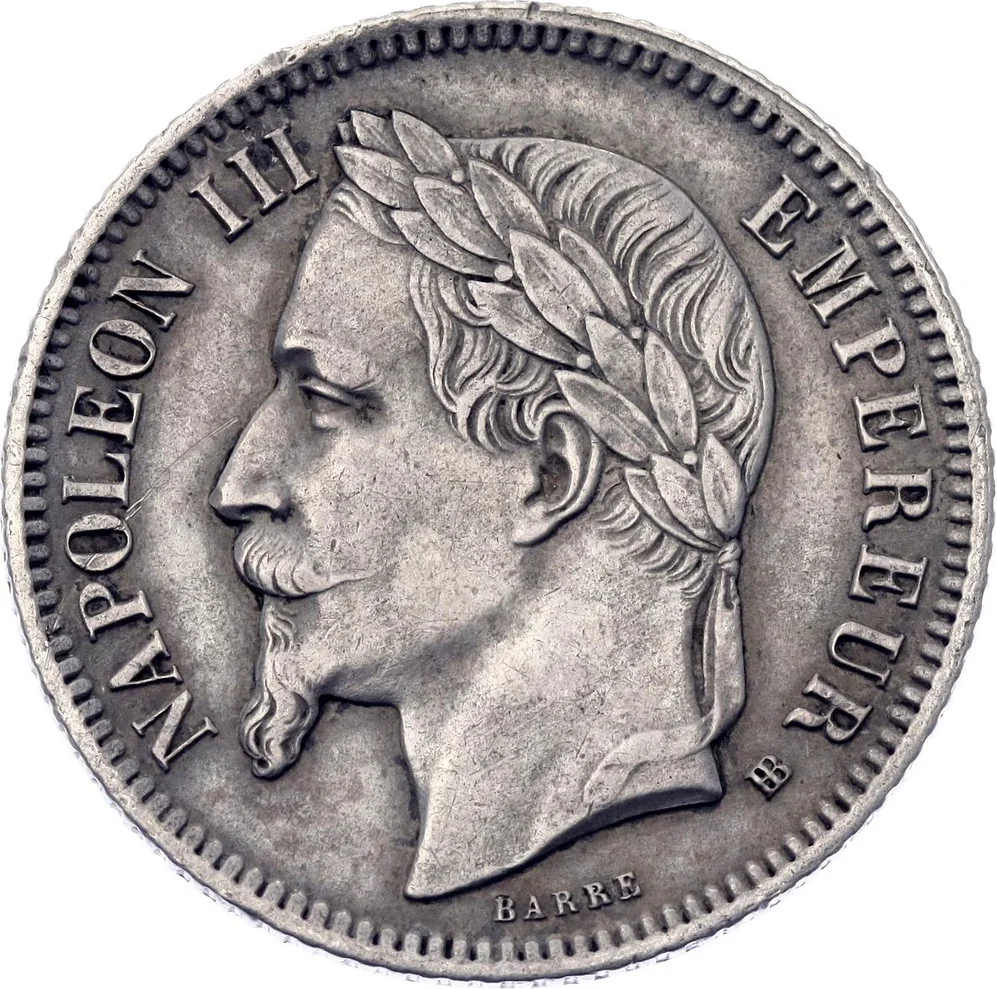
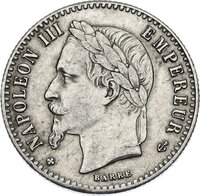
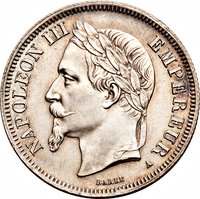
Napoleon III laureate head left; signed BARRE below.
Inscription:
NAPOLEON III EMPEREUR
A
A
Translation:
NAPOLEON III EMPEROR
Script: Latin
Language: French
Engraver: Désiré-Albert Barre
Reverse
Description:
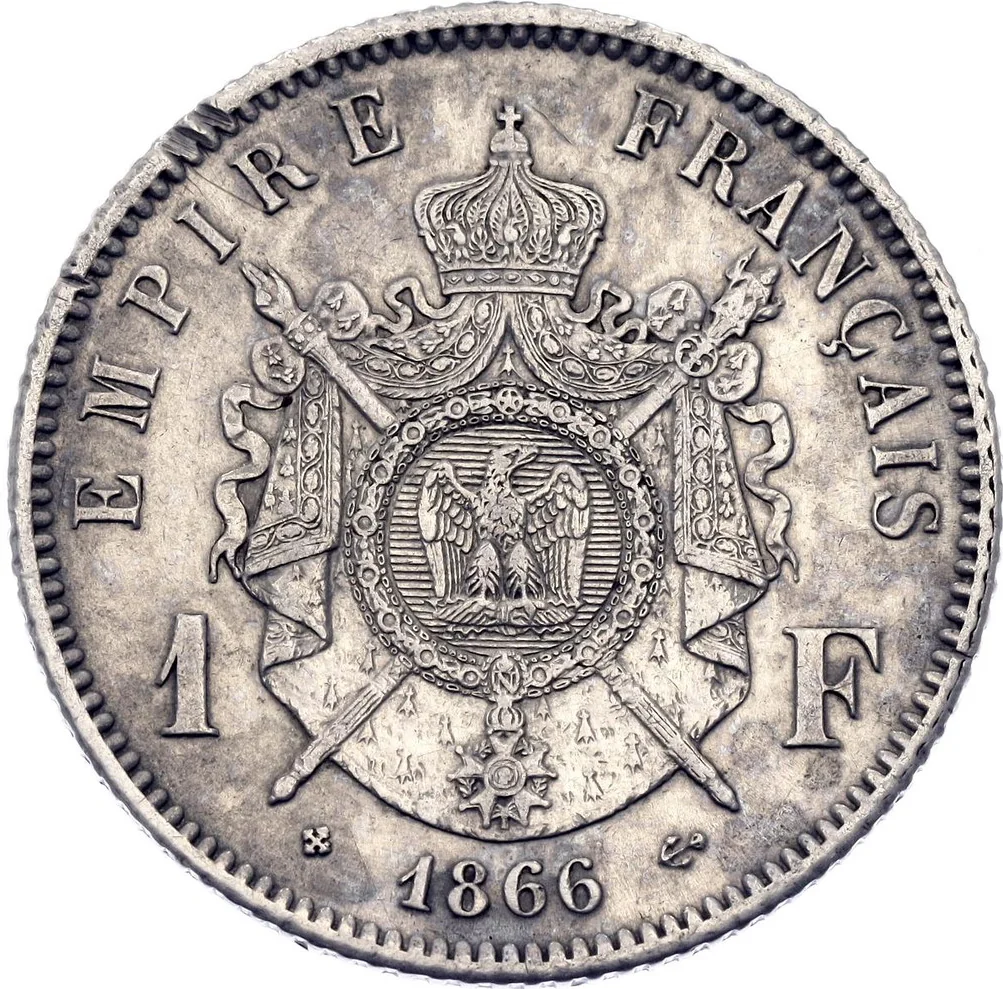
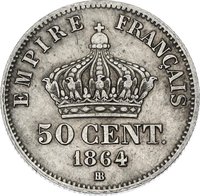
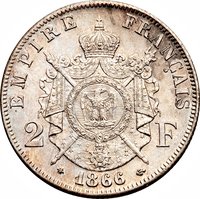
Shield with an eagle on a thunderbolt, encircled by the Legion of Honor necklace, all upon a crowned mantle embroidered with a scepter and hand of justice; date below.
Inscription:
EMPIRE FRANÇAIS
1 F
1868
1 F
1868
Translation:
FRENCH EMPIRE
1 FRANC
1868
1 FRANC
1868
Script: Latin
Language: French
Engraver: Désiré-Albert Barre
Edge
Reeded
Mints
| Name | Mark |
|---|---|
| Monnaie de Paris | A |
| Strasbourg | BB |
| Bordeaux | K |
Mintings
Historical background
In 1866, France operated under a bimetallic monetary system, established by the Latin Monetary Union (LMU) treaty of 1865. This agreement, which included Belgium, Switzerland, Italy, and later Greece, standardized coinage by fixing the gold-to-silver ratio at 1:15.5. The goal was to create a stable, uniform currency zone that would facilitate trade and economic integration across participating nations. French coins like the gold Napoléon and the silver 5-franc piece were legal tender throughout the union, representing a significant step toward European monetary cooperation.
However, this system faced profound structural pressures. The fixed mint ratio did not reflect the fluctuating market values of the metals, particularly as new silver discoveries in the Americas increased its supply and drove its market price down. This created Gresham's Law in practice: cheaper silver flooded into the LMU mints to be coined at the artificially high rate, while gold coins were increasingly hoarded or exported. Consequently, France was effectively draining its gold reserves to support an overvalued silver currency, placing the entire bimetallic framework under severe strain.
The situation in 1866 was therefore one of precarious transition. While the LMU promised stability, the inherent flaws of bimetallism were becoming untenable. French monetary authorities, led by the Banque de France, were grappling with the practical reality that the system was evolving toward a gold standard de facto, even as the law upheld bimetallism de jure. This period set the stage for the eventual, though reluctant, shift of France and the LMU toward a gold-based system in the following decades, as the international monetary order began to coalesce around gold.
However, this system faced profound structural pressures. The fixed mint ratio did not reflect the fluctuating market values of the metals, particularly as new silver discoveries in the Americas increased its supply and drove its market price down. This created Gresham's Law in practice: cheaper silver flooded into the LMU mints to be coined at the artificially high rate, while gold coins were increasingly hoarded or exported. Consequently, France was effectively draining its gold reserves to support an overvalued silver currency, placing the entire bimetallic framework under severe strain.
The situation in 1866 was therefore one of precarious transition. While the LMU promised stability, the inherent flaws of bimetallism were becoming untenable. French monetary authorities, led by the Banque de France, were grappling with the practical reality that the system was evolving toward a gold standard de facto, even as the law upheld bimetallism de jure. This period set the stage for the eventual, though reluctant, shift of France and the LMU toward a gold-based system in the following decades, as the international monetary order began to coalesce around gold.
🌱 Very Common