

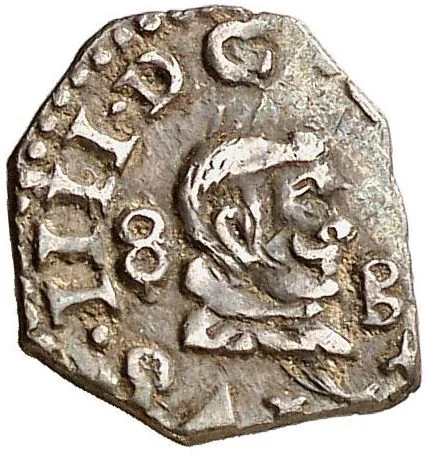
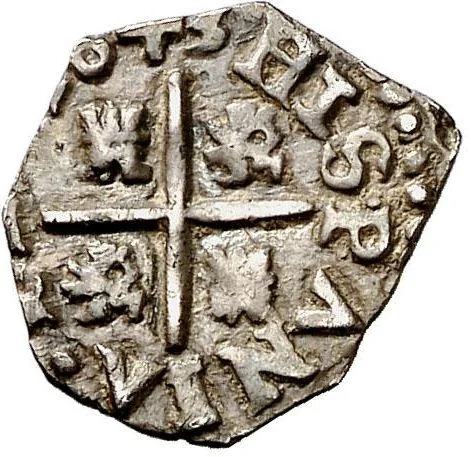
8 Maravedis – Spain
Spain

Material
Weight: 0.8 g
Silver weight: 0.74 g
Shape: Irregular round
Composition: 93.1% Silver
Magnetic: No
Technique: Hammered
References
KM: #Click to copy to clipboard14
Numista: #112790
Value
Bullion value: $2.12
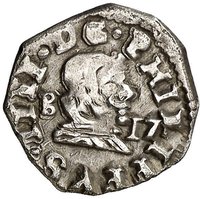
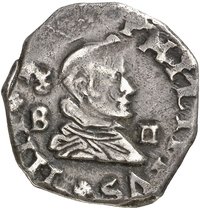
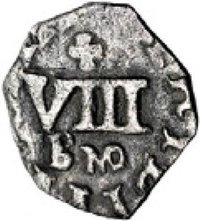
Obverse
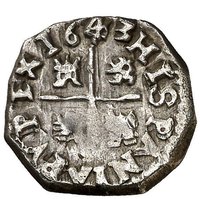
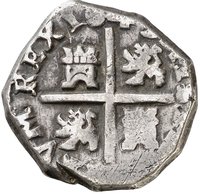
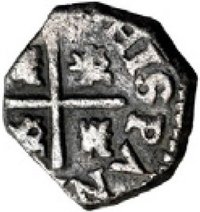
Reverse
Edge
Categories
| Person> Monarch |
| Symbols> Coat of Arms |
Mints
| Name | Mark |
|---|---|
| Royal Mint of Madrid | (MD) |
Mintings
| Year | Mint Mark | Mintage | Quality | Collection |
|---|---|---|---|---|
| 1643 | MDB | — |
Historical background
In 1643, Spain was grappling with a severe and protracted monetary crisis rooted in the Crown's relentless financing of the Thirty Years' War (1618-1648) and concurrent conflicts. Decades of deficit spending, funded by silver and gold from the Americas and massive borrowing, had led to a cycle of debt defaults (the "bankruptcies" of 1627, 1647, and 1652) and rampant currency manipulation. The government, under Philip IV and his chief minister, the Count-Duke of Olivares, repeatedly debased the ubiquitous vellón coinage—a fiduciary currency of copper and silver alloy—by altering its metal content and face value to extract seigniorage revenue. This created a chaotic system of multiple, unstable coinages circulating simultaneously.
The primary symptom in 1643 was a disastrous inflation, particularly in vellón prices, as public trust in the government's money collapsed. The official response was a series of arbitrary decrees aimed at controlling the economy, most notably the attempted stabilization of 1642-1643. This involved setting artificial exchange rates between the silver-based real and the billon vellón, and mandating that certain transactions be conducted in one currency or the other. These measures failed utterly, as they contradicted market realities and were widely evaded. The result was economic paralysis, with prices soaring, credit vanishing, and domestic trade becoming exceedingly difficult as people hoarded good silver coin.
This monetary turmoil was not merely an economic issue; it was a profound political crisis that eroded the social fabric and state authority. The burden of inflation fell hardest on the poor and those on fixed incomes, sparking social unrest. Furthermore, the Crown's desperate financial maneuvers alienated the very Castilian cities and elites whose support was crucial, especially as revolts in Catalonia (since 1640) and Portugal (since 1640) threatened the monarchy's survival. Thus, in 1643, the currency situation was a direct manifestation of imperial overstretch, undermining the Spanish Habsburg state's capacity to wage war and govern effectively at a critical juncture in its history.
The primary symptom in 1643 was a disastrous inflation, particularly in vellón prices, as public trust in the government's money collapsed. The official response was a series of arbitrary decrees aimed at controlling the economy, most notably the attempted stabilization of 1642-1643. This involved setting artificial exchange rates between the silver-based real and the billon vellón, and mandating that certain transactions be conducted in one currency or the other. These measures failed utterly, as they contradicted market realities and were widely evaded. The result was economic paralysis, with prices soaring, credit vanishing, and domestic trade becoming exceedingly difficult as people hoarded good silver coin.
This monetary turmoil was not merely an economic issue; it was a profound political crisis that eroded the social fabric and state authority. The burden of inflation fell hardest on the poor and those on fixed incomes, sparking social unrest. Furthermore, the Crown's desperate financial maneuvers alienated the very Castilian cities and elites whose support was crucial, especially as revolts in Catalonia (since 1640) and Portugal (since 1640) threatened the monarchy's survival. Thus, in 1643, the currency situation was a direct manifestation of imperial overstretch, undermining the Spanish Habsburg state's capacity to wage war and govern effectively at a critical juncture in its history.
✨ Legendary