

2 maravedis – Spain
Add to wishlist
Spain
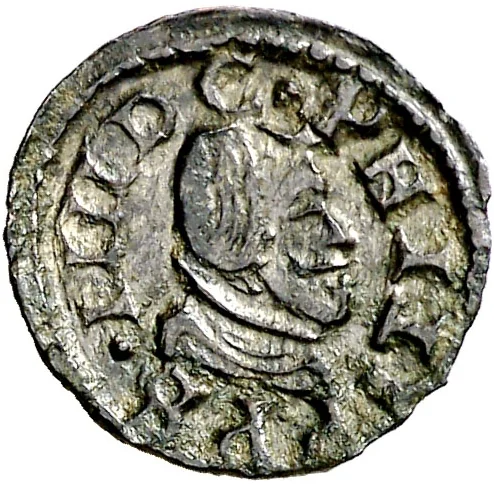
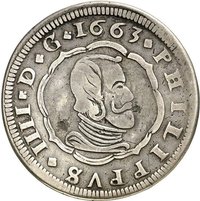
Obverse
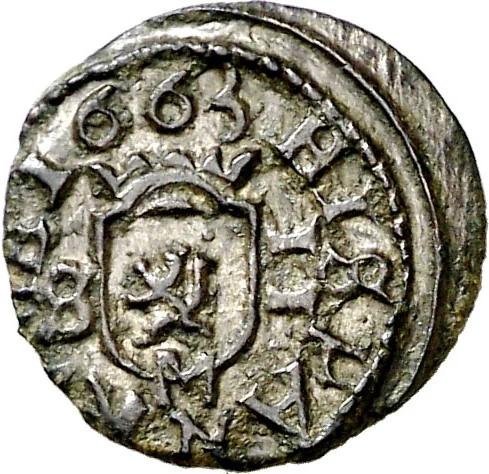
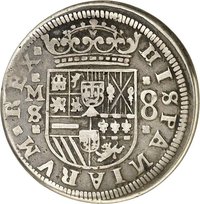
Reverse
Description:
Crowned lion shield between II. Mintmark M below. Legend and date around.
Inscription:
HISPANIARVM REX 1663
S II
M
S II
M
Script: Latin
Edge
Mints
| Name | Mark |
|---|---|
| Alcalá Gate of Madrid | (M) |
Mintings
| Year | Mint Mark | Mintage | Quality | Collection |
|---|---|---|---|---|
| 1662 | MY | — | ||
| 1663 | MS | — | ||
| 1663 | MY | — | ||
| 1664 | MS | — | ||
| 1664 | MY | — |
Historical background
In 1662, Spain's currency system was in a state of profound crisis, a direct consequence of decades of fiscal mismanagement and the immense financial burdens of maintaining its vast empire. The crown, under Philip IV and his chief minister, the Duke of Jesús María, was engaged in a desperate struggle to finance continuous warfare against France, Portugal, and the Dutch Republic. To meet these obligations, the government had repeatedly resorted to debasing the primary silver coin, the real de a ocho (piece of eight), by reducing its silver content and issuing vast quantities of low-denomination vellón (copper) currency. This created a disastrous two-tiered system where "good" silver coin was hoarded or exported, while an inflationary flood of nearly worthless copper overwhelmed domestic markets.
The specific situation in 1662 was one of acute monetary chaos and failed reform. Just two years prior, in 1660, the government had attempted a drastic measure: it demonetized all existing copper vellón and issued new copper currency at half its face value. This policy shattered public trust and caused widespread economic paralysis, as people refused to accept the devalued coin. By 1662, the economy was suffering from severe inflation, a breakdown in commercial transactions, and popular unrest. The crown's credit was exhausted, having previously seized private silver remittances from the Americas and declared bankruptcy multiple times, alienating the Genoese and other banking families who had traditionally financed the Habsburg state.
Consequently, Spain's monetary landscape in 1662 was characterized by a debilitating lack of sound circulating medium, collapsing prices for goods quoted in the unstable copper, and a deep-seated loss of confidence in royal authority over finance. This internal decay starkly contrasted with the external perception of wealth from the New World, as the actual bullion was immediately pledged to foreign creditors. The currency crisis was a critical symptom of the broader "decline of Spain," undermining domestic industry, crippling tax revenues, and eroding the economic foundations of what remained of Habsburg global power.
The specific situation in 1662 was one of acute monetary chaos and failed reform. Just two years prior, in 1660, the government had attempted a drastic measure: it demonetized all existing copper vellón and issued new copper currency at half its face value. This policy shattered public trust and caused widespread economic paralysis, as people refused to accept the devalued coin. By 1662, the economy was suffering from severe inflation, a breakdown in commercial transactions, and popular unrest. The crown's credit was exhausted, having previously seized private silver remittances from the Americas and declared bankruptcy multiple times, alienating the Genoese and other banking families who had traditionally financed the Habsburg state.
Consequently, Spain's monetary landscape in 1662 was characterized by a debilitating lack of sound circulating medium, collapsing prices for goods quoted in the unstable copper, and a deep-seated loss of confidence in royal authority over finance. This internal decay starkly contrasted with the external perception of wealth from the New World, as the actual bullion was immediately pledged to foreign creditors. The currency crisis was a critical symptom of the broader "decline of Spain," undermining domestic industry, crippling tax revenues, and eroding the economic foundations of what remained of Habsburg global power.
✨ Legendary