

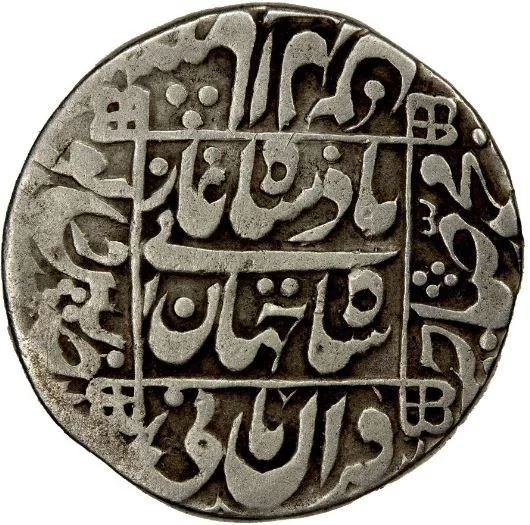
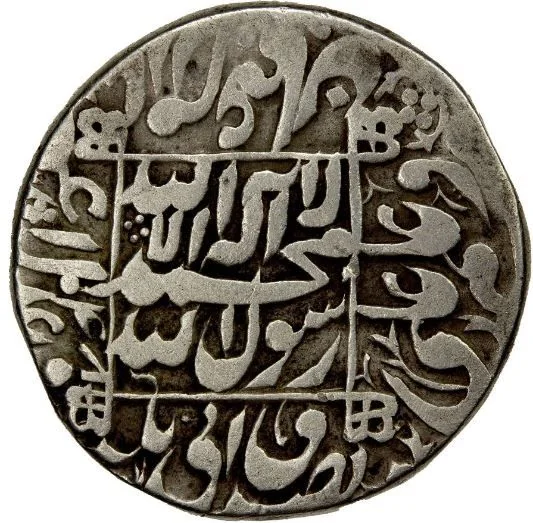
1 Rupee – Mughal Empire
India
Context
Years: 1637–1639
Country: India 
Issuer: Mughal Empire
Ruler: Shah Jahan
Currency:
(1540—1842)
Demonetized: Yes
Material
References
KM: #Click to copy to clipboard235.21
Numista: #354158
Value
Bullion value: $31.26
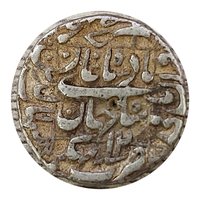
Obverse
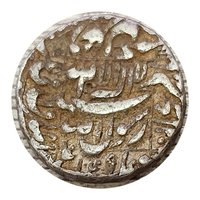
Reverse
Edge
Mintings
| Year | Mint Mark | Mintage | Quality | Collection |
|---|---|---|---|---|
| 1637 | — | — | ||
| 1638 | — | — | ||
| 1639 | — | — |
Historical background
In 1637, the Mughal Empire's currency system under Emperor Shah Jahan was a well-established and sophisticated bimetallic structure, central to the empire's vast economic prosperity. The system was anchored by two primary coins: the silver rupee and the gold mohur, both minted to exceptionally high standards of purity and uniformity. The rupee, the workhorse of the economy for daily trade and revenue collection, was the more dominant of the two. Its widespread acceptance and reliability facilitated commerce across the empire's extensive territories, from Bengal to Kabul, creating a remarkably integrated internal market. This stability was a direct result of imperial control over mints (dar al-zarb) and rich silver inflows, particularly from the New World via European trade at Surat.
The year 1637 falls within a period of significant fiscal demand and monumental construction, most notably the ongoing building of Shah Jahan's new capital, Shahjahanabad, and the Taj Mahal. This colossal state expenditure was funded by a rigorous land revenue system (zabt), collected almost exclusively in silver rupees. Consequently, the treasury's need for bullion was immense, ensuring continuous minting activity. Copper dams served as the fractional currency for smaller, local transactions, with an officially fixed but often locally fluctuating exchange rate against the rupee (typically 40 dams to a rupee).
Despite the overall stability, the system faced underlying pressures. The empire's voracious appetite for silver, while met in 1637, made its economy vulnerable to any disruption in the global bullion supply routes. Furthermore, while the imperial coinage was supreme, older regional coins and foreign currencies, like Spanish Reales, still circulated in port cities, reflecting India's deep connections to global trade networks. The death of Mumtaz Mahal in 1631 and the subsequent commencement of the Taj Mahal's construction meant that by 1637, the state machinery was deeply engaged in mobilizing the vast silver-based wealth required to turn architectural ambition into reality, showcasing the absolute centrality of its currency system to imperial power and legacy.
The year 1637 falls within a period of significant fiscal demand and monumental construction, most notably the ongoing building of Shah Jahan's new capital, Shahjahanabad, and the Taj Mahal. This colossal state expenditure was funded by a rigorous land revenue system (zabt), collected almost exclusively in silver rupees. Consequently, the treasury's need for bullion was immense, ensuring continuous minting activity. Copper dams served as the fractional currency for smaller, local transactions, with an officially fixed but often locally fluctuating exchange rate against the rupee (typically 40 dams to a rupee).
Despite the overall stability, the system faced underlying pressures. The empire's voracious appetite for silver, while met in 1637, made its economy vulnerable to any disruption in the global bullion supply routes. Furthermore, while the imperial coinage was supreme, older regional coins and foreign currencies, like Spanish Reales, still circulated in port cities, reflecting India's deep connections to global trade networks. The death of Mumtaz Mahal in 1631 and the subsequent commencement of the Taj Mahal's construction meant that by 1637, the state machinery was deeply engaged in mobilizing the vast silver-based wealth required to turn architectural ambition into reality, showcasing the absolute centrality of its currency system to imperial power and legacy.
✨ Legendary