

1 Flindrich – County of East Frisia
Context
Years: 1617–1623
Issuer: County of East Frisia
Ruler: Ferdinand II
Currency:
Subdivision: 1 Flindrich = 3 Stüber
Demonetized: Yes
References
KM: #Click to copy to clipboard67
Numista: #352573
Value
Bullion value: $7.44
Obverse
Reverse
Description:
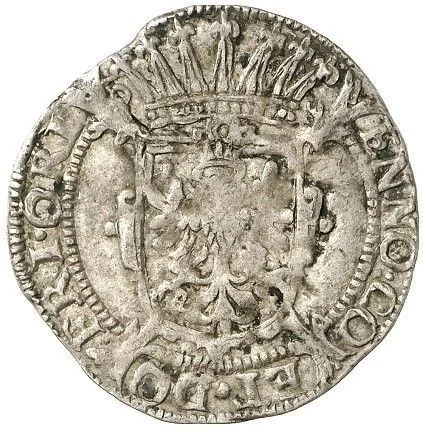
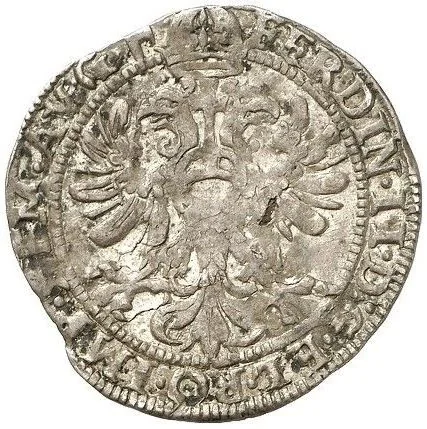
Imperial eagle with crown, orb on breast, bearing Ferdinand II's titles.
Inscription:
FERDIN II D G E L RO IMP SEM AVG
Script: Latin
Edge
Mints
| Name | Mark |
|---|---|
| Emden | — |
Mintings
| Year | Mint Mark | Mintage | Quality | Collection |
|---|---|---|---|---|
| — | — | — |
Historical background
In 1617, the County of East Frisia was entangled in a complex and deteriorating currency situation, caught between regional monetary systems and local political weakness. The county, while nominally part of the Holy Roman Empire, fell within the monetary orbit of the powerful Lower Saxon Circle, which sought to standardize coinage through ordinances like the Reichsmünzordnung. However, the authority of the reigning Count, Enno III, was severely undermined by persistent conflicts with the Estates (representing the towns and landed nobility), leaving him with limited fiscal power and control over the minting process. This political paralysis made consistent monetary policy nearly impossible, creating a vacuum exploited by various actors.
Consequently, the circulation was flooded with a chaotic mix of coins. Alongside legitimate regional issues, vast quantities of debased and low-quality coins, known as Kipper- und Wipper money, poured into East Frisia. These coins, often minted elsewhere with reduced precious metal content, were a symptom of the early stages of the empire-wide currency crisis that would fully erupt in the 1620s. The county's own mint in Emden operated under these pressures, likely producing coins of inconsistent value to meet immediate fiscal needs, further eroding public trust.
The result was a classic "bad money drives out good" scenario, severely disrupting the local economy. Reliable high-value coins like gold guilders and full-weight Reichstalers were hoarded or used for foreign trade, leaving daily commerce to be conducted with unstable, inferior currency. This inflation hit merchants and peasants alike, increasing the cost of goods and sowing economic uncertainty just as the gathering storm of the Thirty Years' War loomed on the horizon, threatening to exacerbate the county's financial fragility.
Consequently, the circulation was flooded with a chaotic mix of coins. Alongside legitimate regional issues, vast quantities of debased and low-quality coins, known as Kipper- und Wipper money, poured into East Frisia. These coins, often minted elsewhere with reduced precious metal content, were a symptom of the early stages of the empire-wide currency crisis that would fully erupt in the 1620s. The county's own mint in Emden operated under these pressures, likely producing coins of inconsistent value to meet immediate fiscal needs, further eroding public trust.
The result was a classic "bad money drives out good" scenario, severely disrupting the local economy. Reliable high-value coins like gold guilders and full-weight Reichstalers were hoarded or used for foreign trade, leaving daily commerce to be conducted with unstable, inferior currency. This inflation hit merchants and peasants alike, increasing the cost of goods and sowing economic uncertainty just as the gathering storm of the Thirty Years' War loomed on the horizon, threatening to exacerbate the county's financial fragility.
✨ Legendary