

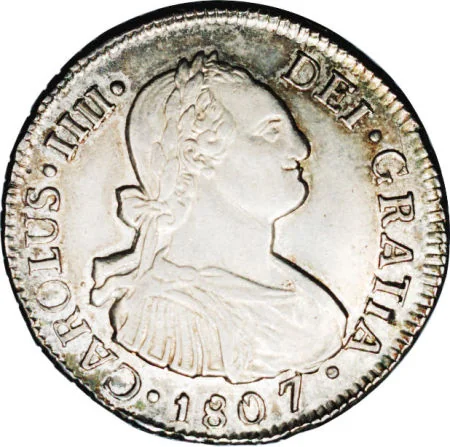
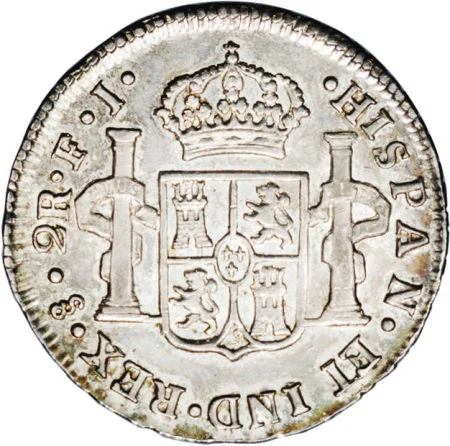
2 reales – Chile
Add to wishlist
Chile
Context
Years: 1792–1808
Issuer: Chile
Ruler: Charles IV
Currency:
(1541—1852)
Demonetized: Yes
Total mintage: 640,000
Material
References
KM: #
Numista: #35206
Value
Bullion value: $14.88
Obverse
Description:
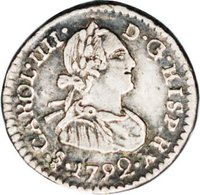
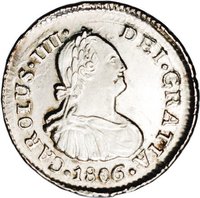
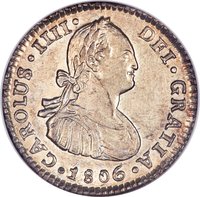
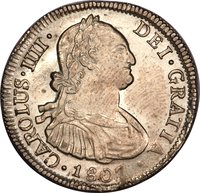
Bust of Charles IV, dated.
Script: Latin
Reverse
Description:
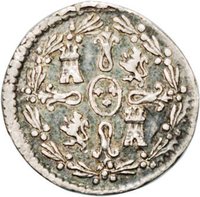
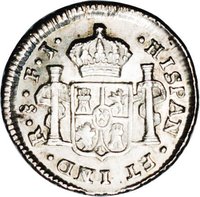
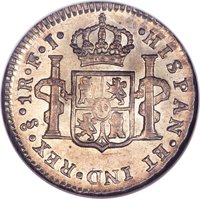
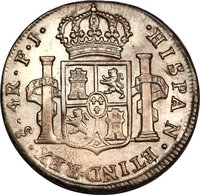
Crested arms and columns.
Inscription:
HISPAN ET IND REX
So 2R FJ
PLUS VLTRA
So 2R FJ
PLUS VLTRA
Script: Latin
Edge
Chained
Mintings
| Year | Mint Mark | Mintage | Quality | Collection |
|---|---|---|---|---|
| 1792 | So | 14,000 | ||
| 1793 | So | 53,000 | ||
| 1794 | So | 58,000 | ||
| 1795 | So | 58,000 | ||
| 1796 | So | 66,000 | ||
| 1797 | So | 49,000 | ||
| 1798 | So | 30,000 | ||
| 1799 | So | — | ||
| 1800 | So | 34,000 | ||
| 1801 | So | 39,000 | ||
| 1802 | So | 28,000 | ||
| 1803 | So | 25,000 | ||
| 1804 | So | — | ||
| 1805 | So | 24,000 | ||
| 1806 | So | 66,000 | ||
| 1807 | So | 42,000 | ||
| 1808 | So | 54,000 |
Historical background
In 1792, the currency situation in the Captaincy General of Chile, a colony of the Spanish Empire, was characterized by severe scarcity and reliance on a chaotic mix of foreign and obsolete coins. The Spanish Crown consistently failed to supply sufficient official coinage, particularly the silver reales and gold escudos minted in Peru and Mexico, to meet the needs of the local economy. This chronic shortage led to the widespread circulation of coins from other empires, including Portuguese, French, and even cut or clipped Spanish pieces, all traded at fluctuating values determined by their metal content and wear.
The local economy responded with a system of "moneda de la tierra" (land money), where common goods like wheat, barley, and even dried cattle dung served as de facto currency for everyday transactions and accounting. This barter-like system was cumbersome but essential for internal trade and paying wages. To provide some order, authorities periodically published "tablas de monedas" (currency tables), which officially rated the value of the various foreign and mutilated coins in circulation, attempting to standardize exchange against the theoretical Spanish standard.
This unstable monetary environment stifled commerce and reflected Chile’s peripheral status within the Bourbon reforms, which prioritized silver extraction for the metropolis over colonial financial stability. The situation would persist until after independence, with the first local mint, the Casa de Moneda de Santiago, being established only in 1749, and even then, its early output was limited. Thus, 1792 represents a point within a long period of monetary improvisation, where Chile’s economy functioned with a fragile and inefficient patchwork of value rather than a unified, sovereign currency.
The local economy responded with a system of "moneda de la tierra" (land money), where common goods like wheat, barley, and even dried cattle dung served as de facto currency for everyday transactions and accounting. This barter-like system was cumbersome but essential for internal trade and paying wages. To provide some order, authorities periodically published "tablas de monedas" (currency tables), which officially rated the value of the various foreign and mutilated coins in circulation, attempting to standardize exchange against the theoretical Spanish standard.
This unstable monetary environment stifled commerce and reflected Chile’s peripheral status within the Bourbon reforms, which prioritized silver extraction for the metropolis over colonial financial stability. The situation would persist until after independence, with the first local mint, the Casa de Moneda de Santiago, being established only in 1749, and even then, its early output was limited. Thus, 1792 represents a point within a long period of monetary improvisation, where Chile’s economy functioned with a fragile and inefficient patchwork of value rather than a unified, sovereign currency.
Series: 1792 Chile circulation coins
⭐ Rare