

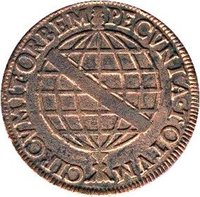
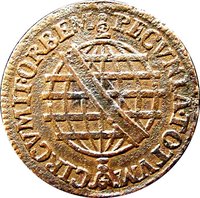
Obverse
Description:
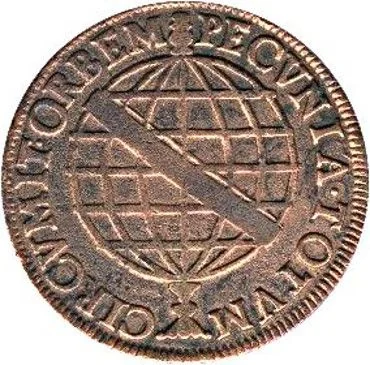
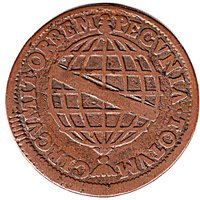
Armillary sphere. No maker's mark.
Inscription:
PECVNIA.TOTVM.CIRCVMIT.ORBEM
Script: Latin
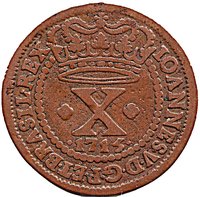
Reverse
Description:
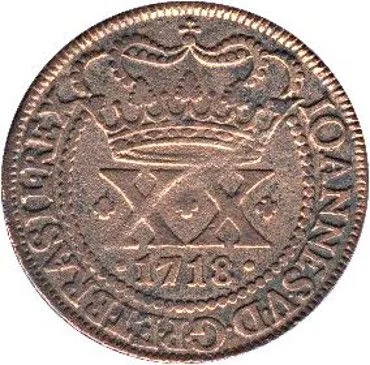
XX face value, three small flowers below a crown, encircled by pearls, with the date beneath.
Inscription:
IOANNES.V.D.G.P.ET.BRASIL.REX.
XX
.1735.
XX
.1735.
Script: Latin
Edge
Plain
Mints
| Name | Mark |
|---|---|
| Imprensa Nacional - Casa da Moeda | — |
Mintings
| Year | Mint Mark | Mintage | Quality | Collection |
|---|---|---|---|---|
| 1715 | — | — | ||
| 1718 | — | — | ||
| 1719 | — | — | ||
| 1729 | — | — | ||
| 1735 | — | — | ||
| 1736 | — | — | ||
| 1746 | — | — | ||
| 1749 | — | — |
Historical background
In 1715, Angola was a Portuguese colony whose economic life was fundamentally shaped by the transatlantic slave trade. The primary "currency" was not minted coins but people. Enslaved Africans were the central commodity, used to settle major debts, pay taxes to the Portuguese crown, and acquire goods from European traders. The trade was quantified in units like the peça da Índia, a standard representing one "prime" enslaved adult male, against which the value of women, children, and the elderly was discounted.
Alongside this human currency, a complex system of commodity money facilitated daily transactions within the colony. The most widespread unit was the libra (lb) of fazenda—literally, a "pound of goods," typically referring to bundles of cloth, especially African or Indian textiles like barafulas and beatilhas. Other essential commodities, including salt, alcohol, tobacco, and cowrie shells, also circulated as mediums of exchange. This reflected a barter-based economy where value was tied directly to useful or tradable goods, as official Portuguese coinage was chronically scarce on the ground.
The Portuguese crown attempted to impose monetary order by introducing copper réis coins specifically for Angola, but these efforts largely failed. These coins were often rejected by both Portuguese settlers and African traders, who distrusted their fluctuating and artificially imposed value. Consequently, the economy of 1715 Angola operated on a dual system: a brutal human currency driving the export economy and a practical, if fragmented, commodity money system governing local trade, all while European coinage remained peripheral and unstable.
Alongside this human currency, a complex system of commodity money facilitated daily transactions within the colony. The most widespread unit was the libra (lb) of fazenda—literally, a "pound of goods," typically referring to bundles of cloth, especially African or Indian textiles like barafulas and beatilhas. Other essential commodities, including salt, alcohol, tobacco, and cowrie shells, also circulated as mediums of exchange. This reflected a barter-based economy where value was tied directly to useful or tradable goods, as official Portuguese coinage was chronically scarce on the ground.
The Portuguese crown attempted to impose monetary order by introducing copper réis coins specifically for Angola, but these efforts largely failed. These coins were often rejected by both Portuguese settlers and African traders, who distrusted their fluctuating and artificially imposed value. Consequently, the economy of 1715 Angola operated on a dual system: a brutal human currency driving the export economy and a practical, if fragmented, commodity money system governing local trade, all while European coinage remained peripheral and unstable.
✨ Legendary