

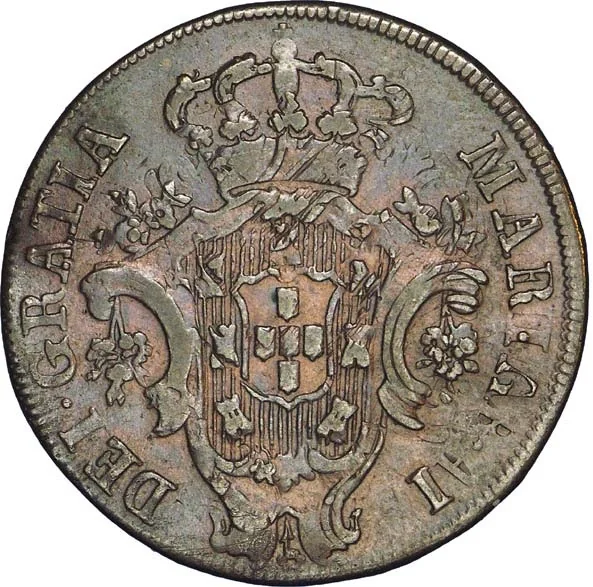
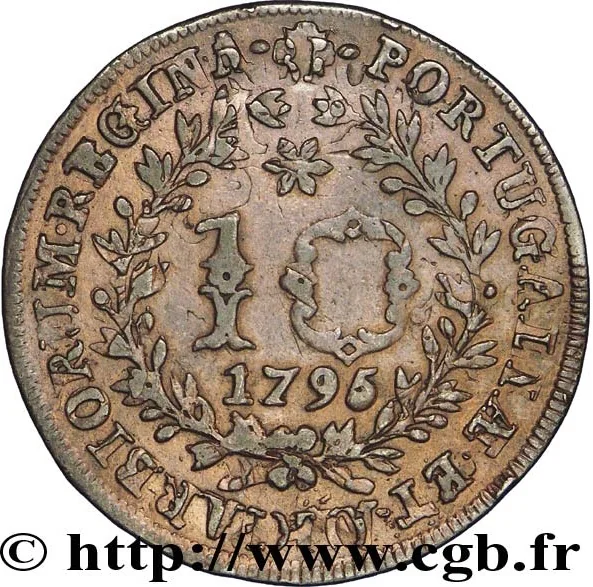
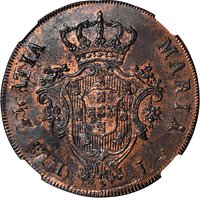
Obverse
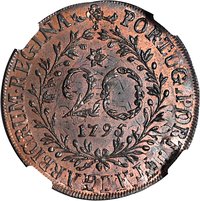
Reverse
Description:
Treasure in the wreath, story in the legend.
Inscription:
PORTVGALIE.ET.ALGARBIORUM.REGINA
10
1795
10
1795
Script: Latin
Edge
Plain
Categories
| Symbols> Coat of Arms |
Mintings
| Year | Mint Mark | Mintage | Quality | Collection |
|---|---|---|---|---|
| 1793 | — | — | ||
| 1795 | — | 116,238 | ||
| 1796 | — | 116,238 |
Historical background
In 1793, the Azores archipelago, as an integral part of the Kingdom of Portugal, operated within the broader Portuguese monetary system. The official currency was the Portuguese real (plural: réis), a system of account that was often physically represented by a mix of coinage. However, the islands' remote location in the mid-Atlantic, coupled with its vital role as a provisioning stop for transoceanic shipping, created a unique and challenging currency environment. The local economy was consistently starved of sufficient official coinage, leading to chronic liquidity problems for everyday trade and government functions.
To compensate for this chronic shortage, a variety of foreign coins circulated widely and were accepted for daily transactions. Spanish silver pesos and gold moedas, particularly from Spain's American colonies, were especially common due to the Azores' position on trade routes. British, French, and Brazilian coins also found their way into circulation through naval and merchant traffic. This created a de facto multi-currency system where the value of coins was determined by their metal content and weight rather than their face value, requiring merchants and officials to be adept at assaying and exchange.
The situation was further complicated by the use of fiduciary money, such as vales (IOUs or promissory notes) issued by municipal councils and even wealthy landowners to facilitate local exchanges when hard currency was utterly unavailable. This patchwork system was inefficient and prone to dispute. Ultimately, the monetary reality in the 1793 Azores was one of necessity and adaptation, defined more by the pragmatic acceptance of any reliable medium of exchange than by strict adherence to the official currency laws emanating from Lisbon.
To compensate for this chronic shortage, a variety of foreign coins circulated widely and were accepted for daily transactions. Spanish silver pesos and gold moedas, particularly from Spain's American colonies, were especially common due to the Azores' position on trade routes. British, French, and Brazilian coins also found their way into circulation through naval and merchant traffic. This created a de facto multi-currency system where the value of coins was determined by their metal content and weight rather than their face value, requiring merchants and officials to be adept at assaying and exchange.
The situation was further complicated by the use of fiduciary money, such as vales (IOUs or promissory notes) issued by municipal councils and even wealthy landowners to facilitate local exchanges when hard currency was utterly unavailable. This patchwork system was inefficient and prone to dispute. Ultimately, the monetary reality in the 1793 Azores was one of necessity and adaptation, defined more by the pragmatic acceptance of any reliable medium of exchange than by strict adherence to the official currency laws emanating from Lisbon.
⭐ Somewhat Rare