

1 Thaler – Austrian Empire
Austria
Context
Years: 1723–1729
Country: Austria 
Issuer: Austrian Empire
Ruler: Charles VI
Currency:
(1520—1754)
Demonetized: Yes
Material
References
KM: #Click to copy to clipboard1610.1
Numista: #347392
Value
Bullion value: $82.48
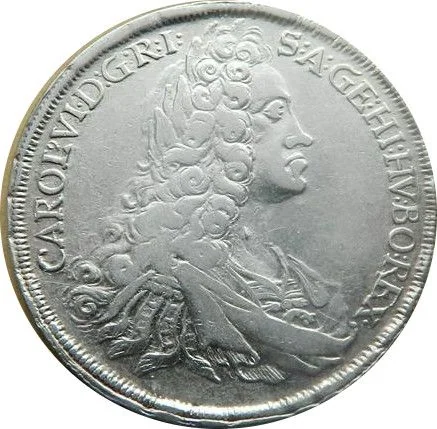
Obverse
Description:
Get in. Let's go.
Inscription:
CAROL • VI • D: G: R: I: - S: A: GE: HI: HV: BO: REX •
Script: Latin
Reverse
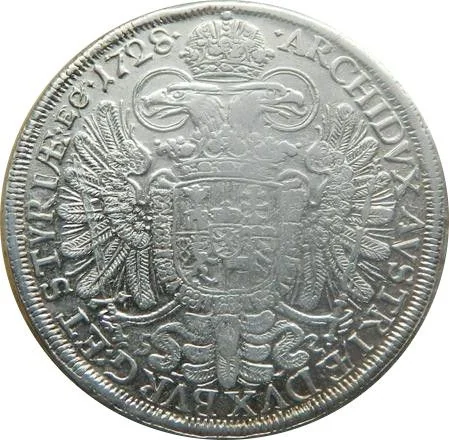
Description:
Imperial double eagle, crowned and bearing arms within an Order chain.
Inscription:
ARCHIDVX AVSTRIÆ • DVX • BVRG: ET STYRIÆ • EC •
Script: Latin
Edge
Mints
| Name | Mark |
|---|---|
| Graz | — |
Mintings
| Year | Mint Mark | Mintage | Quality | Collection |
|---|---|---|---|---|
| 1723 | — | — | ||
| 1728 | — | — | ||
| 1729 | — | — |
Historical background
In 1723, the currency situation in the Habsburg Monarchy (often referred to as the Austrian Empire) was characterized by significant complexity and instability, a legacy of the immense financial strain of recent wars. The state had exhausted its treasury funding conflicts like the War of the Spanish Succession and the recent wars against the Ottoman Empire. To meet these costs, the government repeatedly debased the coinage, notably the small-denomination kreuzer coins used in daily life, by reducing their silver content. This created a system where older, purer coins were hoarded or melted down, while newer, inferior coins flooded the market, leading to a effective devaluation and loss of public trust.
The monetary landscape was a patchwork of different units and physical coins. The official accounting system was based on the Gulden (florin), divided into 60 kreuzer, but actual circulation included various silver thaler coins (like the Reichsthaler) and a plethora of domestic and foreign coins from neighboring German states and beyond. This lack of uniformity hindered trade and economic administration across the diverse provinces of the Habsburg lands. Furthermore, the government's chronic budget deficits were often addressed through short-term expedients rather than systemic fiscal reform, perpetuating the cycle of monetary weakness.
Consequently, the year 1723 fell within a period of persistent inflationary pressure and monetary confusion. While Emperor Charles VI's administration was aware of the problems, comprehensive reform would not begin until the later efforts of Count Gundaker von Starhemberg and the more definitive policies enacted under Maria Theresa in the mid-18th century. Thus, in 1723, the Austrian Empire operated with a fragile and untrustworthy currency system that reflected its broader financial precariousness and the challenges of governing a fragmented, post-war realm.
The monetary landscape was a patchwork of different units and physical coins. The official accounting system was based on the Gulden (florin), divided into 60 kreuzer, but actual circulation included various silver thaler coins (like the Reichsthaler) and a plethora of domestic and foreign coins from neighboring German states and beyond. This lack of uniformity hindered trade and economic administration across the diverse provinces of the Habsburg lands. Furthermore, the government's chronic budget deficits were often addressed through short-term expedients rather than systemic fiscal reform, perpetuating the cycle of monetary weakness.
Consequently, the year 1723 fell within a period of persistent inflationary pressure and monetary confusion. While Emperor Charles VI's administration was aware of the problems, comprehensive reform would not begin until the later efforts of Count Gundaker von Starhemberg and the more definitive policies enacted under Maria Theresa in the mid-18th century. Thus, in 1723, the Austrian Empire operated with a fragile and untrustworthy currency system that reflected its broader financial precariousness and the challenges of governing a fragmented, post-war realm.

✨ Legendary