

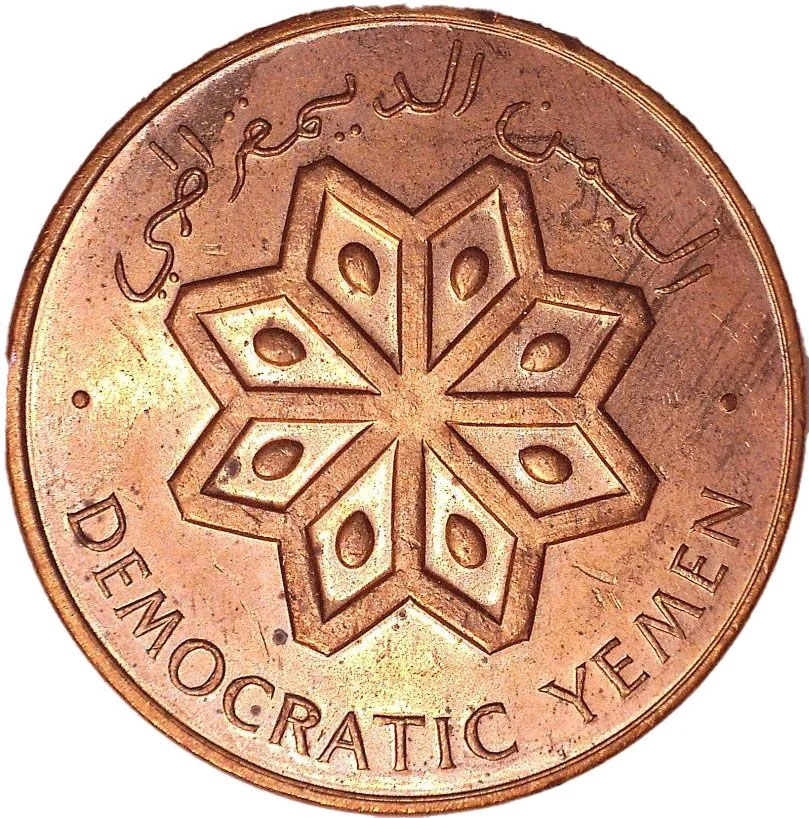
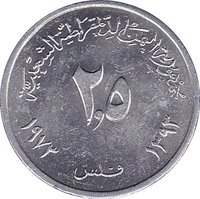
Obverse
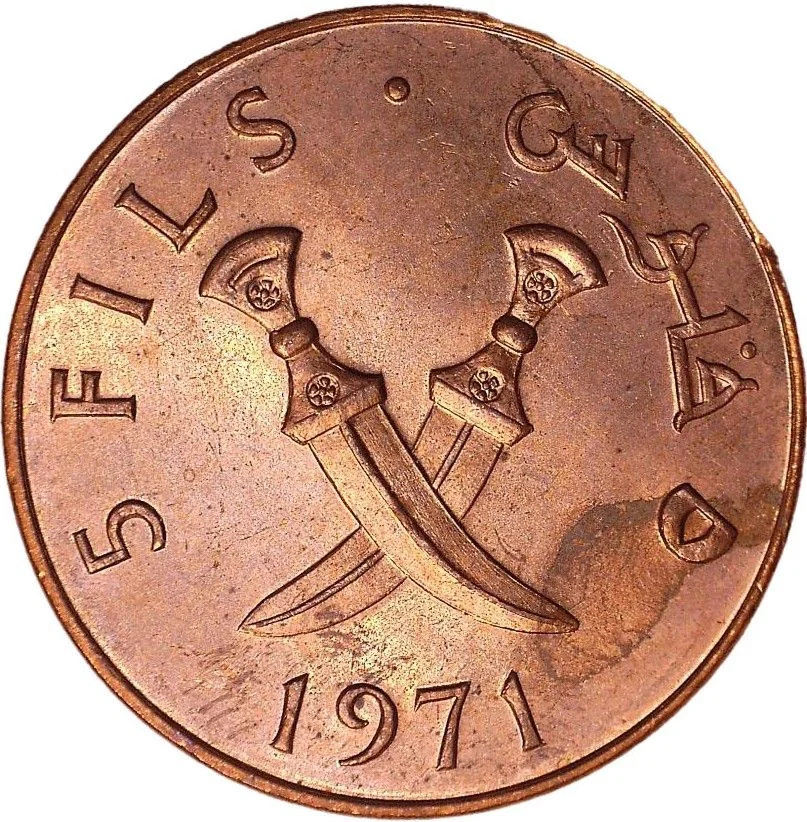
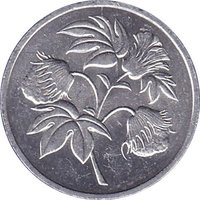
Reverse
Edge
Plain
Categories
| Object> Cold weapons |
Mints
| Name | Mark |
|---|---|
| Royal Canadian Mint of Ottawa | — |
Mintings
| Year | Mint Mark | Mintage | Quality | Collection |
|---|---|---|---|---|
| 1971 | — | 2,000,000 |
Historical background
In 1971, the currency situation in the People's Democratic Republic of Yemen (PDRY, or South Yemen) was defined by transition and the consolidation of its socialist economic model following independence from Britain in 1967. The South Yemeni Dinar (YDD), introduced in 1965 to replace the Gulf Rupee, remained the official currency. However, its management reflected the new state's political realignment. The government, led by the National Liberation Front, had nationalized key industries and banks, bringing monetary policy under direct state control as part of a centrally planned economy aimed at reducing foreign dependence.
This period saw the PDRY progressively distancing itself from the sterling area and British financial influence, a process accelerated after the 1967 closure of the Suez Canal which devastated the port of Aden's economy. While the dinar was not pegged to the British pound, the country's severe economic struggles—including a trade deficit, dwindling foreign reserves, and the loss of Aden's traditional role as an entrepôt—placed significant pressure on the currency's stability. The state's focus was on using financial controls to support its development plans and maintain essential imports, rather than on achieving convertibility.
Furthermore, the currency situation was shaped by the broader geopolitical divide on the Arabian Peninsula. The PDRY's socialist dinar stood in contrast to the rival Yemen Arab Republic (North Yemen), which used the Yemeni Rial. This monetary separation underscored the deep political and ideological rift between the two Yemeni states, a division that would persist until unification in 1990. Thus, in 1971, South Yemen's currency was a symbol of its hard-won sovereignty and its challenging path of state-led economic development in a context of regional isolation and internal scarcity.
This period saw the PDRY progressively distancing itself from the sterling area and British financial influence, a process accelerated after the 1967 closure of the Suez Canal which devastated the port of Aden's economy. While the dinar was not pegged to the British pound, the country's severe economic struggles—including a trade deficit, dwindling foreign reserves, and the loss of Aden's traditional role as an entrepôt—placed significant pressure on the currency's stability. The state's focus was on using financial controls to support its development plans and maintain essential imports, rather than on achieving convertibility.
Furthermore, the currency situation was shaped by the broader geopolitical divide on the Arabian Peninsula. The PDRY's socialist dinar stood in contrast to the rival Yemen Arab Republic (North Yemen), which used the Yemeni Rial. This monetary separation underscored the deep political and ideological rift between the two Yemeni states, a division that would persist until unification in 1990. Thus, in 1971, South Yemen's currency was a symbol of its hard-won sovereignty and its challenging path of state-led economic development in a context of regional isolation and internal scarcity.
🌱 Fairly Common