

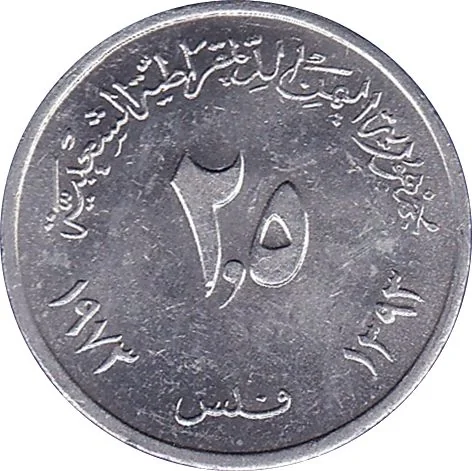
2½ fils – People's Democratic Republic of Yemen
Add to wishlist
Yemen
Context
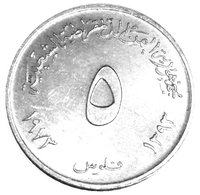
Year: 1973
Islamic (Hijri) Year:: 1393
Country: Yemen
Period:
(1967—1990)
Currency:
(1967—1996)
Demonetized: Yes
Total mintage: 20,000,000
Material
References
KM: #
Numista: #11714
Value
Exchange value: 0.0025 YDD
Obverse
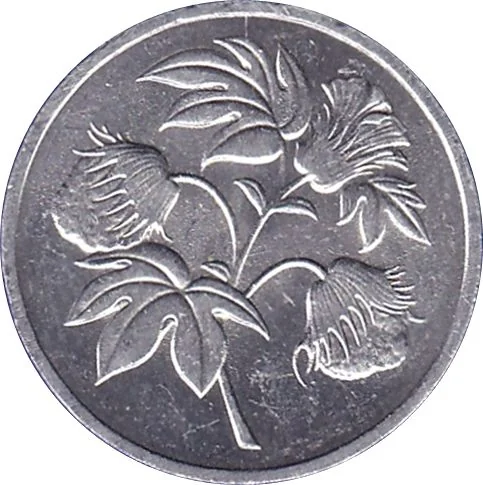
Reverse
Description:
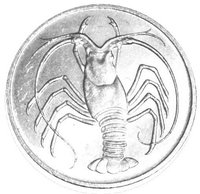
Cotton plant.
Edge
Plain
Mints
| Name | Mark |
|---|---|
| Royal Mint | — |
Mintings
| Year | Mint Mark | Mintage | Quality | Collection |
|---|---|---|---|---|
| 1973 | — | 20,000,000 |
Historical background
In 1973, the currency situation in the People's Democratic Republic of Yemen (PDRY, or South Yemen) was defined by transition and the state's socialist orientation. Following independence from Britain in 1967, the new Marxist-Leninist government inherited the South Arabian dinar, a currency pegged to the British pound and used in the Federation of South Arabia. However, as part of a broader policy to break from colonial economic structures and assert monetary sovereignty, the government introduced its own national currency, the South Yemeni dinar (YD), in 1972. By 1973, this new currency was fully established as the sole legal tender.
The currency's management was centralized under the newly created Bank of Yemen, which functioned as both a central and commercial bank, reflecting the state's command economy. The dinar was not freely convertible and its exchange rate was officially fixed by the government, primarily to the U.S. Dollar, with strict controls on foreign exchange and international transactions. This insulated but also isolated the economy, aligning with the regime's policy of centralized planning and limited engagement with Western capitalist markets.
Economically, the currency situation in 1973 operated within a context of significant challenge. The state's limited foreign exchange reserves were strained by the need to fund nationalization programs and a large public sector, while export earnings relied heavily on the port of Aden and a declining refining industry. Consequently, while the new currency symbolized political independence, it functioned within a fragile and constrained economic system, facing pressures from trade deficits and the practical difficulties of a planned economy in a developing nation.
The currency's management was centralized under the newly created Bank of Yemen, which functioned as both a central and commercial bank, reflecting the state's command economy. The dinar was not freely convertible and its exchange rate was officially fixed by the government, primarily to the U.S. Dollar, with strict controls on foreign exchange and international transactions. This insulated but also isolated the economy, aligning with the regime's policy of centralized planning and limited engagement with Western capitalist markets.
Economically, the currency situation in 1973 operated within a context of significant challenge. The state's limited foreign exchange reserves were strained by the need to fund nationalization programs and a large public sector, while export earnings relied heavily on the port of Aden and a declining refining industry. Consequently, while the new currency symbolized political independence, it functioned within a fragile and constrained economic system, facing pressures from trade deficits and the practical difficulties of a planned economy in a developing nation.
🌱 Fairly Common