

1 Ducat – Denmark
Denmark
Context

References
KM: #Click to copy to clipboard485
Numista: #343093
Value
Bullion value: $570.56
Obverse
Description:
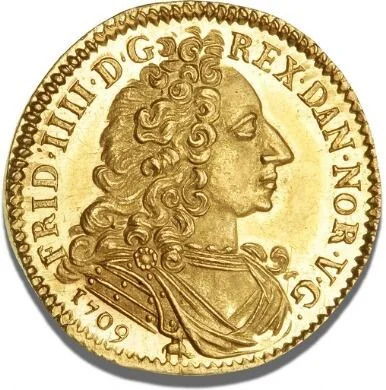
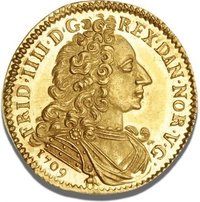
Bust of Frederik IV, right profile
Inscription:
FRID • IIII • D • G REX • DAN • NOR • V • G •
1709
1709
Script: Latin
Reverse
Description:
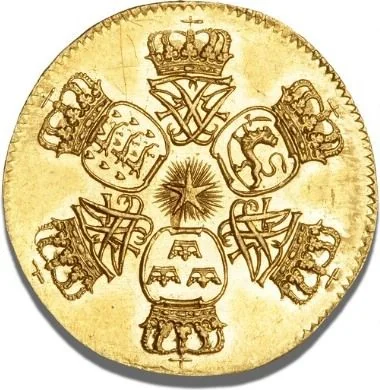
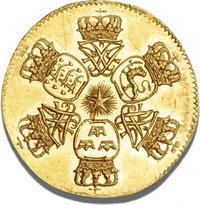
Crowned arms and "F4" monograms alternate in a circle.
Edge
Mintings
| Year | Mint Mark | Mintage | Quality | Collection |
|---|---|---|---|---|
| 1708 | — | — | ||
| 1709 | — | — |
Historical background
In 1708, Denmark found itself in a precarious monetary situation, a direct consequence of the Great Northern War (1700-1721). The conflict, which pitted Denmark-Norway and its allies against the Swedish Empire, placed an immense financial strain on the Danish state. To fund its military campaigns, the government, under King Frederick IV, resorted to the repeated debasement of the currency. This involved reducing the silver content in coins while maintaining their face value, effectively creating more money from the same amount of precious metal to pay soldiers and suppliers.
This policy led to severe inflation and a chaotic monetary system. Older, high-silver coins were hoarded or melted down for their intrinsic value, while the new, inferior coins flooded the market, causing prices to soar. The public lost confidence in the currency, and a dual system emerged where goods were often priced in the older, stable kurant rigsdaler (accounting money) while transactions were conducted in the depreciated skilling coins. This created widespread economic distress, complicating trade and eroding the real value of wages and savings.
Recognizing the crisis, the Danish government attempted a major monetary reform in 1708. The goal was to stabilize the currency by introducing new, standardized silver coins and attempting to recall the debased money. However, the reform was only partially successful. The ongoing financial demands of the war made a full return to sound money impossible, and the state continued to struggle with debt. Thus, 1708 represents a year of acute crisis and a fraught, incomplete attempt at correction within a prolonged period of wartime fiscal instability.
This policy led to severe inflation and a chaotic monetary system. Older, high-silver coins were hoarded or melted down for their intrinsic value, while the new, inferior coins flooded the market, causing prices to soar. The public lost confidence in the currency, and a dual system emerged where goods were often priced in the older, stable kurant rigsdaler (accounting money) while transactions were conducted in the depreciated skilling coins. This created widespread economic distress, complicating trade and eroding the real value of wages and savings.
Recognizing the crisis, the Danish government attempted a major monetary reform in 1708. The goal was to stabilize the currency by introducing new, standardized silver coins and attempting to recall the debased money. However, the reform was only partially successful. The ongoing financial demands of the war made a full return to sound money impossible, and the state continued to struggle with debt. Thus, 1708 represents a year of acute crisis and a fraught, incomplete attempt at correction within a prolonged period of wartime fiscal instability.
Series: 1708 Denmark circulation coins

✨ Legendary