

1 Ducat – Hungary
Hungary
Context
Years: 1759–1765
Issuer: Hungary 
Ruler: Maria Theresa
Currency:
(1526—1754)
Demonetized: Yes
Total mintage: 196,000
Material
References
KM: #Click to copy to clipboard334
Numista: #34013
Value
Bullion value: $573.13
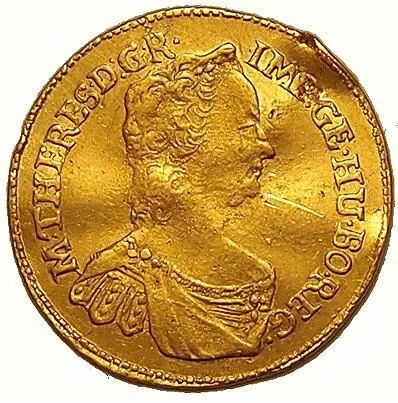
Obverse
Description:
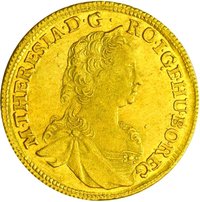
Bust of middle-aged Maria Theresa, facing right.
Inscription:
M . THERES . D . G . R . IMP . GE . HU . BO . REG
Script: Latin
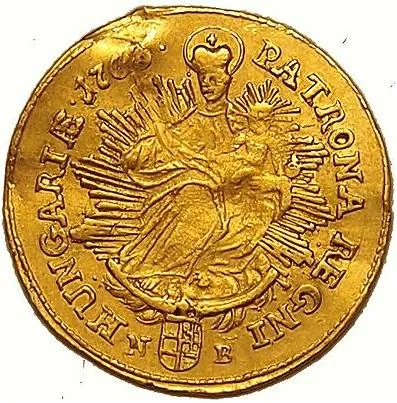
Reverse
Description:
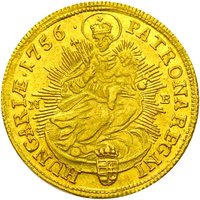
Radiant Madonna crowned and enthroned on crescent, holding child, with separate Hungarian arms and mint mark.
Inscription:
PATRONA REGNI HUNGARIAE 1765
N B
N B
Script: Latin
Edge
Plain
Mints
| Name | Mark |
|---|---|
| Baia Mare | N B |
Mintings
| Year | Mint Mark | Mintage | Quality | Collection |
|---|---|---|---|---|
| 1759 | N | 30,000 | ||
| 1760 | N | 22,000 | ||
| 1761 | N | 27,000 | ||
| 1762 | N | 27,000 | ||
| 1763 | N | 26,000 | ||
| 1764 | N | 31,000 | ||
| 1765 | N | 33,000 |
Historical background
In 1759, Hungary's currency situation was intrinsically tied to its position within the Habsburg Monarchy, governed by Empress Maria Theresa from Vienna. The monetary system was complex and fragmented, operating under the 1754 monetary regulation which established the Conventionsmünze (Convention currency) standard. This standard, shared with other Habsburg territories, defined a silver Conventionsthaler as containing a set amount of fine silver, with the Hungarian forint (or gulden) serving as the primary accounting unit. However, the reality was one of chronic instability, as the monarchy's immense expenses from the ongoing Seven Years' War (1756-1763) placed severe pressure on state finances.
The primary issue was rampant debasement and a severe shortage of specie. To fund the war effort, the state drastically increased the production of low-value copper and silver coins with reduced precious metal content, while also issuing substantial quantities of paper money (Bancozettel) from the Vienna City Bank. This led to a divergence between the official Conventionsmünze and the depreciated circulating currency (currentmünze), causing inflation, confusion in trade, and a loss of public trust. In Hungary specifically, the circulation was a chaotic mix of overvalued domestic coins, underweight foreign coins, and increasingly dubious paper notes.
Consequently, 1759 fell within a period of significant monetary distress. While a major currency reform was being planned in Vienna—which would culminate in the 1760 stabilization that made the paper Bancozettel convertible—the immediate situation for Hungarians was difficult. Prices were unstable, the value of money was unreliable, and the economic strain of financing a distant war exacerbated longstanding tensions between the Hungarian estates and the central Habsburg government over fiscal and political autonomy. The currency chaos of 1759 thus reflected both the immediate fiscal demands of a global conflict and the deeper complexities of Hungary's place within the imperial structure.
The primary issue was rampant debasement and a severe shortage of specie. To fund the war effort, the state drastically increased the production of low-value copper and silver coins with reduced precious metal content, while also issuing substantial quantities of paper money (Bancozettel) from the Vienna City Bank. This led to a divergence between the official Conventionsmünze and the depreciated circulating currency (currentmünze), causing inflation, confusion in trade, and a loss of public trust. In Hungary specifically, the circulation was a chaotic mix of overvalued domestic coins, underweight foreign coins, and increasingly dubious paper notes.
Consequently, 1759 fell within a period of significant monetary distress. While a major currency reform was being planned in Vienna—which would culminate in the 1760 stabilization that made the paper Bancozettel convertible—the immediate situation for Hungarians was difficult. Prices were unstable, the value of money was unreliable, and the economic strain of financing a distant war exacerbated longstanding tensions between the Hungarian estates and the central Habsburg government over fiscal and political autonomy. The currency chaos of 1759 thus reflected both the immediate fiscal demands of a global conflict and the deeper complexities of Hungary's place within the imperial structure.
✨ Legendary