

2 Ducats – Hungary
Hungary

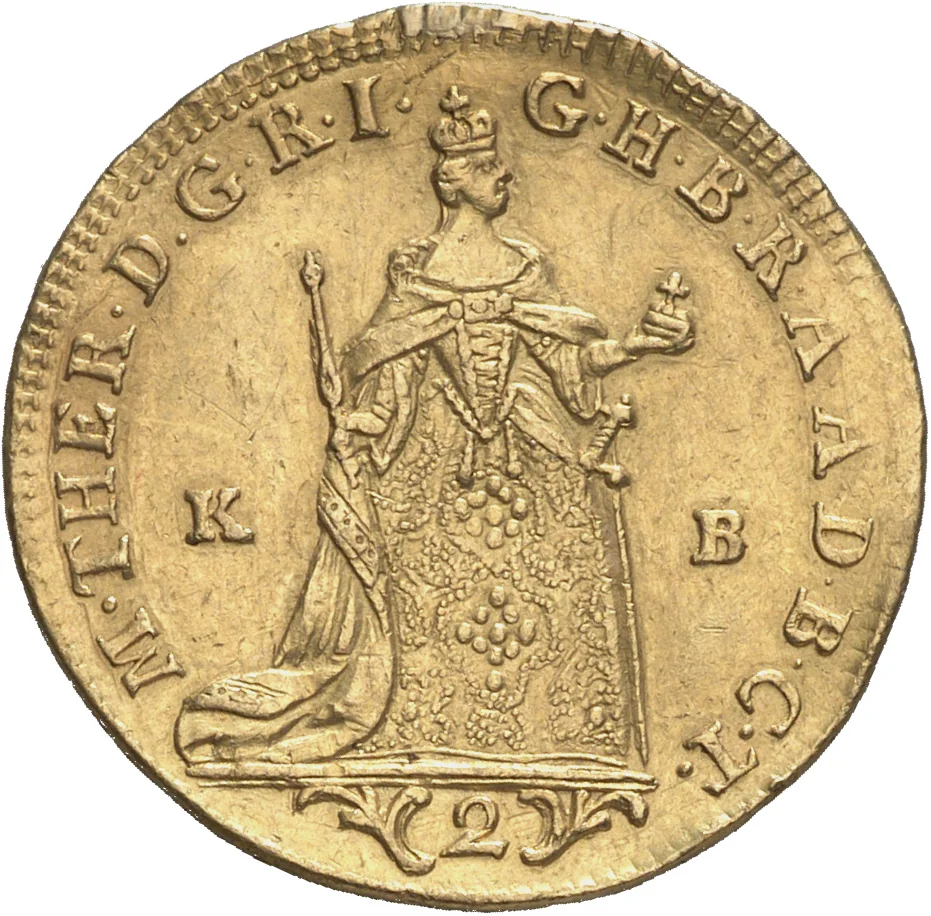
Obverse
Description:
Monarch holding orb and scepter divides mintmark; value (2) below.
Inscription:
M · THER · D · G · R · I · G · H · B · R · A · A · D · B · C · T ·
K B
2
K B
2
Script: Latin
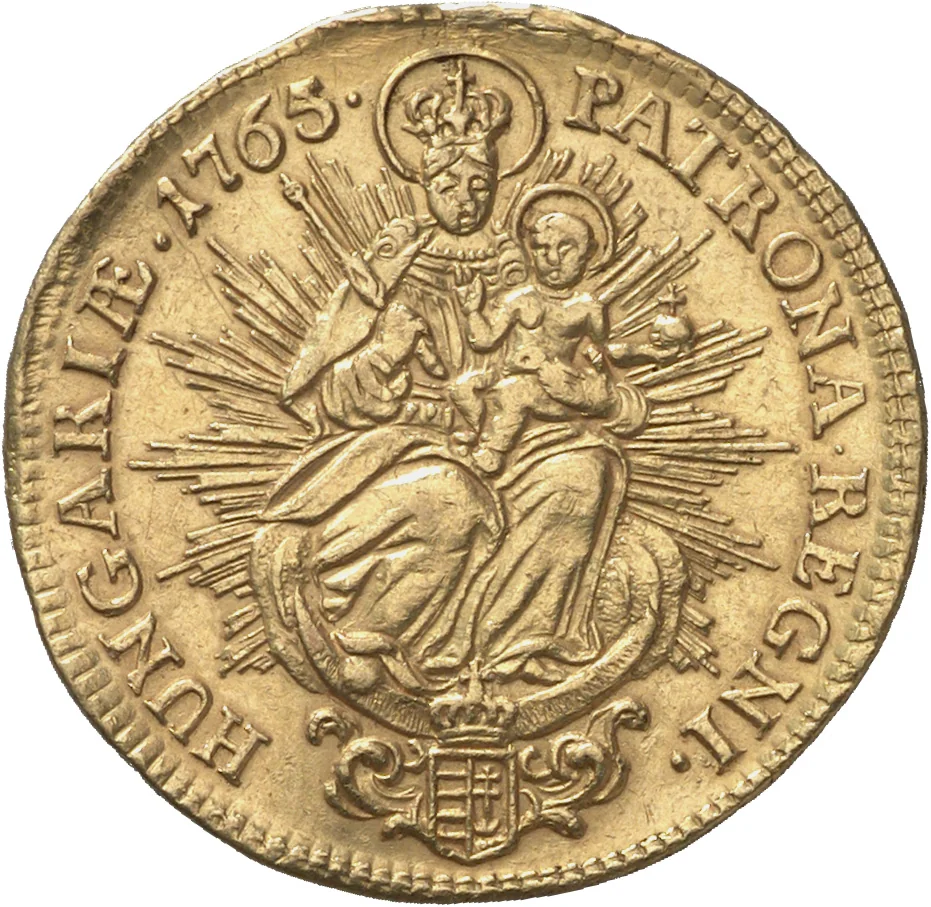
Reverse
Description:
Enthroned, crowned Madonna and Child; she holds an orb and scepter over a crowned Hungarian coat of arms.
Inscription:
PATRONA · REGNI · HUNGARIÆ · 1765 ·
Script: Latin
Edge
Reeded
Mints
| Name | Mark |
|---|---|
| Kremnica | K B |
Mintings
| Year | Mint Mark | Mintage | Quality | Collection |
|---|---|---|---|---|
| 1763 | K | — | ||
| 1764 | K | — | ||
| 1765 | K | — | ||
| 1765 | K-B | — |
Historical background
Following the Seven Years' War (1756-1763), the Habsburg Monarchy, including Hungary, faced severe financial exhaustion. The war had been funded largely through massive debasement of the currency, particularly the silver Conventionsthaler and its subsidiary coins. By 1763, the monetary system was in disarray, with the actual silver content of coins significantly reduced from their nominal value, leading to widespread inflation, hoarding of older, purer coins, and a crippling loss of public trust in the currency.
Recognizing the crisis, Empress Maria Theresa and her advisors, most notably State Chancellor Wenzel Anton von Kaunitz, embarked on a comprehensive monetary reform. The pivotal year of 1763 saw the preparation and initial implementation of this policy. The core of the reform was the introduction of a new, stable silver standard based on the Conventionsthaler, which was to contain a defined and guaranteed amount of fine silver. This created a uniform currency across the Habsburg lands, aiming to restore confidence and facilitate trade.
The 1763 reforms laid the foundation for a period of relative monetary stability in Hungary for the subsequent decades. The new system standardized the Hungarian forint (gulden) and krajcár on the Convention standard, effectively ending the chaotic period of wartime debasement. While challenges remained, including the circulation of older debased coins and the persistent use of paper Bancozettel (banknotes) in Vienna, the reforms of 1763 marked a decisive shift toward a state-managed, standardized monetary system crucial for Hungary's integration into the Habsburg economic sphere.
Recognizing the crisis, Empress Maria Theresa and her advisors, most notably State Chancellor Wenzel Anton von Kaunitz, embarked on a comprehensive monetary reform. The pivotal year of 1763 saw the preparation and initial implementation of this policy. The core of the reform was the introduction of a new, stable silver standard based on the Conventionsthaler, which was to contain a defined and guaranteed amount of fine silver. This created a uniform currency across the Habsburg lands, aiming to restore confidence and facilitate trade.
The 1763 reforms laid the foundation for a period of relative monetary stability in Hungary for the subsequent decades. The new system standardized the Hungarian forint (gulden) and krajcár on the Convention standard, effectively ending the chaotic period of wartime debasement. While challenges remained, including the circulation of older debased coins and the persistent use of paper Bancozettel (banknotes) in Vienna, the reforms of 1763 marked a decisive shift toward a state-managed, standardized monetary system crucial for Hungary's integration into the Habsburg economic sphere.
💎 Extremely Rare