

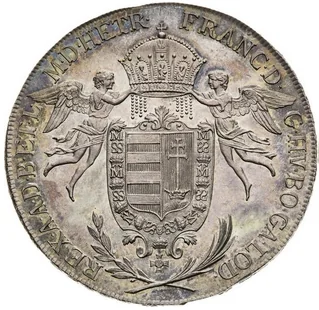

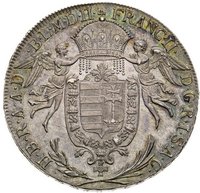
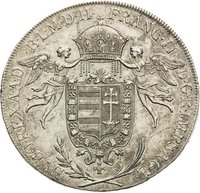
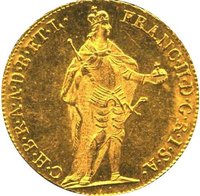
Obverse
Description:
Angels suspended midair, wings folded, holding a crowned double Hungarian shield in a cartouche.
Inscription:
FRANC.D. G.HV.BO.GA.LOD. REX.A.A.D.B. T.L.M.D.HETR.
Script: Latin
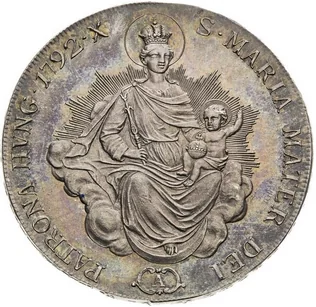
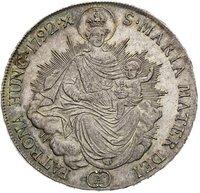
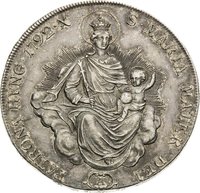
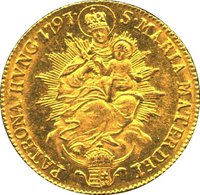
Reverse
Description:
Radiant Madonna and Child enthroned on a crescent moon.
Inscription:
S · MARIA MATER DEI · PATRONA · HUNG · 1792 ·
Script: Latin
Edge
Inscripted
Legend:
LEGE ET FIDE
Categories
| Person> Religious figure |
Mints
| Name | Mark |
|---|---|
| Münze Österreich | A |
Mintings
| Year | Mint Mark | Mintage | Quality | Collection |
|---|---|---|---|---|
| 1792 | A | — |
Historical background
In 1792, the Kingdom of Hungary operated within the complex monetary system of the Habsburg Monarchy, which was characterized by chronic instability and a persistent shortage of specie (coin). The official currency was the Habsburg Conventionsmünze (Convention Coinage), based on the silver gulden (forint) and the kreuzer. However, the state's finances were strained by the costly wars of the 18th century, leading to repeated debasements of the coinage and the issuance of paper money. The most significant of these was the Banco-Zettel, introduced in 1762, an inconvertible paper currency that began to depreciate against silver, creating a dual system of "bank money" and "coin money."
This monetary duality caused significant economic friction within Hungary. While taxes and obligations to the crown and feudal lords were often stipulated in silver currency, daily transactions were increasingly conducted in depreciating paper notes. This disparity burdened the peasantry and smaller landowners, who received payment in paper but had to convert it to meet obligations in harder currency, effectively paying a premium. The situation was further complicated by Hungary's historic legal and fiscal autonomy, which created tensions with the centralizing financial policies emanating from Vienna.
The year 1792 itself was a pivotal moment, as the Habsburg Monarchy, under the new Emperor Francis II, was drawn into the wars against revolutionary France. This impending conflict would dramatically exacerbate the monarchy's fiscal woes. The state would soon resort to massive new issuances of paper money to fund the war effort, setting the stage for the severe inflation and monetary chaos that would mark the coming decades, profoundly impacting Hungary's economy and social structure.
This monetary duality caused significant economic friction within Hungary. While taxes and obligations to the crown and feudal lords were often stipulated in silver currency, daily transactions were increasingly conducted in depreciating paper notes. This disparity burdened the peasantry and smaller landowners, who received payment in paper but had to convert it to meet obligations in harder currency, effectively paying a premium. The situation was further complicated by Hungary's historic legal and fiscal autonomy, which created tensions with the centralizing financial policies emanating from Vienna.
The year 1792 itself was a pivotal moment, as the Habsburg Monarchy, under the new Emperor Francis II, was drawn into the wars against revolutionary France. This impending conflict would dramatically exacerbate the monarchy's fiscal woes. The state would soon resort to massive new issuances of paper money to fund the war effort, setting the stage for the severe inflation and monetary chaos that would mark the coming decades, profoundly impacting Hungary's economy and social structure.
Series: 1792 Hungary circulation coins
✨ Legendary