

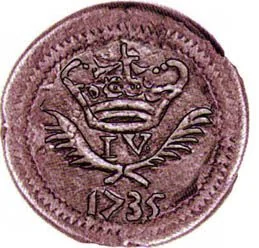
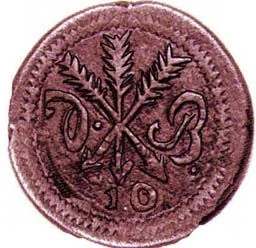
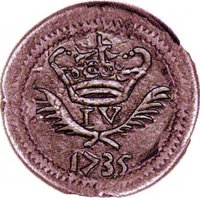
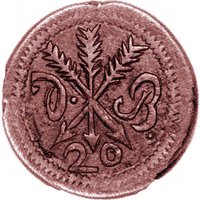
10 Réis – Portuguese India
India
Context
Year: 1735
Country: India 
Issuer: Portuguese India
Issuing organization: Casa da Moeda de Damão
Ruler: João V
Currency:
(1706—1880)
Subdivision: 10 Réis = ⅙ Tanga
Demonetized: Yes
Material
Diameter: 20 mm
Weight: 9.2 g
Shape: Irregular round
Composition: Copper
Magnetic: No
Technique: Hammered
References
KM: #Click to copy to clipboard14
Numista: #338711
Obverse
Reverse
Edge
Mintings
| Year | Mint Mark | Mintage | Quality | Collection |
|---|---|---|---|---|
| 1735 | D-B | — |
Historical background
In 1735, the currency situation in Portuguese India was a complex and challenging reflection of the Estado da India's diminished economic power and its integration into vibrant regional trade networks. The official Portuguese currency, the cruzado, was theoretically the standard, but in practice, the circulation was dominated by a multitude of foreign coins. The most important of these was the Mughal silver rupia (rupee), which served as the de facto benchmark for high-value transactions and external trade due to its consistent silver content and wide acceptance across the Indian Ocean. Alongside it, a plethora of other coins circulated, including gold pagodas from the south, Spanish-American pieces of eight, and various coins from other European trading companies, leading to a chaotic and fragmented monetary environment.
This pluralism was a result of necessity. The Portuguese crown struggled to supply sufficient quantities of reliable, high-quality coinage to its Asian possessions. Local and regional trade, the lifeblood of Goa, demanded currencies that were trusted by merchants from Gujarat to Malabar. Consequently, the Portuguese administration was forced to recognize and even officially rate these foreign coins, publishing periodic bandos (edicts) to fix their exchange values against the theoretical Portuguese standard. This created a constant administrative burden and opened doors for arbitrage and speculation, as the official bando rates often conflicted with market values determined by the intrinsic silver or gold content of the coins.
The situation was further complicated by the widespread practice of clipping and counterfeiting, which eroded trust in any coinage, and by the chronic shortage of small-denomination currency for everyday transactions. To address this, low-value copper coins, known as bazarucos, were minted locally in Goa for local use. However, these were often overproduced, leading to inflation in the local bazaars and a sharp divergence between the currency used in internal markets and that used in long-distance maritime trade. Thus, in 1735, the monetary landscape was one of layered complexity: a theoretical Portuguese system overlaid by a practical dependence on Mughal and other foreign silver, underpinned by a devalued copper currency for the common people, symbolizing the gap between imperial aspiration and colonial economic reality.
This pluralism was a result of necessity. The Portuguese crown struggled to supply sufficient quantities of reliable, high-quality coinage to its Asian possessions. Local and regional trade, the lifeblood of Goa, demanded currencies that were trusted by merchants from Gujarat to Malabar. Consequently, the Portuguese administration was forced to recognize and even officially rate these foreign coins, publishing periodic bandos (edicts) to fix their exchange values against the theoretical Portuguese standard. This created a constant administrative burden and opened doors for arbitrage and speculation, as the official bando rates often conflicted with market values determined by the intrinsic silver or gold content of the coins.
The situation was further complicated by the widespread practice of clipping and counterfeiting, which eroded trust in any coinage, and by the chronic shortage of small-denomination currency for everyday transactions. To address this, low-value copper coins, known as bazarucos, were minted locally in Goa for local use. However, these were often overproduced, leading to inflation in the local bazaars and a sharp divergence between the currency used in internal markets and that used in long-distance maritime trade. Thus, in 1735, the monetary landscape was one of layered complexity: a theoretical Portuguese system overlaid by a practical dependence on Mughal and other foreign silver, underpinned by a devalued copper currency for the common people, symbolizing the gap between imperial aspiration and colonial economic reality.
✨ Legendary