

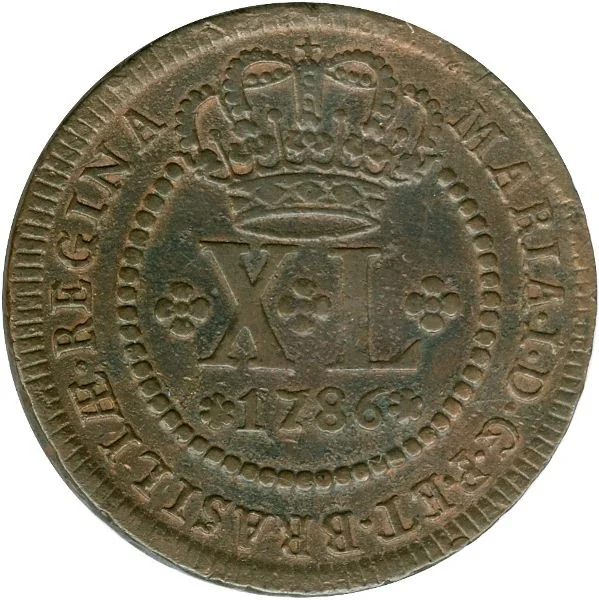
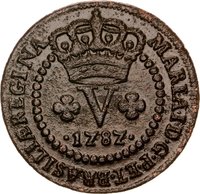
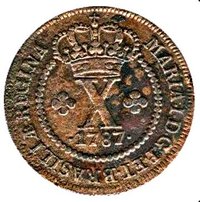
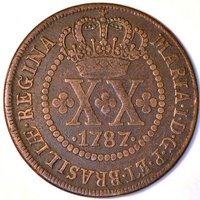
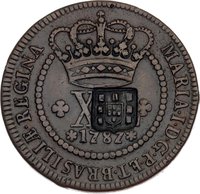
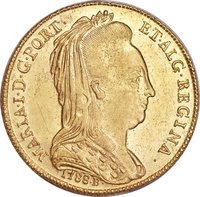
Obverse
Description:
Pearl-circled crown over XL, flowers, and date.
Inscription:
MARIA . I . D . G . P . ET . BRASILIÆ . REGINA .
Script: Latin
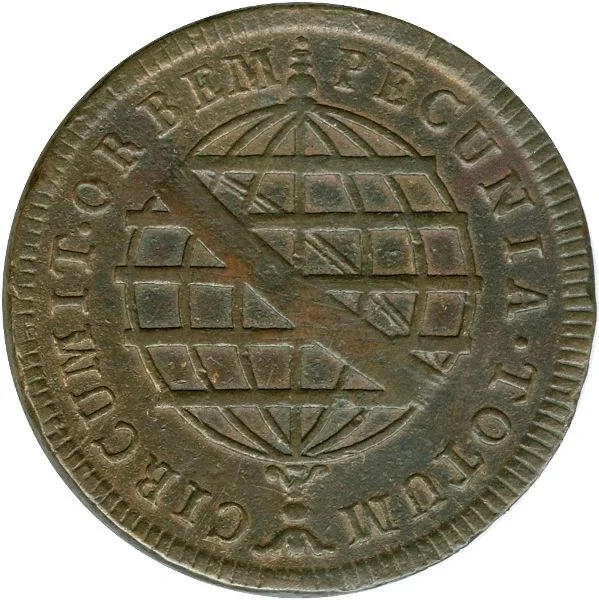
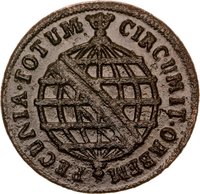
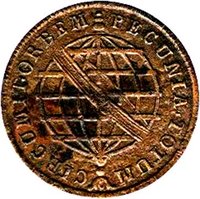
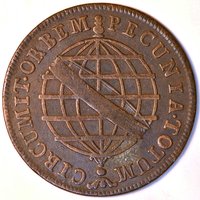
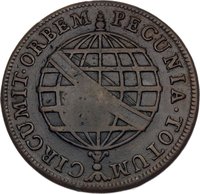
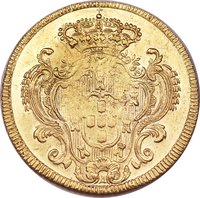
Reverse
Description:
Armillary sphere, no mintmark.
Inscription:
PECUNIA . TOTUM . CIRCUMIT . ORBEM .
Script: Latin
Edge
Plain
Mints
| Name | Mark |
|---|---|
| Imprensa Nacional - Casa da Moeda | — |
Mintings
| Year | Mint Mark | Mintage | Quality | Collection |
|---|---|---|---|---|
| 1786 | — | 99,757 | ||
| 1787 | — | 79,286 | ||
| 1790 | — | 140,496 | ||
| 1791 | — | 52,914 | ||
| 1796 | — | 101,924 |
Historical background
In 1786, the currency situation in the Kingdom of Brazil was one of profound crisis and confusion, rooted in the fiscal policies of the Portuguese colonial administration. The primary circulating medium was the réis (singular real), but a severe shortage of official coinage, especially gold and copper, plagued the economy. To fill the void, a vast array of informal and often debased tokens, known as moeda de necessidade (emergency money), circulated alongside worn and clipped official coins. This created a chaotic monetary environment where the face value of coins bore little relation to their intrinsic metal content, undermining trade and fostering widespread fraud.
This instability was a direct consequence of Portugal's mercantilist policies. The crown had long siphoned Brazilian gold to Lisbon, leaving the colony starved of specie. Furthermore, the 1750s ban on local minting, intended to centralize control in Portugal, had backfired disastrously. The Viceroy, Luís de Vasconcelos e Sousa, recognized the paralyzing effects on commerce and administration. In response to his urgent appeals, the Royal Treasury in Lisbon authorized a significant recoinage in 1786, ordering the minting of new copper réis at the Casa da Moeda in Rio de Janeiro to restore confidence and uniformity.
Thus, 1786 marked a pivotal year of attempted reform rather than resolution. The authorization for new coinage was a critical step, but the process of replacing the chaotic mix of tokens and worn coins would take years. The underlying structural issue—colonial extraction that drained Brazil of its monetary base—remained unaddressed. Therefore, while the year set in motion a necessary recoinage to stabilize the medium of exchange, the fundamental fragility of Brazil's currency, dependent on Lisbon's priorities, persisted as a constraint on the colony's economic development.
This instability was a direct consequence of Portugal's mercantilist policies. The crown had long siphoned Brazilian gold to Lisbon, leaving the colony starved of specie. Furthermore, the 1750s ban on local minting, intended to centralize control in Portugal, had backfired disastrously. The Viceroy, Luís de Vasconcelos e Sousa, recognized the paralyzing effects on commerce and administration. In response to his urgent appeals, the Royal Treasury in Lisbon authorized a significant recoinage in 1786, ordering the minting of new copper réis at the Casa da Moeda in Rio de Janeiro to restore confidence and uniformity.
Thus, 1786 marked a pivotal year of attempted reform rather than resolution. The authorization for new coinage was a critical step, but the process of replacing the chaotic mix of tokens and worn coins would take years. The underlying structural issue—colonial extraction that drained Brazil of its monetary base—remained unaddressed. Therefore, while the year set in motion a necessary recoinage to stabilize the medium of exchange, the fundamental fragility of Brazil's currency, dependent on Lisbon's priorities, persisted as a constraint on the colony's economic development.
Series: 1786 Brazil circulation coins
✨ Legendary