

1 Thaler – Prince-bishopric of Liege
Belgium
Context
Years: 1614–1641
Country: Belgium 
Issuer: Prince-bishopric of Liege
Ruler: Ferdinand of Bavaria
Currency:
(1545—1650)
Subdivision: 1 Thaler = 30 Patards
Demonetized: Yes
Material
References
KM: #Click to copy to clipboard60
Numista: #328003
Value
Bullion value: $47.20
Obverse
Description:
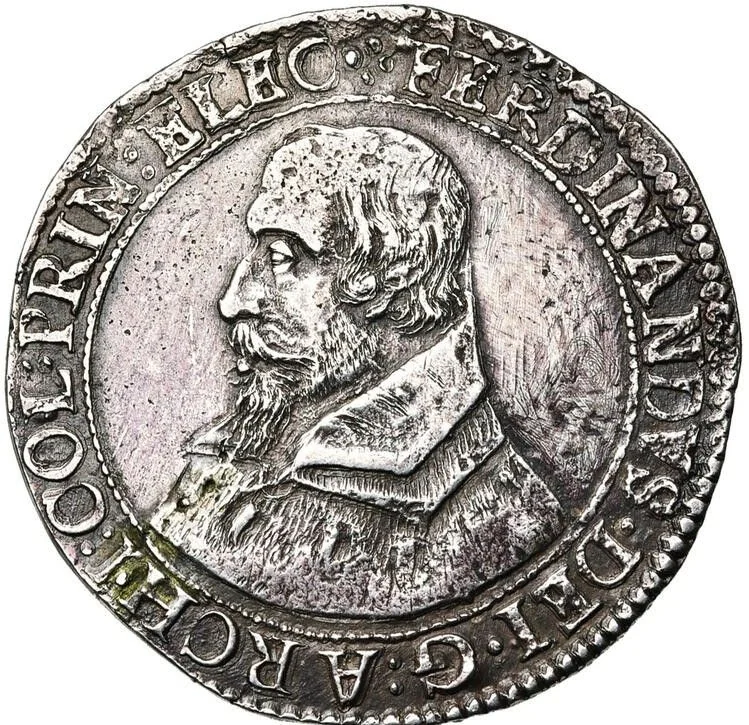
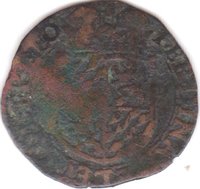
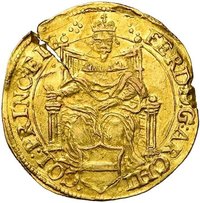
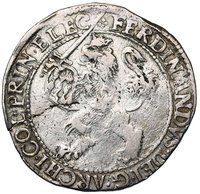
Ferdinand left bust in beaded circle.
Inscription:
⁕ FERDINANDVS · DEI · G : ARCHI : COL : PRIN : ELECT
Script: Latin
Reverse
Description:
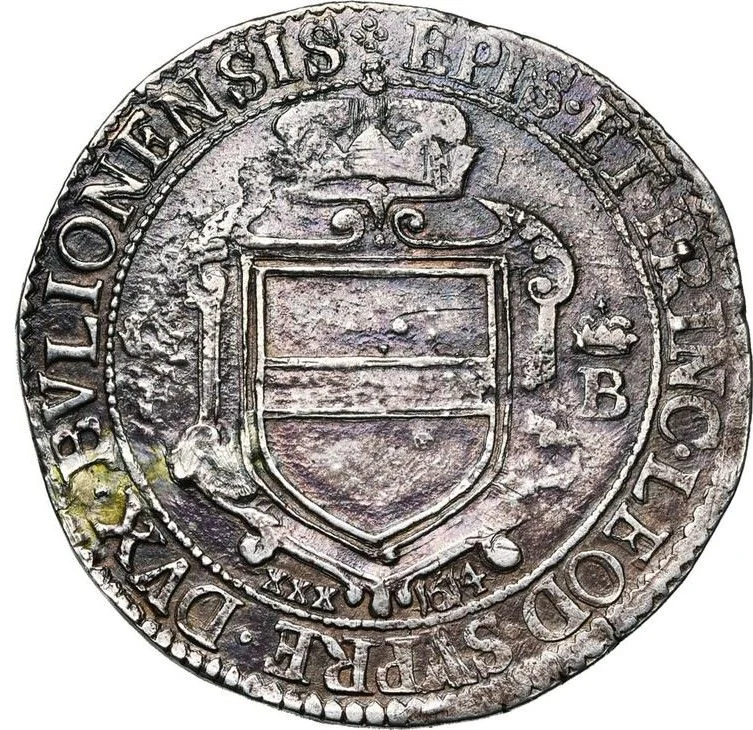
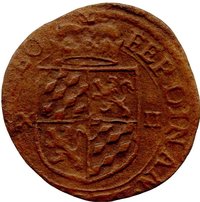
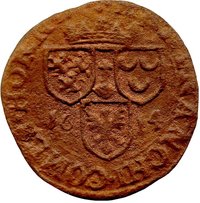
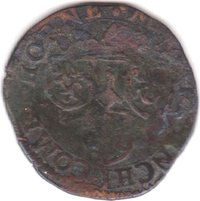
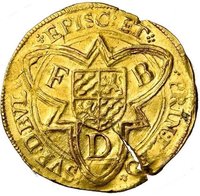
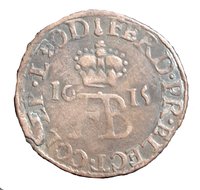
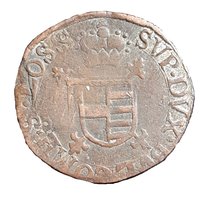
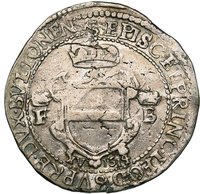
Liege's crowned arms in a cartouche, flanking crowned initials F B, with value and date below.
Inscription:
EPIS · ET· PRINC · LEOD · SVPRE · DVX · BVLIONENSIS
F B
XXX 1614
F B
XXX 1614
Script: Latin
Edge
Plain
Mints
| Name | Mark |
|---|---|
| Hasselt | — |
| Liège | — |
| Visé, Liège | — |
Mintings
| Year | Mint Mark | Mintage | Quality | Collection |
|---|---|---|---|---|
| 1614 | — | — | ||
| 1615 | — | — | ||
| 1619 | — | — | ||
| 1621 | — | — | ||
| 1622 | — | — | ||
| 1624 | — | — | ||
| 1625 | — | — | ||
| 1631 | — | — | ||
| 1633 | — | — | ||
| 1641 | — | — |
Historical background
In 1614, the Prince-Bishopric of Liège was grappling with a severe monetary crisis typical of the "Kipper- und Wipperzeit," a period of rampant currency debasement across the Holy Roman Empire. The autonomous ecclesiastical state, while politically independent, was economically intertwined with its neighbors, making it highly vulnerable to the flood of adulterated coinage entering its borders. Local mints, including those operated by the bishop and even by powerful abbeys within the territory, were under intense pressure to compete, often lowering the silver content of coins like patards and liards to generate seigniorage revenue, thereby fueling inflation and eroding public trust.
The situation was exacerbated by the political weakness of the ruling Prince-Bishop, Ferdinand of Bavaria. As a simultaneous Archbishop-Elector of Cologne, he was often absent, leaving the day-to-day governance to officials who struggled to enforce monetary ordinances. Speculators and money-changers ("Kipper und Wipper") exploited the fragmented regulatory landscape, physically "clipping" good coins and trafficking in debased ones, creating a chaotic multi-currency environment where the value of money could change from town to town.
This monetary instability had dire social and economic consequences within the prince-bishopric. It disrupted trade, penalized wage earners and creditors, and sparked widespread popular discontent. While the Liège authorities, like the Imperial Circles, issued decrees against bad coinage, effective enforcement was nearly impossible. The crisis of 1614 thus highlighted the structural vulnerabilities of Liège's economy and governance, persisting until broader imperial reforms and a return to sound minting practices were gradually implemented in the following years.
The situation was exacerbated by the political weakness of the ruling Prince-Bishop, Ferdinand of Bavaria. As a simultaneous Archbishop-Elector of Cologne, he was often absent, leaving the day-to-day governance to officials who struggled to enforce monetary ordinances. Speculators and money-changers ("Kipper und Wipper") exploited the fragmented regulatory landscape, physically "clipping" good coins and trafficking in debased ones, creating a chaotic multi-currency environment where the value of money could change from town to town.
This monetary instability had dire social and economic consequences within the prince-bishopric. It disrupted trade, penalized wage earners and creditors, and sparked widespread popular discontent. While the Liège authorities, like the Imperial Circles, issued decrees against bad coinage, effective enforcement was nearly impossible. The crisis of 1614 thus highlighted the structural vulnerabilities of Liège's economy and governance, persisting until broader imperial reforms and a return to sound minting practices were gradually implemented in the following years.
✨ Legendary