

¼ Daler – Sweden
Sweden
Context

Material
References
KM: #Click to copy to clipboard1
Numista: #111803
Value
Bullion value: $18.30
Obverse
Description:
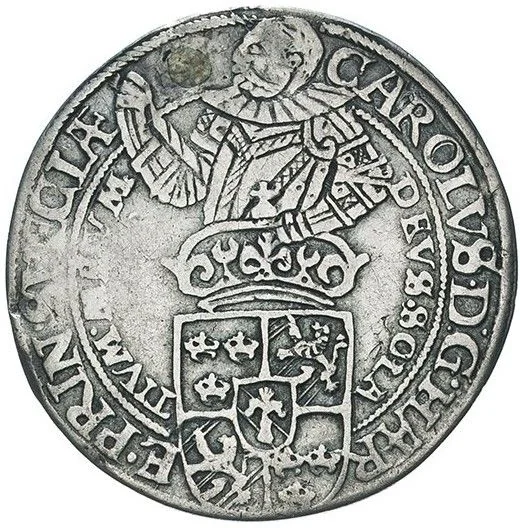
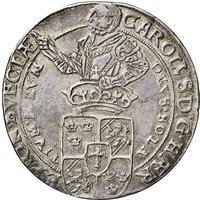
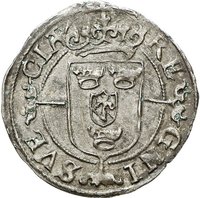
Bare-headed armored bust of Prince Karl holding a scepter, above the crowned Greater Arms of Sweden. The central shield and bust are encircled by legends.
Inscription:
CAROLVS · D:G · HÆR | E · PRIN · SVECIÆ
DEVS · SOLA | TIVM · MEVM
DEVS · SOLA | TIVM · MEVM
Reverse
Description:
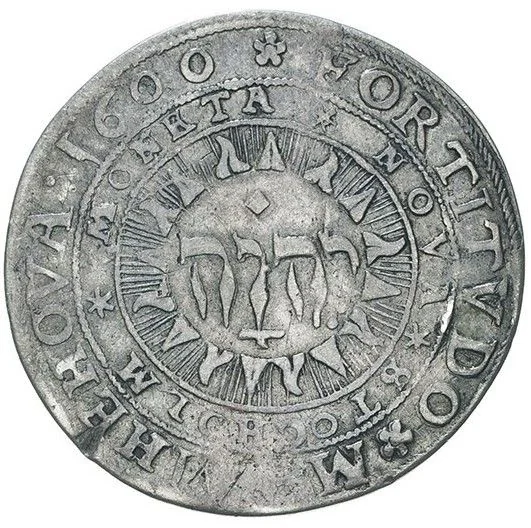
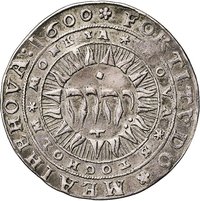
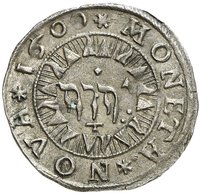
Radiant sun containing Hebrew "Jehovah" within a double circle and two legends.
Inscription:
יהוה
MONETA * NOVA * STOCHOLM *
1603 * FORTITVDO * MEA IEHOVA *
MONETA * NOVA * STOCHOLM *
1603 * FORTITVDO * MEA IEHOVA *
Edge
Mints
| Name | Mark |
|---|---|
| Stockholm | — |
Mintings
| Year | Mint Mark | Mintage | Quality | Collection |
|---|---|---|---|---|
| 1600 | — | — | ||
| 1603 | — | — |
Historical background
During the early 17th century, Sweden’s currency system was chaotic and unstable, a legacy of the preceding Vasa kings. The primary coin was the silver daler, but its value and silver content were frequently debased to finance state expenses, particularly the ongoing wars in the Baltic. This resulted in a confusing multiplicity of coins in circulation, including older, purer coins hoarded by the public and newer, inferior ones used for trade. The situation was further complicated by the widespread use of foreign coins, especially German and Dutch, which were often preferred for their reliable metal content.
Recognizing the economic harm, King Karl IX initiated a major currency reform in 1604. He introduced a new, standardized silver riksdaler (rixdollar) intended to restore confidence. The reform aimed to recall and melt down old debased coins, replacing them with new ones of fixed weight and purity aligned with international standards. However, the reform's success was limited. The Crown's perpetual need for war finance—especially under Gustav II Adolf—continued to create pressure, leading to periodic debasements even of the new coinage.
Consequently, Sweden in the 1600s operated with a dual system: the intended "riksdaler" for larger transactions and official accounts, and a plethora of smaller, often clipped or worn öre and mark coins for everyday use. This instability hampered commerce and state finance, creating a persistent problem that would only find a more stable, though innovative, solution later in the century with the introduction of Europe’s first successful paper money and the establishment of the Stockholm Banco in the 1660s.
Recognizing the economic harm, King Karl IX initiated a major currency reform in 1604. He introduced a new, standardized silver riksdaler (rixdollar) intended to restore confidence. The reform aimed to recall and melt down old debased coins, replacing them with new ones of fixed weight and purity aligned with international standards. However, the reform's success was limited. The Crown's perpetual need for war finance—especially under Gustav II Adolf—continued to create pressure, leading to periodic debasements even of the new coinage.
Consequently, Sweden in the 1600s operated with a dual system: the intended "riksdaler" for larger transactions and official accounts, and a plethora of smaller, often clipped or worn öre and mark coins for everyday use. This instability hampered commerce and state finance, creating a persistent problem that would only find a more stable, though innovative, solution later in the century with the introduction of Europe’s first successful paper money and the establishment of the Stockholm Banco in the 1660s.
Series: 1600 Sweden circulation coins
✨ Legendary