

2 Reales – Spain
Spain
Context

Material
Diameter: 26 mm
Weight: 6.8 g
Silver weight: 6.33 g
Thickness: 1 mm
Shape: Round
Composition: 93.1% Silver
Magnetic: No
Technique: Roller milled
References
KM: #Click to copy to clipboard184
Numista: #111678
Value
Bullion value: $17.76
Obverse
Description:
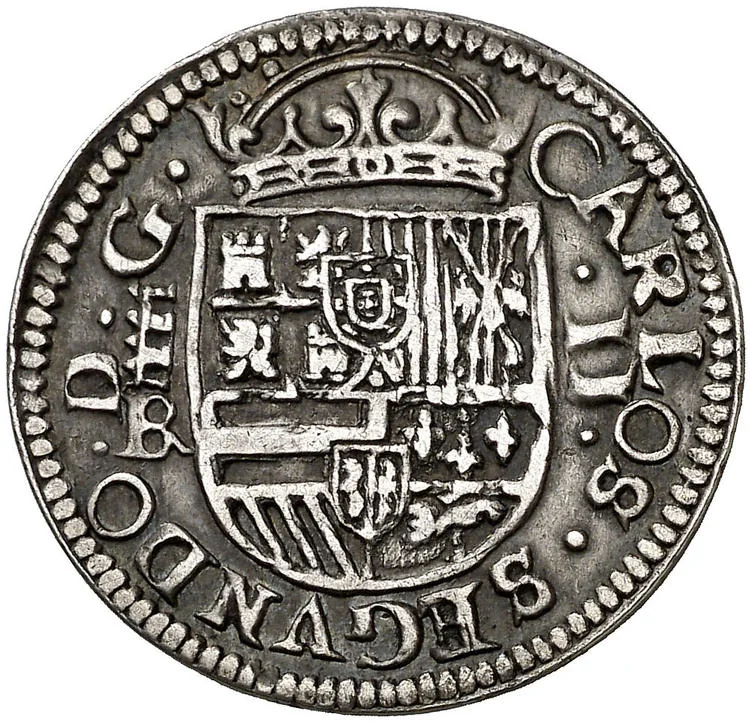
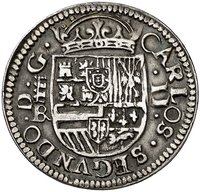
Spanish coat of arms with Portuguese arms.
Inscription:
CARLOS · SEGVNDO · D · G ·
BR
· II ·
BR
· II ·
Script: Latin
Reverse
Description:
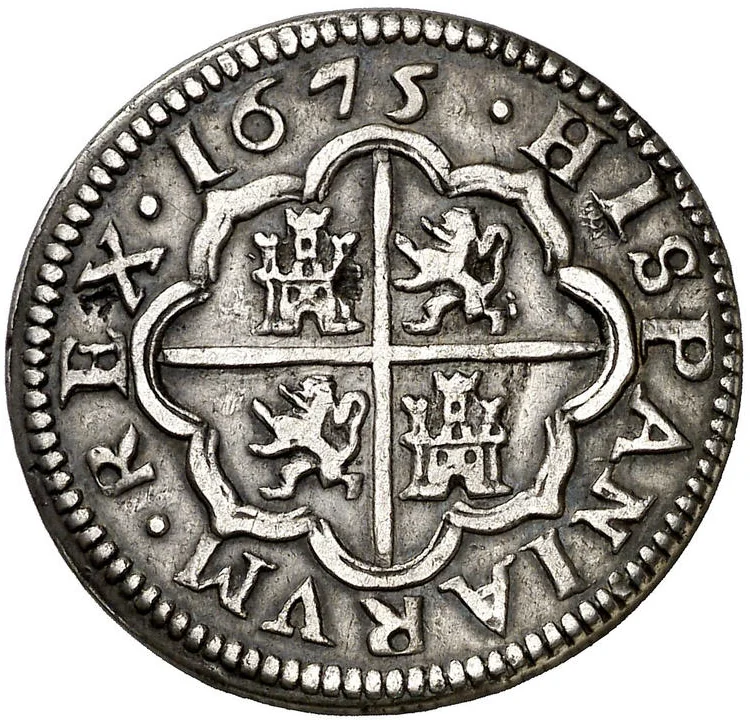
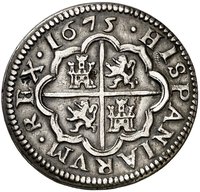
Castile and León's coat of arms in an octolobe.
Inscription:
· HISPANIARVM · REX · 1675
Script: Latin
Edge
Categories
| Symbols> Coat of Arms |
Mints
| Name | Mark |
|---|---|
| Royal Mint of Segovia | — |
Mintings
| Year | Mint Mark | Mintage | Quality | Collection |
|---|---|---|---|---|
| 1675 | BR | — |
Historical background
In 1675, Spain's currency system was in a state of profound crisis, a direct consequence of decades of fiscal mismanagement and the economic policies of the Habsburg monarchy. The crown, perpetually bankrupt from financing endless European wars, had repeatedly resorted to debasing the coinage to raise short-term funds. This involved reducing the precious metal content in coins like the real and the escudo while maintaining their face value, a practice that flooded the economy with increasingly worthless currency. The situation was exacerbated by the widespread circulation of clipped and counterfeit coins, creating a chaotic monetary environment where the intrinsic value of a coin rarely matched its nominal worth.
This debasement triggered severe inflation, known as the "Price Revolution," which eroded purchasing power and created a deep distrust in the royal currency. In daily transactions, people and merchants increasingly relied on a confusing array of older, full-weight coins from earlier reigns, foreign currencies (particularly silver pieces of eight from the Americas), and even simple barter. The government's attempts to fix prices and legislate the value of coins repeatedly failed, as market forces and Gresham's Law ("bad money drives out good") prevailed. The economy suffered from this instability, hindering trade and investment at a time when Spain was already losing its commercial dominance to rivals like the Dutch Republic and England.
Ultimately, the monetary chaos of 1675 was a symptom of Spain's broader imperial decline. While silver from the New World still arrived, it flowed directly out to pay foreign creditors and armies, failing to stimulate domestic production. The crown's inability to provide a stable medium of exchange reflected its weakening authority and failing fiscal state. This period set the stage for the more comprehensive, though still fraught, monetary reforms that would be attempted under the incoming Bourbon dynasty in the following century, highlighting how currency instability was both a cause and a consequence of Spain's 17th-century difficulties.
This debasement triggered severe inflation, known as the "Price Revolution," which eroded purchasing power and created a deep distrust in the royal currency. In daily transactions, people and merchants increasingly relied on a confusing array of older, full-weight coins from earlier reigns, foreign currencies (particularly silver pieces of eight from the Americas), and even simple barter. The government's attempts to fix prices and legislate the value of coins repeatedly failed, as market forces and Gresham's Law ("bad money drives out good") prevailed. The economy suffered from this instability, hindering trade and investment at a time when Spain was already losing its commercial dominance to rivals like the Dutch Republic and England.
Ultimately, the monetary chaos of 1675 was a symptom of Spain's broader imperial decline. While silver from the New World still arrived, it flowed directly out to pay foreign creditors and armies, failing to stimulate domestic production. The crown's inability to provide a stable medium of exchange reflected its weakening authority and failing fiscal state. This period set the stage for the more comprehensive, though still fraught, monetary reforms that would be attempted under the incoming Bourbon dynasty in the following century, highlighting how currency instability was both a cause and a consequence of Spain's 17th-century difficulties.
✨ Legendary