

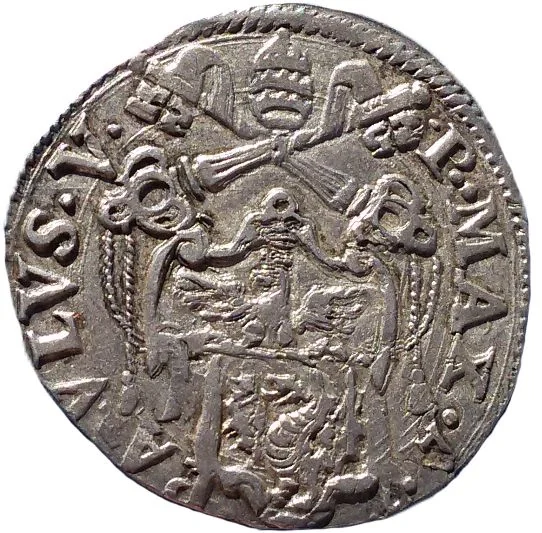
1 Teston – Papal States
Vatican City
Context
Years: 1608–1611
Country: Vatican City 
Issuer: Papal States
Ruler: Paul V
Currency:
(1534—1835)
Demonetized: Yes
Material
References
KM: #Click to copy to clipboard51
Numista: #320786
Value
Bullion value: $24.51
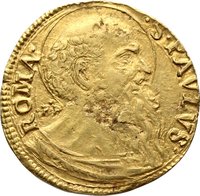
Obverse
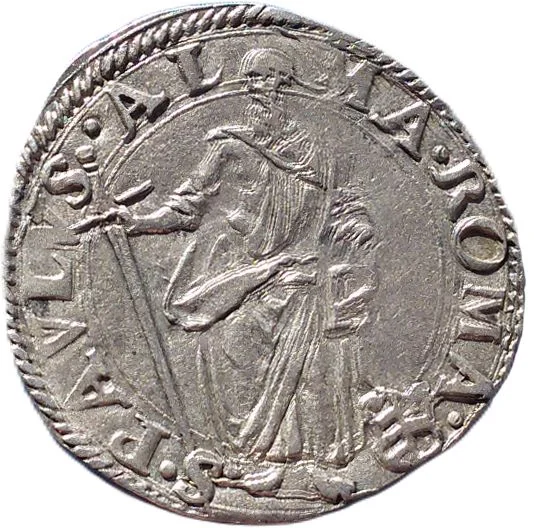
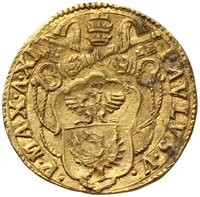
Reverse
Description:
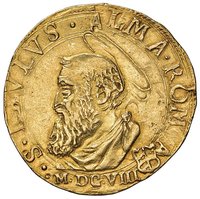
Saint Paul, left, holding a sword in his right hand and a book in his left.
Inscription:
S • PAVLVS • ALMA • ROMA
Script: Latin
Edge
Plain
Mints
| Name | Mark |
|---|---|
| Rome | — |
Mintings
| Year | Mint Mark | Mintage | Quality | Collection |
|---|---|---|---|---|
| 1608 | — | — | ||
| 1609 | — | — | ||
| 1610 | — | — | ||
| 1611 | — | — |
Historical background
In 1608, the Papal States, under the pontificate of Pope Paul V, operated within a complex and often chaotic monetary system typical of early modern Italian states. There was no single, unified Papal currency; instead, the circulating medium was a heterogeneous mix of coins minted by the papal mint in Rome, alongside a flood of foreign coins from other Italian states (like the Venetian ducat and Florentine florin), Spanish silver reales, and various debased local issues. The value of these coins was not strictly tied to their metal content but was often set by official proclamation, leading to frequent agio (exchange premiums) and market confusion.
The primary papal silver coin was the giulio, named after Pope Julius II, and its larger counterpart, the paolo (worth 10 baiocchi). The gold scudo was the high-value unit for major transactions. However, the system was plagued by chronic instability. Successive popes had frequently debased the silver coinage to raise short-term revenue for wars, building projects, and administrative costs, eroding public trust. This practice created a gap between the officially minted "good" coin and the worn or debased coins in everyday circulation, leading to Gresham's Law in action: "bad money drives out good."
Consequently, the monetary situation in 1608 was one of fragile equilibrium managed through constant edicts. The Camera Apostolica (papal treasury) issued regular bandi (decrees) attempting to fix exchange rates between the myriad coins and to outlaw the circulation of particularly debased or counterfeit pieces. These efforts were only partially successful, as both internal economic pressures and the influx of foreign bullion from the Americas continued to disrupt the market. Thus, daily commerce in the Papal States relied on a delicate and often contentious negotiation between official proclamations and the practical realities of a fragmented monetary landscape.
The primary papal silver coin was the giulio, named after Pope Julius II, and its larger counterpart, the paolo (worth 10 baiocchi). The gold scudo was the high-value unit for major transactions. However, the system was plagued by chronic instability. Successive popes had frequently debased the silver coinage to raise short-term revenue for wars, building projects, and administrative costs, eroding public trust. This practice created a gap between the officially minted "good" coin and the worn or debased coins in everyday circulation, leading to Gresham's Law in action: "bad money drives out good."
Consequently, the monetary situation in 1608 was one of fragile equilibrium managed through constant edicts. The Camera Apostolica (papal treasury) issued regular bandi (decrees) attempting to fix exchange rates between the myriad coins and to outlaw the circulation of particularly debased or counterfeit pieces. These efforts were only partially successful, as both internal economic pressures and the influx of foreign bullion from the Americas continued to disrupt the market. Thus, daily commerce in the Papal States relied on a delicate and often contentious negotiation between official proclamations and the practical realities of a fragmented monetary landscape.
✨ Legendary