

2 Grossetti – Ferrara
Italy
Context
Material
Diameter: 24 mm
Weight: 2.7 g
Shape: Irregular round
Composition: Billon
Technique: Hammered
Alignment: Medal alignment
flip
References
KM: #Click to copy to clipboard104
Numista: #319660
Obverse
Description:
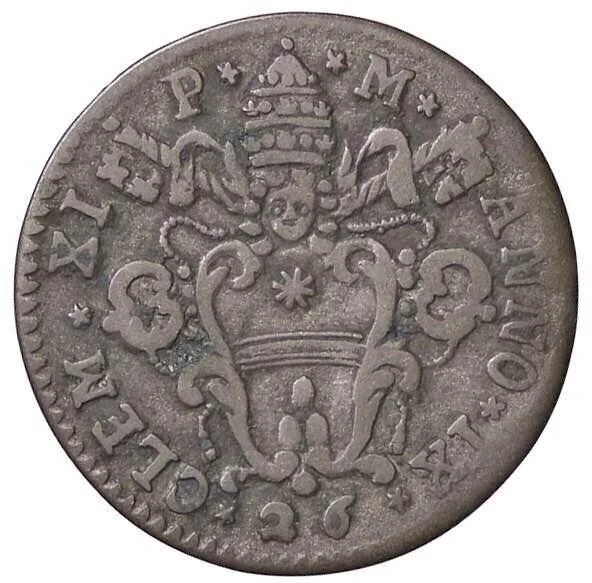
Albani coat of arms under Papal tiara and keys, cherub beneath tiara. Value "26" below.
Inscription:
CLEM ✶ XI P * M * ANNO * IX
Script: Latin
Reverse
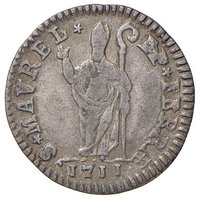
Description:
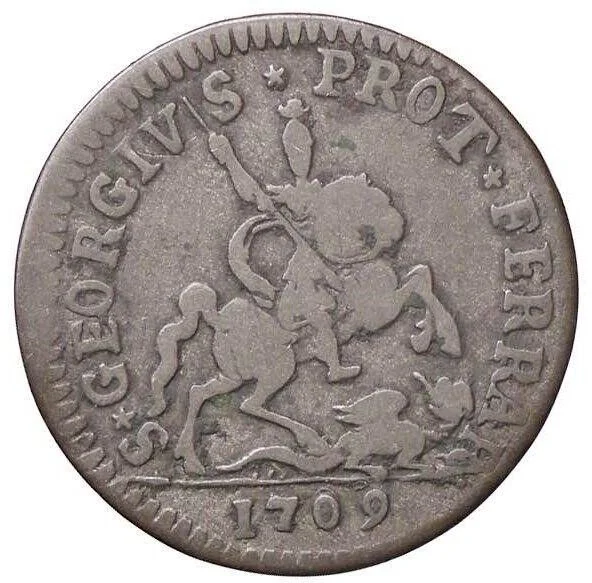
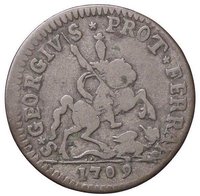
Saint George on horseback, right, spearing dragon. Date in exergue.
Inscription:
S ✶ GEORGIVS ✶ PROT ✶FERRAR
Script: Latin
Edge
Plain
Categories
| Symbol> Crown |
| Mythology> Fantastic animal |
| Animal> Horse |
| Symbols> Coat of Arms |
| Object> Cold weapons |
Mints
| Name | Mark |
|---|---|
| Ferrara | — |
Mintings
| Year | Mint Mark | Mintage | Quality | Collection |
|---|---|---|---|---|
| 1709 | — | — |
Historical background
In 1709, Ferrara found itself in a precarious monetary situation, a direct consequence of its political status within the Papal States. Since the devolution of the Duchy of Ferrara to the Papacy in 1598, the city had lost its sovereign minting authority. Consequently, its currency circulation was dominated by a chaotic mix of foreign coins, primarily from other Italian states like Venice (ducats and lire), Milan (scudi), and Bologna (baiocchi), alongside the official papal coinage. This proliferation of currencies of varying weights and alloys created a complex and unstable exchange environment, frustrating merchants and complicating everyday transactions.
The year 1709 fell within the devastating War of the Spanish Succession (1701-1714), which severely exacerbated Ferrara's financial woes. The conflict disrupted regional trade routes through the Po Valley, straining the local agrarian economy. More directly, the passage and occasional occupation of imperial and French armies in northern Italy placed extreme fiscal pressure on the city, leading to forced levies and the debasement of circulating coinage. Wartime inflation and scarcity of sound money were acute, as precious metal was hoarded or siphoned away to fund military campaigns, leaving the populace to contend with a degraded and unreliable medium of exchange.
This monetary confusion reflected Ferrara's diminished economic and political standing. Without control over its own currency, the city's authorities could not implement effective monetary policy to stabilize the situation. Efforts were likely limited to periodic official gridas (edicts) that attempted to fix exchange rates between the myriad coins, but these were often ineffective against market forces and widespread counterfeiting. Thus, in 1709, Ferrara's currency landscape was one of fragmentation, inflation, and dependency—a microcosm of the broader economic instability gripping Italy during the prolonged European war.
The year 1709 fell within the devastating War of the Spanish Succession (1701-1714), which severely exacerbated Ferrara's financial woes. The conflict disrupted regional trade routes through the Po Valley, straining the local agrarian economy. More directly, the passage and occasional occupation of imperial and French armies in northern Italy placed extreme fiscal pressure on the city, leading to forced levies and the debasement of circulating coinage. Wartime inflation and scarcity of sound money were acute, as precious metal was hoarded or siphoned away to fund military campaigns, leaving the populace to contend with a degraded and unreliable medium of exchange.
This monetary confusion reflected Ferrara's diminished economic and political standing. Without control over its own currency, the city's authorities could not implement effective monetary policy to stabilize the situation. Efforts were likely limited to periodic official gridas (edicts) that attempted to fix exchange rates between the myriad coins, but these were often ineffective against market forces and widespread counterfeiting. Thus, in 1709, Ferrara's currency landscape was one of fragmentation, inflation, and dependency—a microcosm of the broader economic instability gripping Italy during the prolonged European war.
✨ Legendary