

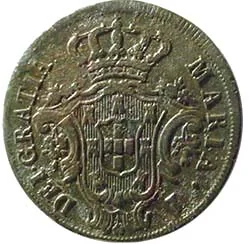
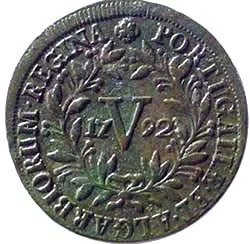

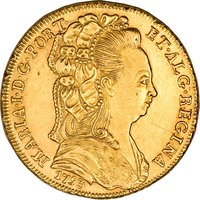
Obverse
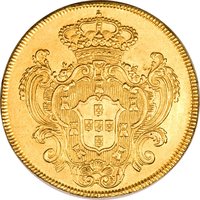
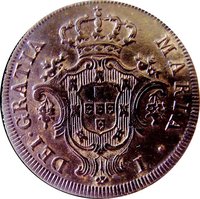
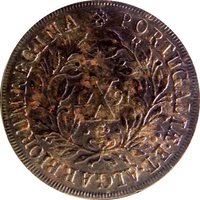
Reverse
Description:
Date split by value in wreath.
Inscription:
PORTUGALIÆ.ET.ALGARBIORUM.REGINA
Script: Latin
Edge
Plain
Mints
| Name | Mark |
|---|---|
| Imprensa Nacional - Casa da Moeda | — |
Mintings
| Year | Mint Mark | Mintage | Quality | Collection |
|---|---|---|---|---|
| 1791 | — | — | ||
| 1792 | — | 602,026 | ||
| 1797 | — | 218,890 | ||
| 1799 | — | 33,466 |
Historical background
In 1791, Portugal operated under a complex and strained monetary system, largely inherited from its colonial empire. The official currency was the Portuguese real (plural: réis), a monetary unit of account that had been in use for centuries. However, the physical money in circulation was a chaotic mix of domestic and foreign coinage. Alongside Portuguese gold moedas and silver cruzados, vast quantities of Brazilian gold coins and even Spanish and French coins circulated freely, their value determined by their precious metal content rather than their face value. This reflected Portugal's deep economic dependence on Brazilian gold, which had fueled the economy in the earlier 18th century but was now in decline.
The system was under significant pressure. The influx of Brazilian gold had previously caused inflation, and by 1791, the state faced serious financial difficulties. The ambitious reconstruction of Lisbon after the 1755 earthquake, the maintenance of the vast empire, and costly court expenditures under Queen Maria I had drained the treasury. To raise funds, the crown frequently resorted to debasing the coinage (reducing its precious metal content) and issuing copper currency, which led to a loss of public confidence and further inflationary pressures. The economy remained heavily mercantilist, with wealth measured in bullion, but the supply was becoming unreliable.
Furthermore, 1791 fell within the period of the "Viradeira," a conservative reaction following the fall of the Marquis of Pombal. Economic policy was cautious and less reform-minded. While neighboring Spain was implementing monetary reforms, Portugal's system remained archaic and cumbersome, with calculations often requiring massive numbers of réis. This unstable and fragmented currency landscape mirrored the broader anxieties of the Portuguese state on the eve of the revolutionary wars that would soon engulf Europe, threatening its traditional alliances and colonial wealth.
The system was under significant pressure. The influx of Brazilian gold had previously caused inflation, and by 1791, the state faced serious financial difficulties. The ambitious reconstruction of Lisbon after the 1755 earthquake, the maintenance of the vast empire, and costly court expenditures under Queen Maria I had drained the treasury. To raise funds, the crown frequently resorted to debasing the coinage (reducing its precious metal content) and issuing copper currency, which led to a loss of public confidence and further inflationary pressures. The economy remained heavily mercantilist, with wealth measured in bullion, but the supply was becoming unreliable.
Furthermore, 1791 fell within the period of the "Viradeira," a conservative reaction following the fall of the Marquis of Pombal. Economic policy was cautious and less reform-minded. While neighboring Spain was implementing monetary reforms, Portugal's system remained archaic and cumbersome, with calculations often requiring massive numbers of réis. This unstable and fragmented currency landscape mirrored the broader anxieties of the Portuguese state on the eve of the revolutionary wars that would soon engulf Europe, threatening its traditional alliances and colonial wealth.
🌟 Uncommon