


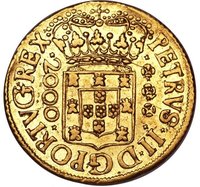
Obverse
Description:
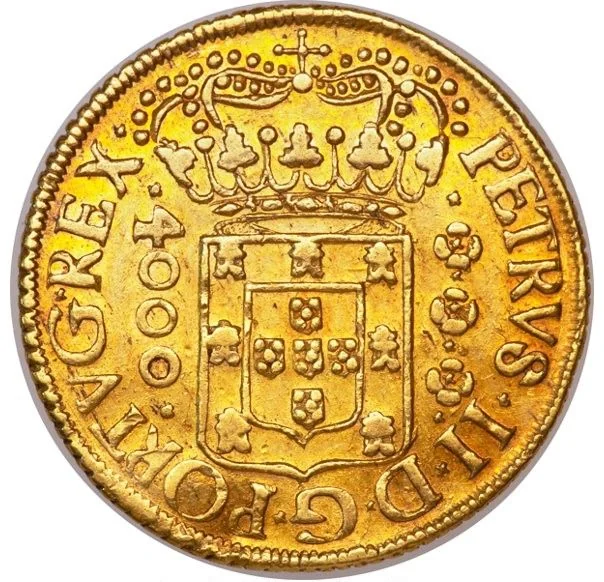
Portuguese arms, 4000 value, three flowers.
Inscription:
PETRVS. II. DG. PORTVG. REX.
4000
4000
Script: Latin
Engraver: Domingos Ferreira Zambuja
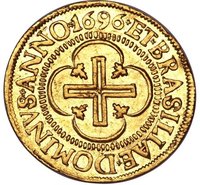
Reverse
Description:
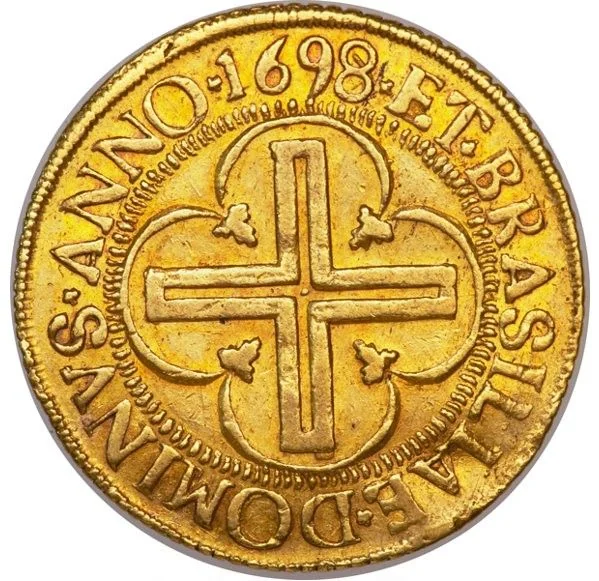
Saint George's cross with ornaments and date.
Inscription:
ET. BRASILIAE. DOMINVS. ANNO. 1698
Script: Latin
Engraver: Domingos Ferreira Zambuja
Edge
Reeded.
Categories
| Symbols> Coat of Arms |
| Symbol> Cross |
Mints
| Name | Mark |
|---|---|
| Bahia | — |
Mintings
| Year | Mint Mark | Mintage | Quality | Collection |
|---|---|---|---|---|
| 1696 | — | — | ||
| 1697 | — | — | ||
| 1698 | — | — |
Historical background
In 1696, Brazil was in the midst of a severe monetary crisis rooted in the scarcity of official coinage. The colony's economy, driven by sugar and a nascent gold boom, relied heavily on a chaotic mix of commodity money (like sugar itself), crude locally minted copper coins, and a limited supply of Portuguese réis. However, widespread clipping and counterfeiting of these coins, particularly the 640-réis piece, had drastically degraded their value and public trust, paralyzing commerce and tax collection. The Portuguese Crown, recognizing that the financial system was breaking down, had already taken the decisive step to intervene.
The solution was the establishment of Brazil's first official mint, the Casa da Moeda do Brasil, in Bahia in 1694. By 1696, this mint was actively addressing the crisis through a radical monetary reform: the recall and demonetization of all old, debased coins. These were to be surrendered and reminted into a new, standardized silver coinage with precise weight and purity, bearing the Crown's seal to guarantee its value. This process aimed to restore confidence, stabilize prices, and reassert royal control over the economic life of the colony.
The context of this reform was profoundly shaped by the recent discovery of significant gold deposits in Minas Gerais in the 1690s. While the 1696 currency measures predated the full flood of gold into the economy, the Crown's actions were strategically aimed at creating a reliable monetary system to capture and regulate the coming wealth. Thus, the currency situation of 1696 represents a pivotal transition—an attempt to end a period of monetary anarchy and lay the fiscal groundwork for the century of gold that would define Brazil's importance to the Portuguese Empire.
The solution was the establishment of Brazil's first official mint, the Casa da Moeda do Brasil, in Bahia in 1694. By 1696, this mint was actively addressing the crisis through a radical monetary reform: the recall and demonetization of all old, debased coins. These were to be surrendered and reminted into a new, standardized silver coinage with precise weight and purity, bearing the Crown's seal to guarantee its value. This process aimed to restore confidence, stabilize prices, and reassert royal control over the economic life of the colony.
The context of this reform was profoundly shaped by the recent discovery of significant gold deposits in Minas Gerais in the 1690s. While the 1696 currency measures predated the full flood of gold into the economy, the Crown's actions were strategically aimed at creating a reliable monetary system to capture and regulate the coming wealth. Thus, the currency situation of 1696 represents a pivotal transition—an attempt to end a period of monetary anarchy and lay the fiscal groundwork for the century of gold that would define Brazil's importance to the Portuguese Empire.

✨ Legendary