

1 Mohur – Mughal Empire
India
Context
Years: 1621–1623
Country: India 
Issuer: Mughal Empire
Ruler: Jahangir I
Currency:
(1540—1842)
Demonetized: Yes
Material
References
KM: #Click to copy to clipboard180.5
Numista: #315543
Value
Bullion value: $1798.08
Obverse
Description:
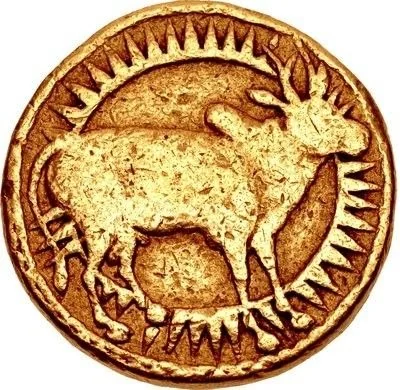
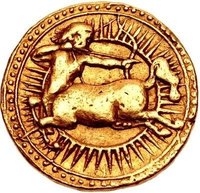
Bull facing right; sun behind.
Reverse
Inscription:
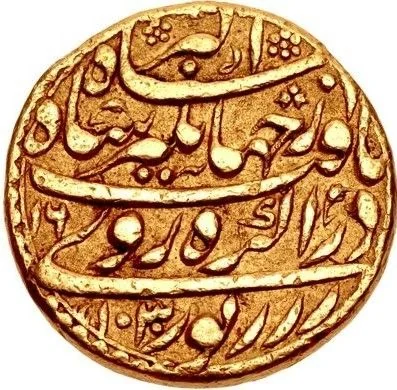
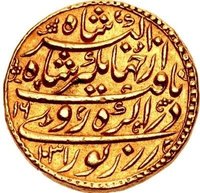
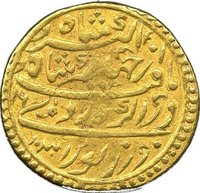
zar zewar dar Agra ruye yaft az Jahangir Shah Akbar Shah
Edge
Mints
| Name | Mark |
|---|---|
| Agra | — |
Mintings
| Year | Mint Mark | Mintage | Quality | Collection |
|---|---|---|---|---|
| 1621 | — | — | ||
| 1622 | — | — | ||
| 1623 | — | — |
Historical background
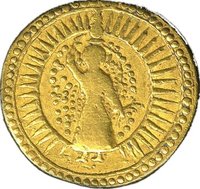
In 1621, the Mughal Empire’s currency system under Emperor Jahangir was robust, sophisticated, and a critical pillar of imperial authority and economic integration. The system was bimetallic, based on the silver rupee and the gold mohur, with a largely fixed exchange rate maintained by the state. The primary silver rupee, notably the high-purity Jahangiri rupee, was the workhorse of the economy, used for revenue collection, large trade transactions, and military pay. Copper dams served as the ubiquitous fractional currency for daily local markets. All coins were meticulously minted in imperial mints (dar al-zarb) across key cities like Surat, Ahmedabad, Lahore, and Patna, bearing Persian inscriptions that proclaimed the emperor’s legitimacy and, in a famous innovation by Jahangir, even featured zodiacal symbols.
This monetary stability was actively managed and deeply intertwined with the empire’s geopolitical fortunes. A steady influx of New World silver, entering primarily through trade with European companies at Surat and other ports, provided the essential bullion to mint coins in vast quantities, preventing deflation and fueling economic activity. The reliability of the rupee made it a preferred currency not just within the empire but across the Indian Ocean trade network. However, this external dependency also created vulnerability; any disruption to trade routes or bullion flows could strain the system. Furthermore, the empire was engaged in costly military campaigns, particularly in the Deccan, which placed immense and continuous pressure on the treasury, requiring efficient revenue extraction and coinage.
Despite these pressures, the year 1621 fell within a period of overall monetary stability before the later fiscal strains of Shah Jahan’s reign. The centralized control over mints ensured uniform quality, crushing counterfeit operations and punishing corrupt mint officials to maintain trust. The system effectively facilitated both the agricultural revenue base and the burgeoning commercial economy, supporting the empire’s immense wealth. Thus, the currency situation in 1621 reflects a mature imperial system at its height, where coinage was not just an economic tool but a powerful symbol of sovereignty and a linchpin holding a vast and diverse empire together.
This monetary stability was actively managed and deeply intertwined with the empire’s geopolitical fortunes. A steady influx of New World silver, entering primarily through trade with European companies at Surat and other ports, provided the essential bullion to mint coins in vast quantities, preventing deflation and fueling economic activity. The reliability of the rupee made it a preferred currency not just within the empire but across the Indian Ocean trade network. However, this external dependency also created vulnerability; any disruption to trade routes or bullion flows could strain the system. Furthermore, the empire was engaged in costly military campaigns, particularly in the Deccan, which placed immense and continuous pressure on the treasury, requiring efficient revenue extraction and coinage.
Despite these pressures, the year 1621 fell within a period of overall monetary stability before the later fiscal strains of Shah Jahan’s reign. The centralized control over mints ensured uniform quality, crushing counterfeit operations and punishing corrupt mint officials to maintain trust. The system effectively facilitated both the agricultural revenue base and the burgeoning commercial economy, supporting the empire’s immense wealth. Thus, the currency situation in 1621 reflects a mature imperial system at its height, where coinage was not just an economic tool but a powerful symbol of sovereignty and a linchpin holding a vast and diverse empire together.
✨ Legendary