Logo Title
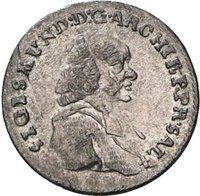
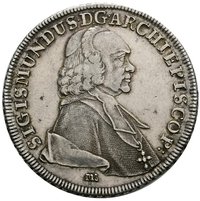
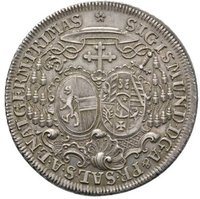
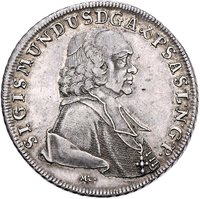
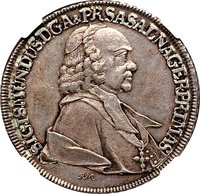
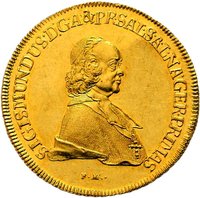
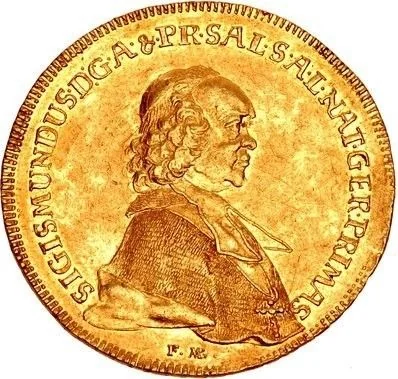
obverse
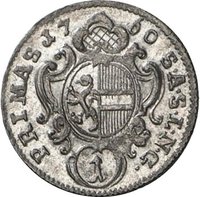
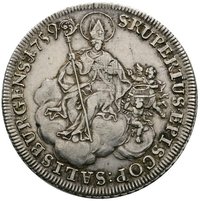
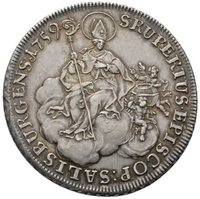
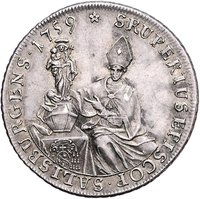
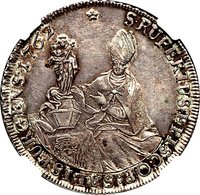
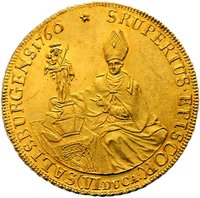
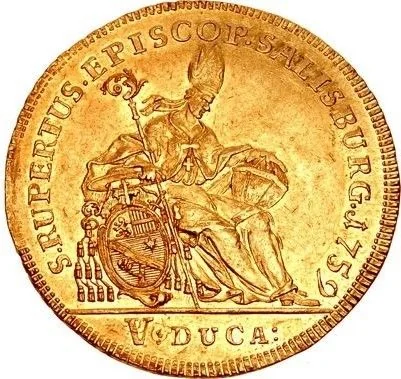
reverse
Classical Numismatic Group, Inc.
Context
Year: 1759
Country: Austria Country flag
Currency:
Demonetized: Yes
Material
Diameter: 36 mm
Weight: 17.46 g
Gold weight: 17.22 g
Shape: Round
Composition: 98.6% Gold
Magnetic: No
Technique: Milled
Alignment: Medal alignment
Obverse
OBVERSE ↑
flip
Reverse
REVERSE ↑
References
KM: #Click to copy to clipboard396
Numista: #315506
Value
Bullion value: $2877.50

Obverse

Description:
Bust facing right, in zucchetto and mozzetta.
Inscription:
SIGISMUND D G A & PR SAL S A L NAT GER PRIMAS

F M K
Script: Latin

Reverse

Description:
St. Rupert seated right, holding a salt cellar and crozier, arm resting on a coat of arms topped by a tasseled galero.
Inscription:
S. RUPERTUS EPISCOP SALISBURG 1759

V DUCA
Script: Latin

Edge

Mints

NameMark
Salzburg

Mintings

YearMint MarkMintageQualityCollection
1759F

Historical background

In 1759, the Prince-Archbishopric of Salzburg, under the rule of Sigismund III Christoph von Schrattenbach, operated within the complex monetary landscape of the Holy Roman Empire. The bishopric minted its own coins, most notably the Salzburger Gulden, which was subdivided into 60 Kreuzer. However, its currency did not exist in isolation; it circulated alongside a multitude of regional and foreign coins, particularly those from the powerful neighboring Austrian Habsburg Monarchy. This created a constant challenge of exchange rates and valuation, as the intrinsic silver content of coins was paramount in an era of fiduciary money.

The period was marked by the upheaval of the Seven Years' War (1756-1763), which placed significant financial strain on Salzburg. While officially neutral, the bishopric faced increased military expenditure for its own defense and was impacted by the wider European economic disruption. A common method for states to raise funds in wartime was through currency debasement—reducing the precious metal content in coins while maintaining their face value. There is strong evidence that Salzburg engaged in this practice around 1759, issuing lightweight or debased coinage to help finance the archbishopric's obligations, a move that risked inflation and loss of public trust.

Consequently, the monetary situation in Salzburg in 1759 was one of fragility and controlled crisis. The local currency system, already complicated by competing circulations, was under direct pressure from the fiscal demands of continental war. Archbishop Schrattenbach's administration likely navigated between the necessity of securing state finances and the need to maintain a functioning, credible currency for daily commerce, setting the stage for potential economic difficulties in the following years.

Series: 1759 Bishopric of Salzburg circulation coins

1 Kreuzer obverse
1 Kreuzer reverse
1 Kreuzer
1759-1764
1 Thaler - 1 Guldiner obverse
1 Thaler - 1 Guldiner reverse
1 Thaler - 1 Guldiner
1759
1 Thaler - 1 Guldiner obverse
1 Thaler - 1 Guldiner reverse
1 Thaler - 1 Guldiner
1759
1 Thaler - 1 Guldiner obverse
1 Thaler - 1 Guldiner reverse
1 Thaler - 1 Guldiner
1759-1760
1 Thaler - 1 Guldiner obverse
1 Thaler - 1 Guldiner reverse
1 Thaler - 1 Guldiner
1759-1762
5 Ducats obverse
5 Ducats reverse
5 Ducats
1759
Legendary