

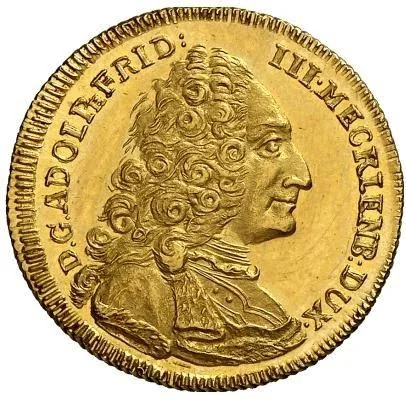
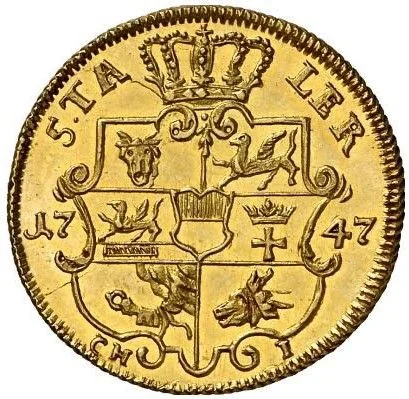
5 Thalers – Duchy of Mecklenburg-Strelitz
Germany
Context
Year: 1747
Country: Germany 
Issuer: Duchy of Mecklenburg-Strelitz
Ruler: Adolphus Frederick III
Currency:
(1701—1872)
Demonetized: Yes
Total mintage: 730
Material
References
KM: #Click to copy to clipboard30
Numista: #314130
Value
Bullion value: $1000.36
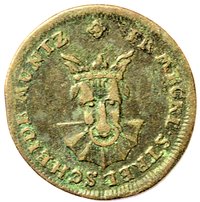
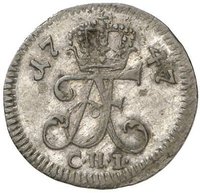
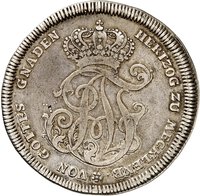
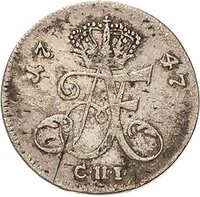
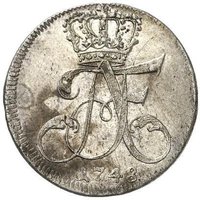
Obverse
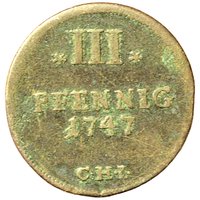
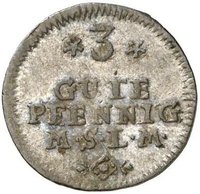
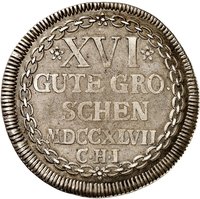
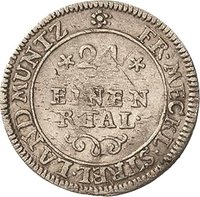
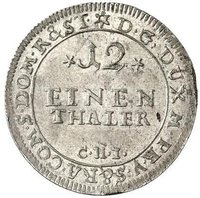
Reverse
Edge
Mints
| Name | Mark |
|---|---|
| Stargard-Szczeciński | — |
Mintings
| Year | Mint Mark | Mintage | Quality | Collection |
|---|---|---|---|---|
| 1747 | — | 730 |
Historical background
In 1747, the currency situation in the Duchy of Mecklenburg-Strelitz was complex and challenging, typical of the fragmented Holy Roman Empire. The duchy did not possess a strong, independent minting tradition and primarily relied on a circulation of diverse foreign coins. The most important of these was the Mecklenburg Thaler, which adhered to the Reichsthaler standard as defined by the Imperial Coinage Ordinance of 1738. However, alongside these larger silver coins, a plethora of smaller regional and foreign coins, such as Schilling and Pfennig denominations from neighboring states, facilitated daily transactions, leading to a chronically confused monetary environment.
This confusion was exacerbated by the duchy's economic position. Mecklenburg-Strelitz was a relatively poor, agrarian territory with limited trade, which made it vulnerable to the inflow of debased and underweight coins from neighboring regions. The constant fluctuation in the value and silver content of these various coins created significant problems for both commerce and state finances. Duke Adolf Friedrich III’s administration faced the persistent issue of trying to maintain a stable medium of exchange while lacking the economic power to enforce a uniform currency or prevent the circulation of inferior money.
Consequently, the year 1747 did not mark a monetary reform but rather represented a point within an ongoing struggle. The ducal government’s efforts were likely focused on defensive ordinances, attempting to regulate exchange rates and prohibit the worst foreign coins, rather than launching a new coinage. The situation underscored the duchy's limited sovereignty in monetary matters, as it remained entangled in the wider Empire's inconsistent coinage system, where the theoretical Reichsthaler standard clashed with the messy reality of countless circulating currencies.
This confusion was exacerbated by the duchy's economic position. Mecklenburg-Strelitz was a relatively poor, agrarian territory with limited trade, which made it vulnerable to the inflow of debased and underweight coins from neighboring regions. The constant fluctuation in the value and silver content of these various coins created significant problems for both commerce and state finances. Duke Adolf Friedrich III’s administration faced the persistent issue of trying to maintain a stable medium of exchange while lacking the economic power to enforce a uniform currency or prevent the circulation of inferior money.
Consequently, the year 1747 did not mark a monetary reform but rather represented a point within an ongoing struggle. The ducal government’s efforts were likely focused on defensive ordinances, attempting to regulate exchange rates and prohibit the worst foreign coins, rather than launching a new coinage. The situation underscored the duchy's limited sovereignty in monetary matters, as it remained entangled in the wider Empire's inconsistent coinage system, where the theoretical Reichsthaler standard clashed with the messy reality of countless circulating currencies.
✨ Legendary