Logo Title
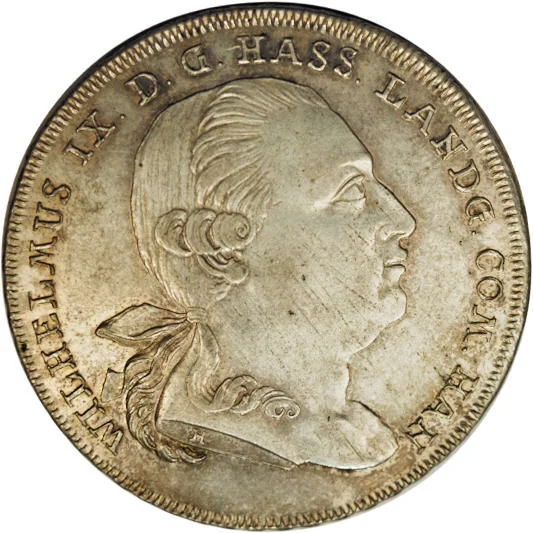
obverse
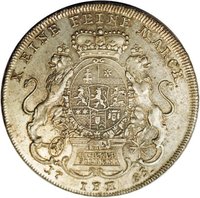
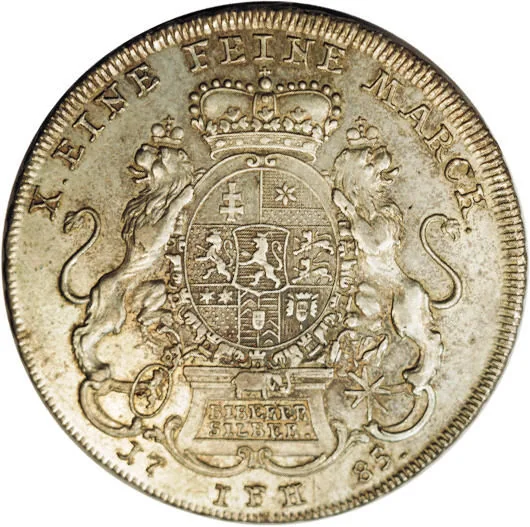
reverse
Heritage Auctions

1 Conventionsthaler – Landgraviate of Hesse-Cassel

Context
Years: 1784–1785
Ruler: William IX
Currency:
Subdivision: 1 Conventionsthaler = ⅒ Cologne Mark
Demonetized: Yes
Material
Diameter: 39 mm
Shape: Round
Composition: Silver
Magnetic: No
Alignment: Medal alignment
Obverse
OBVERSE ↑
flip
Reverse
REVERSE ↑
References
KM: #Click to copy to clipboard528
Numista: #31273

Obverse

Description:
Wilhelm IX bust right, encircled by legend.
Inscription:
WILHELMUS IX. D.G.HASS.LANDG.COM.HAN.
Script: Latin

Reverse

Description:
Crowned coat of arms flanked by lions, encircled by legend.
Inscription:
X.FEINE FEINE MARCK.

BIBERER

SILBER.

17 IFH 85.
Script: Latin

Edge
Mints

NameMark
Hanau

Mintings

YearMint MarkMintageQualityCollection
1784
1785

Historical background

In 1784, the currency situation in the Landgraviate of Hesse-Cassel was complex and fragmented, a common legacy of the Holy Roman Empire's decentralized political structure. The landgraviate did not have a single, unified currency but operated within a multi-layered monetary system. The official unit of account was the Hessian Thaler, but in practice, a plethora of physical coins circulated. These included not only coins minted by Hesse-Cassel itself but also those from neighboring German states, as well as high-value international coins like the Dutch Rijksdaalder and the Austrian Conventionsthaler. This created a constant need for exchange and conversion, complicating trade and daily transactions.

The system was further strained by the landgraviate's unique economic position. Under Landgrave Frederick II (reigned 1760-1785) and his successor William IX, Hesse-Cassel was notably wealthy, largely due to the lucrative practice of renting out Hessian soldiers to foreign powers, most notably Great Britain during the American Revolutionary War. This influx of foreign subsidy payments, often in foreign coin, added to the monetary diversity. However, it also risked inflation and highlighted the lack of a strong, centralized fiduciary currency. The authorities attempted to manage this by issuing periodic Münzedikte (coin decrees) that set exchange rates for the various circulating coins against the accounting Thaler, but these were often reactive and difficult to enforce.

Consequently, by 1784, the currency landscape was one of official regulation struggling to keep pace with practical reality. Money changers and bankers, particularly the growing Jewish banking community in Kassel, played a crucial role in facilitating commerce by navigating this complex web of values. While the state's treasury was full, the everyday monetary experience for citizens and merchants remained cumbersome, setting the stage for future reforms under William IX, who would later become Prince-Elector and significantly streamline the monetary system in the early 19th century.
Legendary