

Obverse
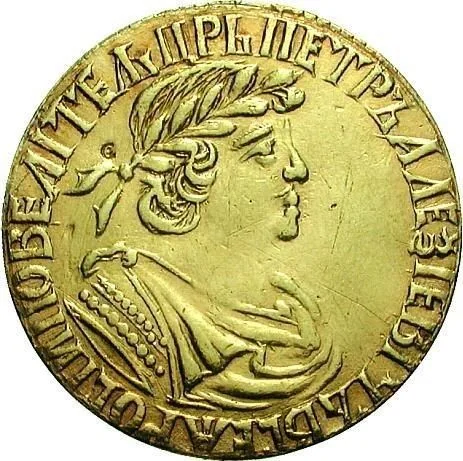
Description:
Laureate head right
Script: Cyrillic
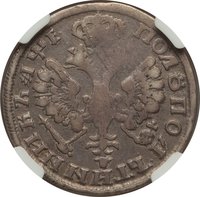
Reverse
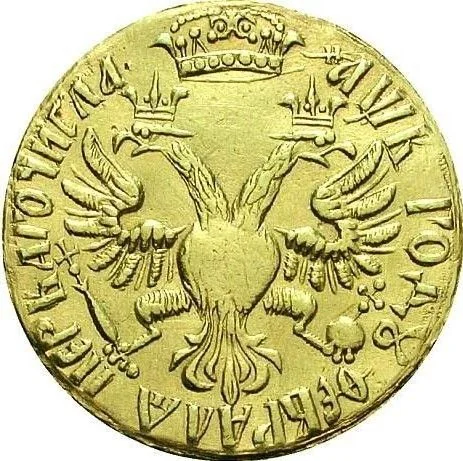
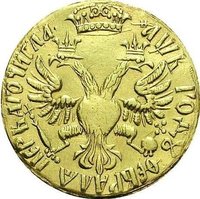
Description:
Crowned double-headed eagle with a crown above.
Script: Cyrillic
Edge
Translation:Russian Rouble by Moscow mint
Mintings
| Year | Mint Mark | Mintage | Quality | Collection |
|---|---|---|---|---|
| 1702 | — | — |
Historical background
In 1702, the Russian Empire’s currency system was in a state of profound strain, directly shaped by the immense fiscal demands of the Great Northern War (1700–1721). Tsar Peter I’s ambitious military reforms and the ongoing conflict against Sweden required vast sums of money, far exceeding the state’s traditional revenue streams. The government’s primary response was to debase the silver kopeck, the backbone of the monetary system, by repeatedly reducing its silver content. This practice, which had accelerated since the war's start, increased the nominal number of coins in circulation to pay armies and suppliers but triggered severe inflation, eroding public trust and causing economic hardship.
The currency in circulation was predominantly small-denomination silver dengas and kopecks, often irregularly shaped and clipped from wire (wire money or pripoynaya moneta). There were no large silver roubles or gold coins for everyday use; the rouble existed only as a unit of account, equal to 100 kopecks. The chronic shortage of precious metals, exacerbated by the war’s disruption of trade, forced the mints to stretch available silver supplies thinner. Furthermore, the state maintained a monopoly on mintage, with several mints, including the main one in Moscow’s Red Square, operating at full capacity to produce the debased coins.
This inflationary monetary policy was a deliberate, if desperate, instrument of war finance, effectively a hidden tax on the population. It caused market instability, complicated trade, and placed a heavy burden on the peasantry and soldiers paid in devalued coin. The situation in 1702 thus represented a critical point on a path of fiscal expediency that would eventually compel Peter the Great to pursue more systematic reforms, culminating in the major monetary overhaul of the 1710s that introduced machine-struck copper and silver coins of regulated weight.
The currency in circulation was predominantly small-denomination silver dengas and kopecks, often irregularly shaped and clipped from wire (wire money or pripoynaya moneta). There were no large silver roubles or gold coins for everyday use; the rouble existed only as a unit of account, equal to 100 kopecks. The chronic shortage of precious metals, exacerbated by the war’s disruption of trade, forced the mints to stretch available silver supplies thinner. Furthermore, the state maintained a monopoly on mintage, with several mints, including the main one in Moscow’s Red Square, operating at full capacity to produce the debased coins.
This inflationary monetary policy was a deliberate, if desperate, instrument of war finance, effectively a hidden tax on the population. It caused market instability, complicated trade, and placed a heavy burden on the peasantry and soldiers paid in devalued coin. The situation in 1702 thus represented a critical point on a path of fiscal expediency that would eventually compel Peter the Great to pursue more systematic reforms, culminating in the major monetary overhaul of the 1710s that introduced machine-struck copper and silver coins of regulated weight.
✨ Legendary