

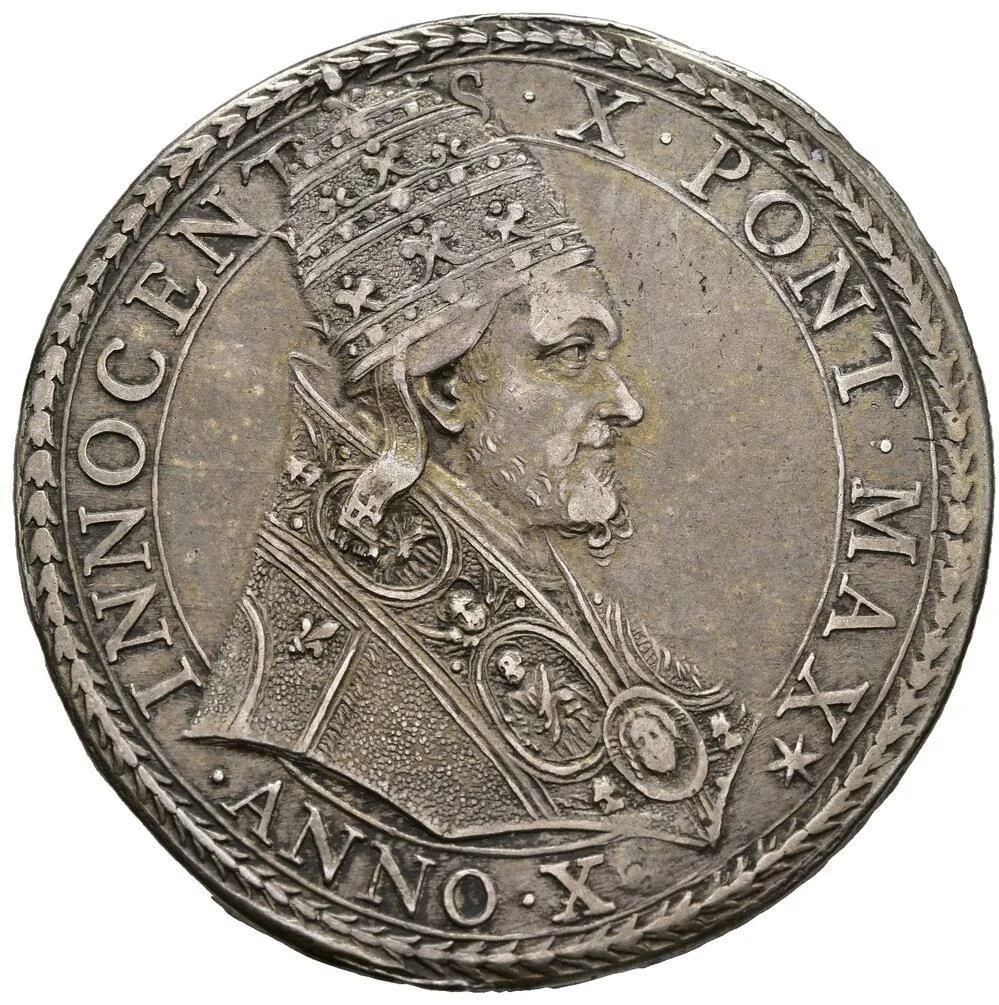
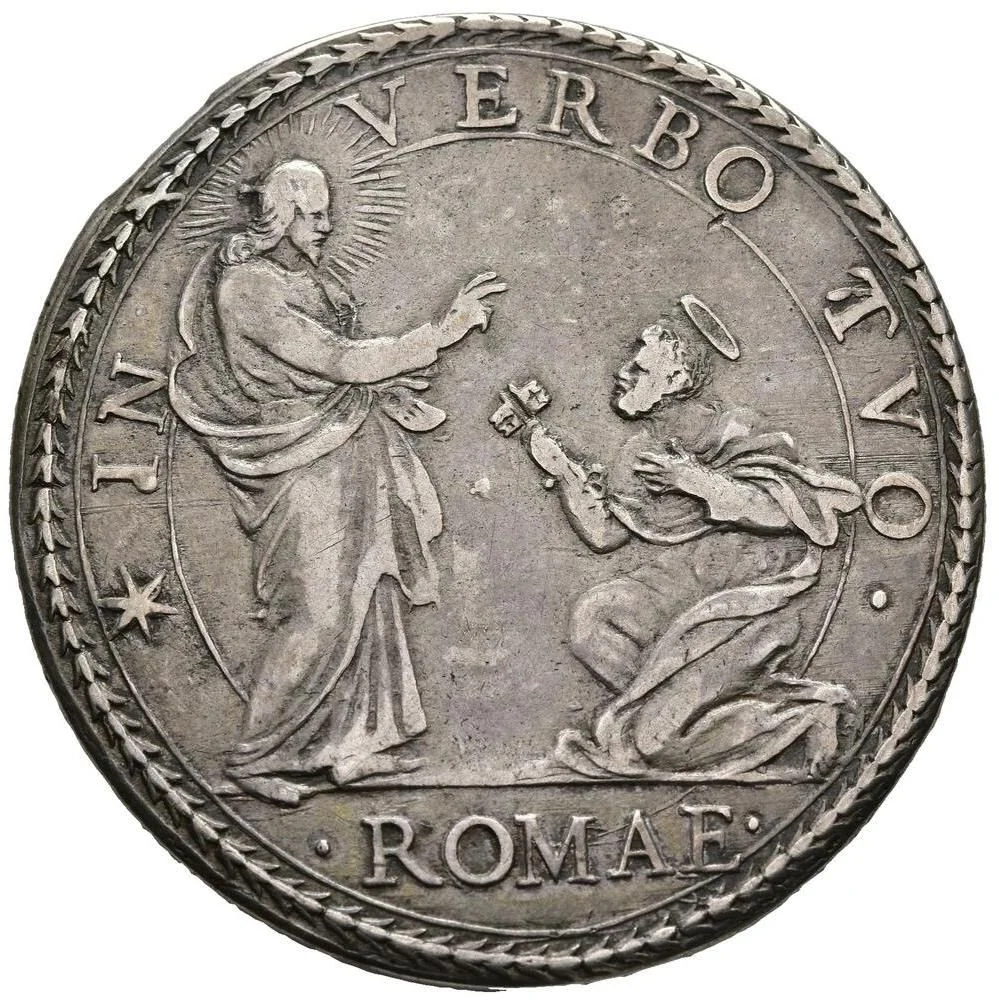
1 Piastra – Papal States
Vatican City
Context
Years: 1653–1654
Country: Vatican City 
Issuer: Papal States
Ruler: Innocent X
Currency:
(1534—1835)
Demonetized: Yes
Material
Weight: 31.59 g
Silver weight: 31.59 g
Shape: Round
Composition: Silver
Standard: Silver ounce
Magnetic: No
References
KM: #Click to copy to clipboard279
Numista: #311531
Value
Bullion value: $91.07
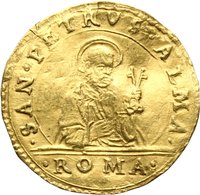
Obverse
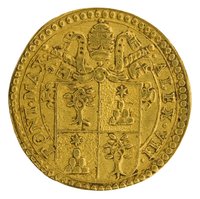
Reverse
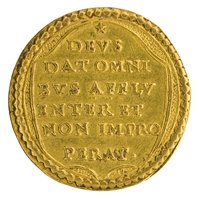
Edge
Mints
| Name | Mark |
|---|---|
| Rome | — |
Mintings
| Year | Mint Mark | Mintage | Quality | Collection |
|---|---|---|---|---|
| 1653 | — | — | ||
| 1654 | — | — |
Historical background
In 1653, the Papal States, under Pope Innocent X, were grappling with a severe and chronic monetary crisis typical of mid-17th century Italy. The fundamental problem was the widespread debasement of the coinage. The state's mint, the Zecca, frequently issued silver giulii and copper baiocchi with reduced precious metal content to generate immediate revenue for the papal treasury, which was strained by administrative costs, artistic patronage, and military expenditures. This practice led to a classic manifestation of Gresham's Law, where "bad money drives out good." Older, purer coins were hoarded or exported, leaving the economy flooded with unstable, inferior currency, causing price inflation and eroding public trust in the monetary system.
The situation was exacerbated by a fragmented and inefficient monetary system within the Papal States themselves. While Rome set the standard, various provincial cities like Bologna and Ferrara often minted their own subsidiary coins, leading to complexity and inconsistent values across territories. Furthermore, the widespread circulation of foreign coins, particularly Spanish silver reales and gold scudi from other Italian states, complicated commerce, as merchants had to constantly negotiate exchange rates. This monetary chaos disrupted trade, created uncertainty for artisans and farmers, and made tax collection problematic, as the real value of payments in debased coinage was difficult to assess.
Pope Innocent X's administration was aware of the crisis and attempted reforms. In the early 1650s, efforts were made to recall debased coins and issue new ones with stricter metallic standards. However, these measures were often temporary and insufficient, as the underlying fiscal pressures that necessitated debasement remained. The monetary instability of 1653 was therefore not an isolated event but a persistent feature of papal finance, reflecting the broader challenge of maintaining a stable economy in a period of rising costs and limited, land-based revenues, ultimately undermining the economic foundation of the temporal power of the papacy.
The situation was exacerbated by a fragmented and inefficient monetary system within the Papal States themselves. While Rome set the standard, various provincial cities like Bologna and Ferrara often minted their own subsidiary coins, leading to complexity and inconsistent values across territories. Furthermore, the widespread circulation of foreign coins, particularly Spanish silver reales and gold scudi from other Italian states, complicated commerce, as merchants had to constantly negotiate exchange rates. This monetary chaos disrupted trade, created uncertainty for artisans and farmers, and made tax collection problematic, as the real value of payments in debased coinage was difficult to assess.
Pope Innocent X's administration was aware of the crisis and attempted reforms. In the early 1650s, efforts were made to recall debased coins and issue new ones with stricter metallic standards. However, these measures were often temporary and insufficient, as the underlying fiscal pressures that necessitated debasement remained. The monetary instability of 1653 was therefore not an isolated event but a persistent feature of papal finance, reflecting the broader challenge of maintaining a stable economy in a period of rising costs and limited, land-based revenues, ultimately undermining the economic foundation of the temporal power of the papacy.
✨ Legendary