

2 Escudos – Spain
Spain

Material
Diameter: 25 mm
Weight: 6.8 g
Gold weight: 6.24 g
Thickness: 0.7 mm
Shape: Round
Composition: 91.7% Gold
Magnetic: No
Technique: Roller milled
References
KM: #Click to copy to clipboard137
Numista: #111206
Value
Bullion value: $1041.57
Obverse
Description:
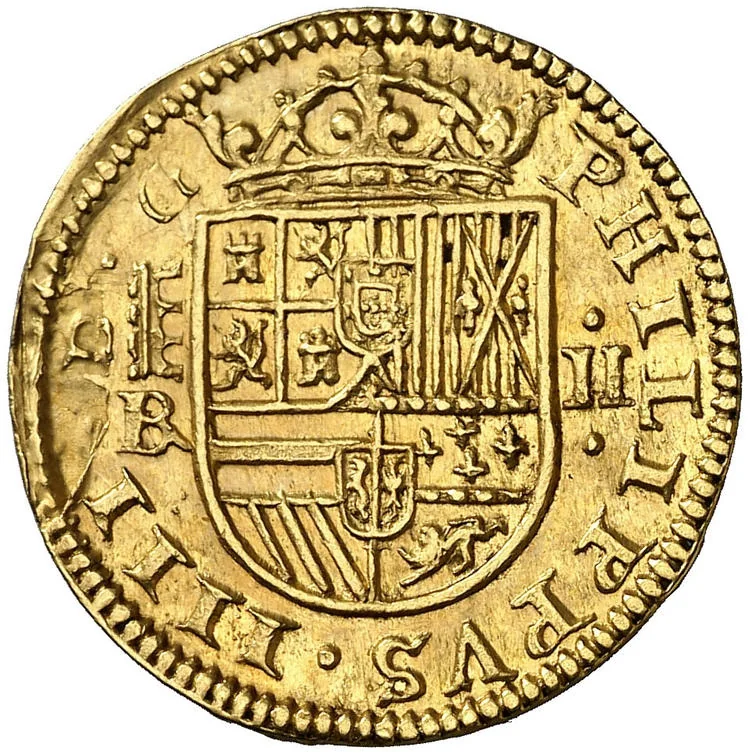
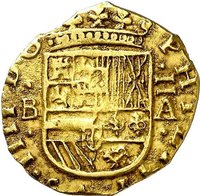
Crowned arms, no inner circle.
Inscription:
PHILIPPVS · IIII · D · G
BR II
BR II
Script: Latin
Reverse
Edge
Mints
| Name | Mark |
|---|---|
| Royal Mint of Segovia | — |
Mintings
| Year | Mint Mark | Mintage | Quality | Collection |
|---|---|---|---|---|
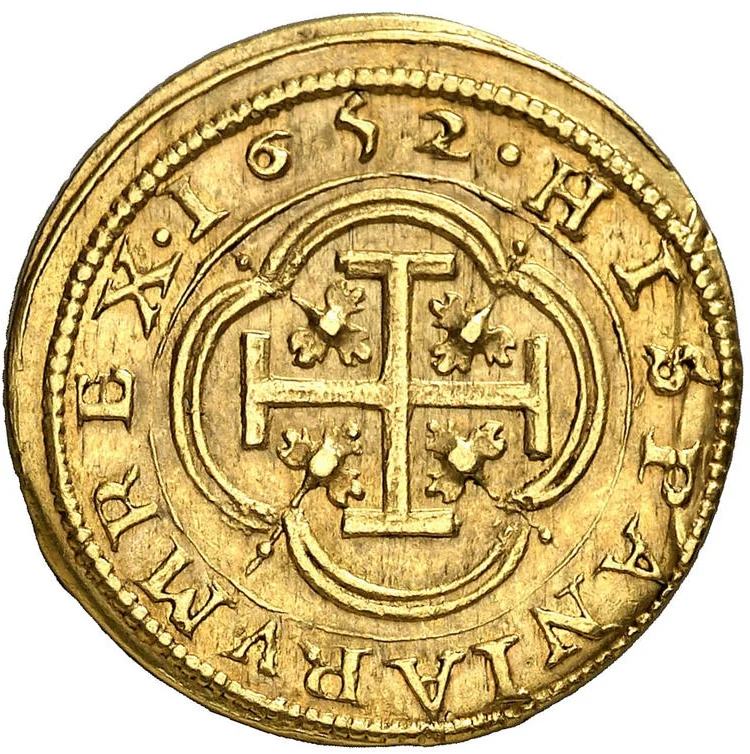
| 1652 | BR | — |
Historical background
In 1652, Spain's currency situation was one of profound crisis and debasement, a direct consequence of decades of relentless warfare and economic strain. The Habsburg monarchy was embroiled in multiple conflicts, including the ongoing Thirty Years' War and the Franco-Spanish War, which drained the royal treasury. To finance these wars, the crown had repeatedly resorted to devaluing the principal silver coin, the real of eight (or piece of eight), by reducing its silver content and issuing vast quantities of vellón—a cheap copper coinage. This created a disastrous two-tiered system where good silver coin was hoarded or exported, while the economy flooded with nearly worthless copper.
The immediate trigger for the 1652 crisis was the failed monetary reform of 1642, which attempted to fix the value of copper vellón at an artificially high rate. The result was rampant inflation, price chaos, and a collapse in public trust. By 1652, the copper currency had lost most of its purchasing power, causing severe hardship for ordinary people whose wages were paid in vellón while prices for essential goods soared. This monetary breakdown contributed directly to major social unrest, most notably the revolt in Barcelona that year, where economic grievance was a key factor alongside political tensions.
Faced with this untenable situation, the government of Philip IV, advised by reformers like Luis de Haro, was forced to act. In 1652, it began the process of finally withdrawing and demonetizing the copper vellón, a policy that would be fully implemented in the coming years. This drastic measure aimed to restore confidence by returning to a silver-based standard, but it came at a short-term cost of severe deflation and credit contraction. Thus, 1652 stands as a pivotal year of reckoning, marking the painful end of a failed experiment with fiduciary currency and a desperate attempt to stabilize the Spanish monetary system amidst imperial decline.
The immediate trigger for the 1652 crisis was the failed monetary reform of 1642, which attempted to fix the value of copper vellón at an artificially high rate. The result was rampant inflation, price chaos, and a collapse in public trust. By 1652, the copper currency had lost most of its purchasing power, causing severe hardship for ordinary people whose wages were paid in vellón while prices for essential goods soared. This monetary breakdown contributed directly to major social unrest, most notably the revolt in Barcelona that year, where economic grievance was a key factor alongside political tensions.
Faced with this untenable situation, the government of Philip IV, advised by reformers like Luis de Haro, was forced to act. In 1652, it began the process of finally withdrawing and demonetizing the copper vellón, a policy that would be fully implemented in the coming years. This drastic measure aimed to restore confidence by returning to a silver-based standard, but it came at a short-term cost of severe deflation and credit contraction. Thus, 1652 stands as a pivotal year of reckoning, marking the painful end of a failed experiment with fiduciary currency and a desperate attempt to stabilize the Spanish monetary system amidst imperial decline.
✨ Legendary