

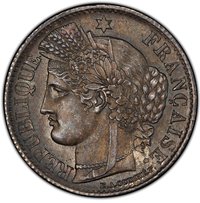
Obverse
Description:
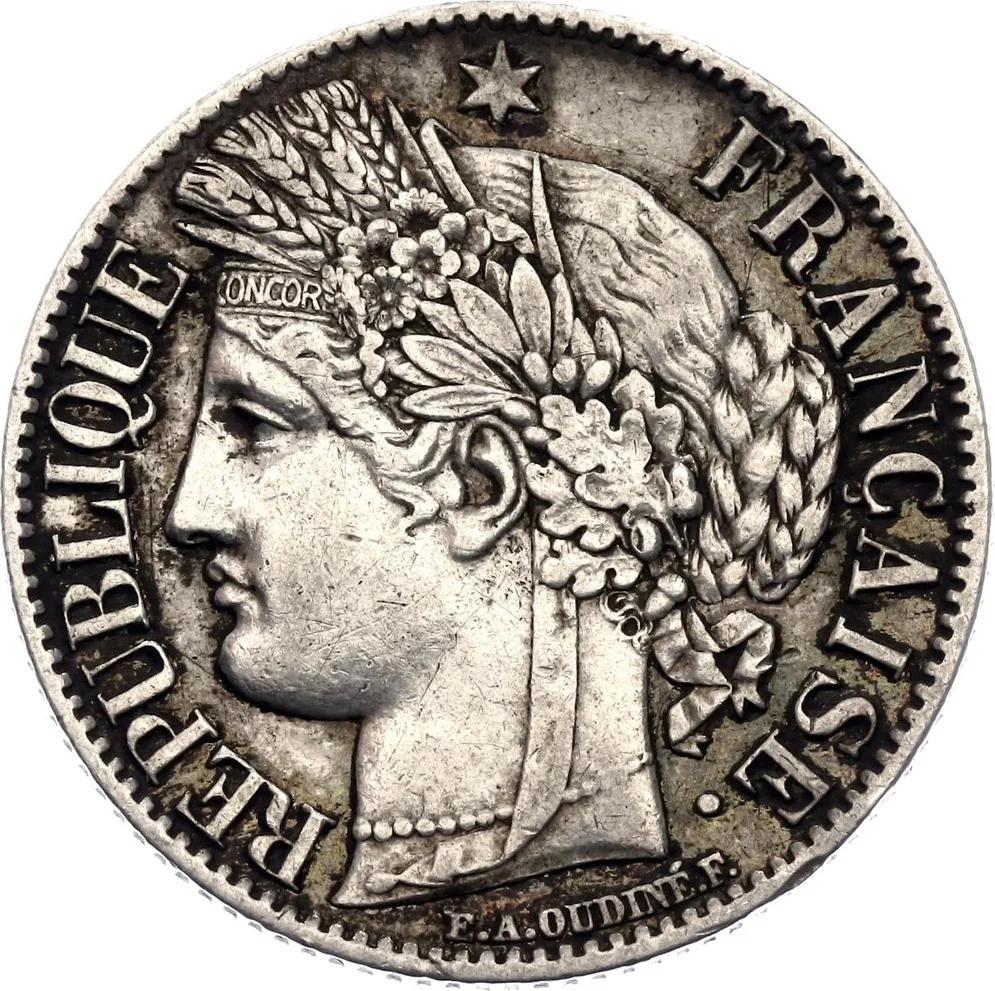
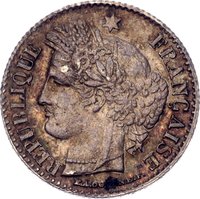
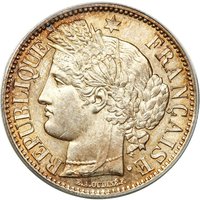
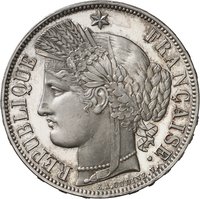
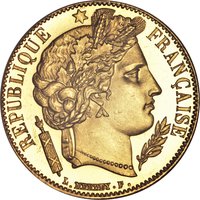
Portrait of Marianne facing left, encircled by text.
Inscription:
REPUBLIQUE * FRANÇAISE.
E.A. OUDINÉ F.
E.A. OUDINÉ F.
Translation:
FRENCH REPUBLIC.
E.A. OUDINÉ F.
E.A. OUDINÉ F.
Script: Latin
Language: French
Engraver: Eugène-André Oudiné
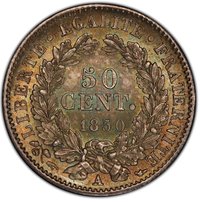
Reverse
Description:
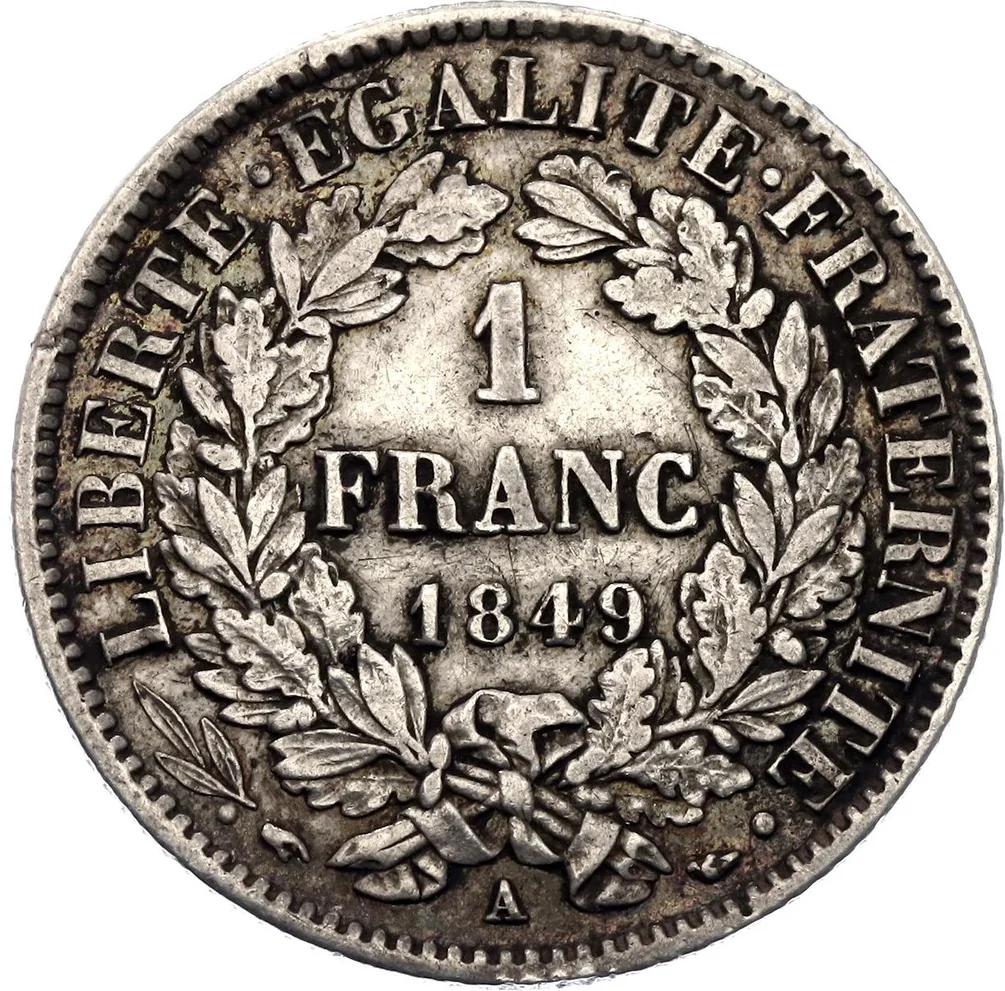
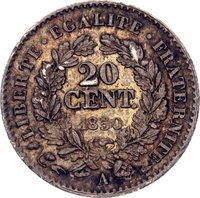
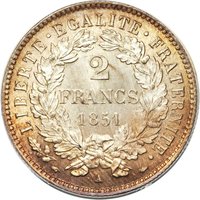
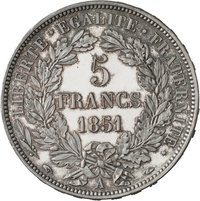
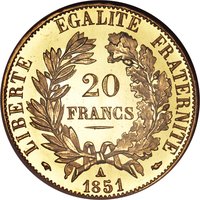
Denomination and year within a laurel, encircled by text.
Inscription:
LIBERTE·EGALITE·FRATERNITE·
1
FRANC
1850
A
1
FRANC
1850
A
Translation:
LIBERTY EQUALITY FRATERNITY
1 FRANC 1850 A
1 FRANC 1850 A
Script: Latin
Language: French
Engraver: Eugène-André Oudiné
Edge
Milled
Mints
| Name | Mark |
|---|---|
| Monnaie de Paris | A |
| Strasbourg | BB |
| Bordeaux | K |
Mintings
Historical background
In 1849, France found itself in a complex monetary transition, caught between the legacy of bimetallism and the practical dominance of silver. The official system, established by the Germinal Franc law of 1803, was bimetallic, defining the franc in terms of both gold and silver at a fixed ratio (1 gold Napoleon = 15.5 silver francs). However, global gold discoveries in the 1840s, particularly in California and Australia, began to destabilize this fixed ratio internationally, making silver relatively more valuable in France than abroad. This led to the gradual outflow of silver coins (écus and 5-franc pieces) for melting or export, causing a domestic shortage of full-bodied specie and leaving the economy reliant on an unstable mix of fractional small change, banknotes, and increasingly scarce silver.
The political context was equally turbulent, as 1849 was the year following the Revolution of 1848 that toppled the July Monarchy. The new Second Republic, facing financial crisis and a run on banks, had been forced to make banknotes from the Bank of France and its provincial branches legal tender and to suspend their convertibility into specie. While this emergency measure prevented a total collapse, it created a climate of monetary uncertainty. By 1849, convertibility had been restored, but the state's fiscal struggles and the legacy of "forced currency" (cours forcé) had shaken public confidence in paper money, increasing the demand for reliable metallic coinage precisely when it was disappearing from circulation.
Consequently, the everyday currency situation for most French citizens was one of inconvenience and frustration. The scarcity of official silver coinage led to the widespread use and even counterfeiting of subsidiary coins, foreign coins (like Spanish dollars), and private tokens issued by merchants and municipalities. The government attempted to address the shortage by increasing the minting of fractional silver coins, but this was a stopgap. The fundamental instability of the bimetallic system would ultimately push France, along with other European nations, toward the gold standard in the coming decades, a shift that began with the practical demonetization of silver in the 1850s and was formalized in the Latin Monetary Union of 1865.
The political context was equally turbulent, as 1849 was the year following the Revolution of 1848 that toppled the July Monarchy. The new Second Republic, facing financial crisis and a run on banks, had been forced to make banknotes from the Bank of France and its provincial branches legal tender and to suspend their convertibility into specie. While this emergency measure prevented a total collapse, it created a climate of monetary uncertainty. By 1849, convertibility had been restored, but the state's fiscal struggles and the legacy of "forced currency" (cours forcé) had shaken public confidence in paper money, increasing the demand for reliable metallic coinage precisely when it was disappearing from circulation.
Consequently, the everyday currency situation for most French citizens was one of inconvenience and frustration. The scarcity of official silver coinage led to the widespread use and even counterfeiting of subsidiary coins, foreign coins (like Spanish dollars), and private tokens issued by merchants and municipalities. The government attempted to address the shortage by increasing the minting of fractional silver coins, but this was a stopgap. The fundamental instability of the bimetallic system would ultimately push France, along with other European nations, toward the gold standard in the coming decades, a shift that began with the practical demonetization of silver in the 1850s and was formalized in the Latin Monetary Union of 1865.
Series: 1849 France circulation coins
🌱 Fairly Common