


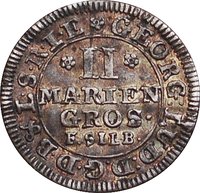
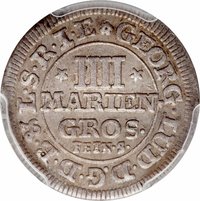
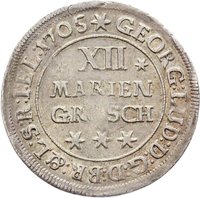
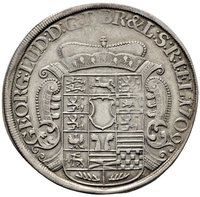
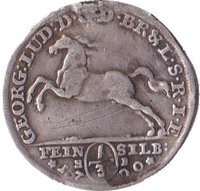
Obverse
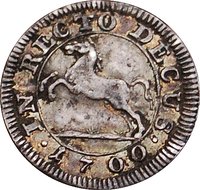
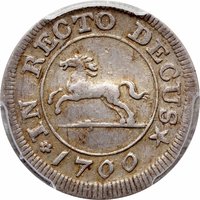
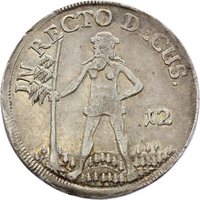
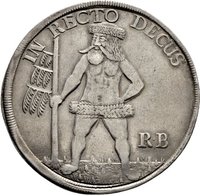
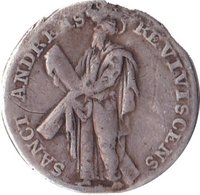
Reverse
Description:
Blank.
Edge
Mints
| Name | Mark |
|---|---|
| Zellerfeld | — |
Mintings
| Year | Mint Mark | Mintage | Quality | Collection |
|---|---|---|---|---|
| 1700 | — | — | ||
| 1704 | — | — | ||
| 1705 | — | — | ||
| 1706 | — | — | ||
| 1707 | — | — | ||
| 1708 | — | — | ||
| 1710 | — | — | ||
| 1712 | — | — | ||
| 1713 | — | — | ||
| 1715 | — | — |
Historical background
In the year 1700, the currency situation in the Duchy of Brunswick-Lüneburg, specifically the Principality of Calenberg (soon to be known as Hanover), was complex and fragmented, reflecting the broader monetary disarray of the Holy Roman Empire. The territory did not have a uniform, sovereign coinage system. Instead, it operated within the framework of the Reichstaler, a theoretical imperial standard, but in practice, a multitude of different coins circulated. These included coins minted by various Brunswick-Lüneburg branch lines, as well as a flood of foreign currency from neighboring states and trade partners, particularly the Dutch Rijksdaalder and Ducats, which were crucial for international commerce. The value and silver content of these coins varied widely, leading to constant calculation difficulties and exchange disputes.
This monetary plurality was actively managed through official Kuranttabelle (exchange rate tables), which were periodically published by the authorities to fix the relative values of the many circulating coins against the accounting unit, the Reichstaler in Conventionsmünze. However, the system was under strain. A key issue was the chronic shortage of high-value, full-weight silver coins (Kurantmünzen) for state and trade finance, which tended to be hoarded or exported. This was exacerbated by the practice of minting lower-quality, debased Landmünzen (small change) for local daily transactions, creating a two-tier monetary circuit that was prone to manipulation and loss of public trust.
The situation was further complicated by the impending political future of the dynasty. In 1701, the Elector of Hanover was poised to become King George I of Great Britain. This dynastic elevation would profoundly shift the principality's economic focus and integrate it into a larger financial world. While the immediate year 1700 still exhibited a characteristic early modern patchwork of currencies, the coming union with Britain would gradually pull Hanover towards more stable monetary policies, influenced by London's growing financial power, though the full resolution of its internal currency fragmentation would remain a challenge for much of the 18th century.
This monetary plurality was actively managed through official Kuranttabelle (exchange rate tables), which were periodically published by the authorities to fix the relative values of the many circulating coins against the accounting unit, the Reichstaler in Conventionsmünze. However, the system was under strain. A key issue was the chronic shortage of high-value, full-weight silver coins (Kurantmünzen) for state and trade finance, which tended to be hoarded or exported. This was exacerbated by the practice of minting lower-quality, debased Landmünzen (small change) for local daily transactions, creating a two-tier monetary circuit that was prone to manipulation and loss of public trust.
The situation was further complicated by the impending political future of the dynasty. In 1701, the Elector of Hanover was poised to become King George I of Great Britain. This dynastic elevation would profoundly shift the principality's economic focus and integrate it into a larger financial world. While the immediate year 1700 still exhibited a characteristic early modern patchwork of currencies, the coming union with Britain would gradually pull Hanover towards more stable monetary policies, influenced by London's growing financial power, though the full resolution of its internal currency fragmentation would remain a challenge for much of the 18th century.

✨ Legendary