Logo Title
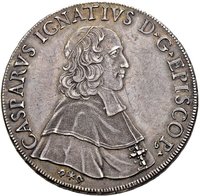
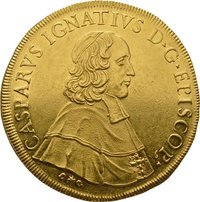
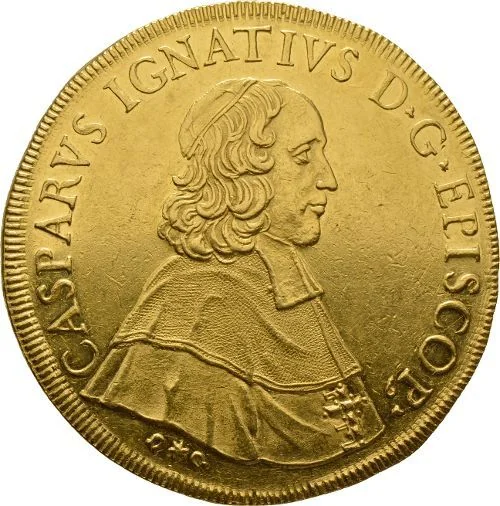
obverse
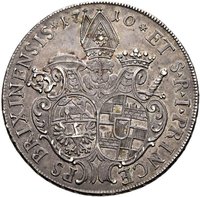
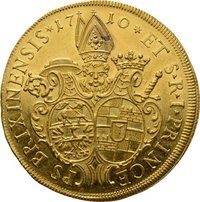
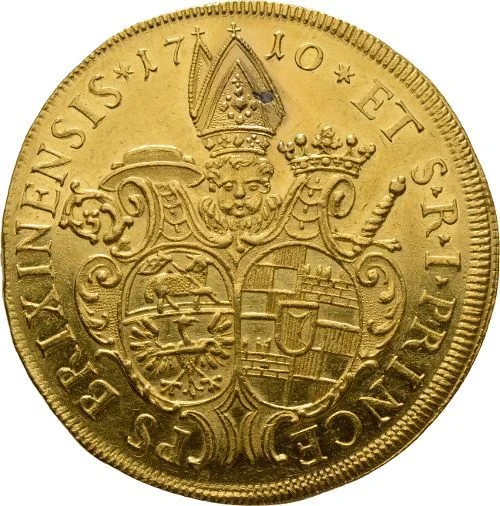
reverse
Staatliche Münzsammlung München CC BY-NC-SA 4.0 DE
Context
Year: 1710
Country: Austria Country flag
Currency:
Demonetized: Yes
Material
Diameter: 41.7 mm
Weight: 35 g
Gold weight: 34.51 g
Shape: Round
Composition: 98.6% Gold
Magnetic: No
Technique: Milled
References
KM: #Click to copy to clipboard24
Numista: #306935
Value
Bullion value: $5753.98

Obverse

Description:
Bust right, legend within pearls.
Inscription:
CASPARVS IGNATIVS D G EPISCOP
Script: Latin

Reverse

Description:
Diocesan and episcopal arms under a cardinal’s hat and a crown, above a cherub’s head with a miter, crossed sword and crozier behind. Legend on a pearl-bordered outer ring.
Inscription:
ET S R I PRINCE - PS BRIXINENSIS 1710
Script: Latin

Edge


Mints

NameMark
Augsburg

Mintings

YearMint MarkMintageQualityCollection
1710

Historical background

In the early 18th century, the Bishopric of Brixen, a small ecclesiastical principality within the Holy Roman Empire (located in modern-day South Tyrol, Italy), faced a complex and challenging currency situation typical of the German lands. The region operated within a fragmented monetary system where the official currency, the Brixen Gulden, competed with a plethora of circulating coins from neighboring states like Tyrol, Austria, and various Italian territories. This proliferation of foreign coinage, often of varying silver content and value, led to chronic instability, confusion in trade, and frequent disputes over exchange rates.

The core problem was a severe shortage of high-quality, full-weight coinage, a consequence of the bishopric's limited minting capacity and the broader European phenomenon of currency debasement. Princes often reduced the precious metal content in their coins to generate short-term revenue, leading to "bad money" driving out the "good." In Brixen, this meant that heavier, purer coins were hoarded or melted down, while lighter, debased coins flooded the market, eroding public trust and causing inflation in local transactions. The bishopric's economy, heavily reliant on agriculture, transit trade, and pilgrimage, suffered from this unreliable medium of exchange.

By 1710, these pressures likely compelled Prince-Bishop Kaspar Ignaz von Künigl to confront the issue, though detailed records of specific reforms for that exact year are sparse. The general response of such territories was to periodically issue minting ordinances (Münzmandate) to reassert the official exchange rates, forbid the circulation of certain foreign coins, and attempt to recall and remint debased currency. However, these measures were often temporary, as the bishopric's limited economic power made it difficult to resist the tidal wave of regional currency flows, leaving its monetary system fragile and dependent on the policies of larger neighboring powers.

Series: 1710 Bishopric of Brixen circulation coins

1 Thaler obverse
1 Thaler reverse
1 Thaler
1710
10 Ducats obverse
10 Ducats reverse
10 Ducats
1710
20 Ducats obverse
20 Ducats reverse
20 Ducats
1710
Legendary