

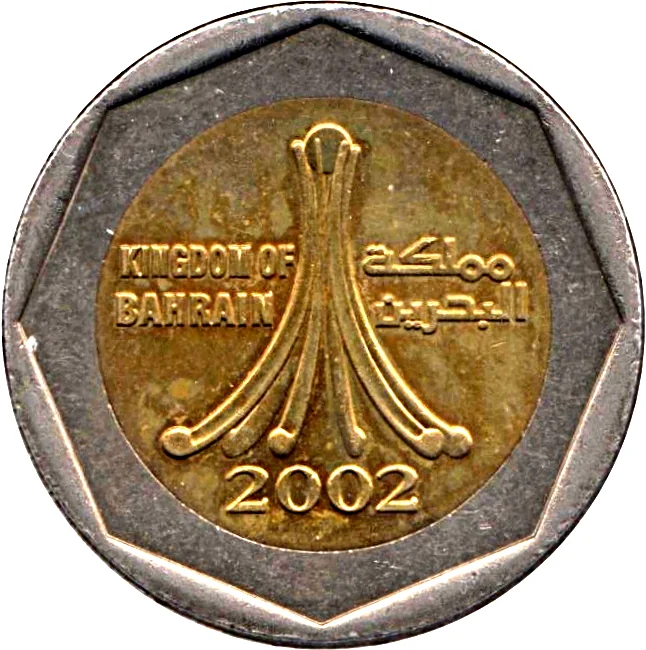
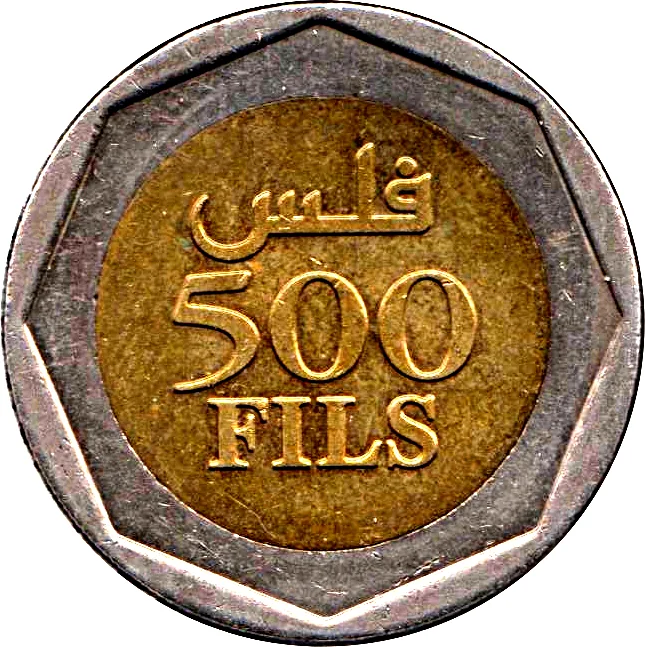
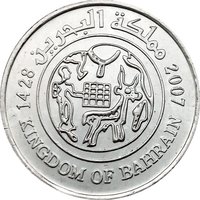
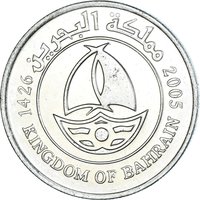
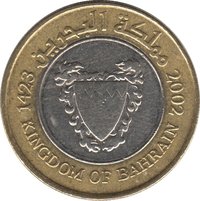
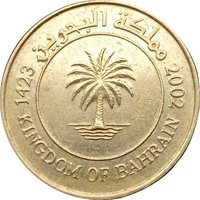
Obverse
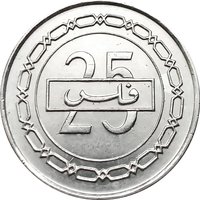
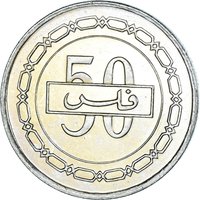
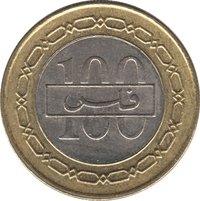
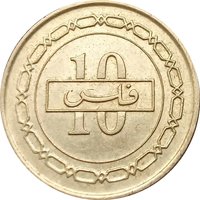
Reverse
Edge
Reeded
Mints
| Name | Mark |
|---|---|
| Royal Mint | — |
Mintings
| Year | Mint Mark | Mintage | Quality | Collection |
|---|---|---|---|---|
| 2002 | — | — |
Historical background
In 2002, Bahrain's currency situation was defined by its long-standing and stable peg to the US Dollar, a policy formally established in 1980. The Bahraini Dinar (BHD) was fixed at a rate of 1 USD = 0.376 BHD, a parity that provided crucial monetary stability and predictability for the kingdom's open, hydrocarbon-dependent economy. This peg was managed by the Bahrain Monetary Agency (BMA), the precursor to the Central Bank of Bahrain, which held substantial foreign reserves to defend the fixed exchange rate and maintain full convertibility.
This monetary framework was a cornerstone of Bahrain's economic strategy, particularly as it positioned itself as a leading financial services hub in the Gulf region. The dollar peg helped control inflation, facilitate international trade and investment, and anchor confidence in the domestic banking sector. However, it also meant that Bahrain imported the monetary policy of the United States Federal Reserve, relinquishing independent control over its interest rates. This was generally manageable, though it presented challenges when US policy cycles did not align with Bahrain's domestic economic conditions.
The context of 2002 was particularly significant as it followed the introduction of the Gulf Cooperation Council (GCC) single currency project, which aimed for economic and monetary union by 2010. Bahrain was an active participant in these discussions, which envisioned a new, common currency pegged to the dollar. Therefore, in 2002, Bahrain's currency policy was in a state of dual commitment: firmly maintaining its proven national dollar peg while simultaneously working with its GCC neighbors on the technical and legal preparations for a future shared monetary system.
This monetary framework was a cornerstone of Bahrain's economic strategy, particularly as it positioned itself as a leading financial services hub in the Gulf region. The dollar peg helped control inflation, facilitate international trade and investment, and anchor confidence in the domestic banking sector. However, it also meant that Bahrain imported the monetary policy of the United States Federal Reserve, relinquishing independent control over its interest rates. This was generally manageable, though it presented challenges when US policy cycles did not align with Bahrain's domestic economic conditions.
The context of 2002 was particularly significant as it followed the introduction of the Gulf Cooperation Council (GCC) single currency project, which aimed for economic and monetary union by 2010. Bahrain was an active participant in these discussions, which envisioned a new, common currency pegged to the dollar. Therefore, in 2002, Bahrain's currency policy was in a state of dual commitment: firmly maintaining its proven national dollar peg while simultaneously working with its GCC neighbors on the technical and legal preparations for a future shared monetary system.
Series: 2002 Bahrain circulation coins
🌱 Common