

5 cents – United States
Add to wishlist
United States
Context
Years: 1796–1797
Issuer: United States
Period:
(since 1776)
Currency:
(since 1785)
Total mintage: 10,230
Material
References
KM: #
Numista: #30319
Value
Exchange value: 0.05 USD = $0.05
Bullion value: $3.08
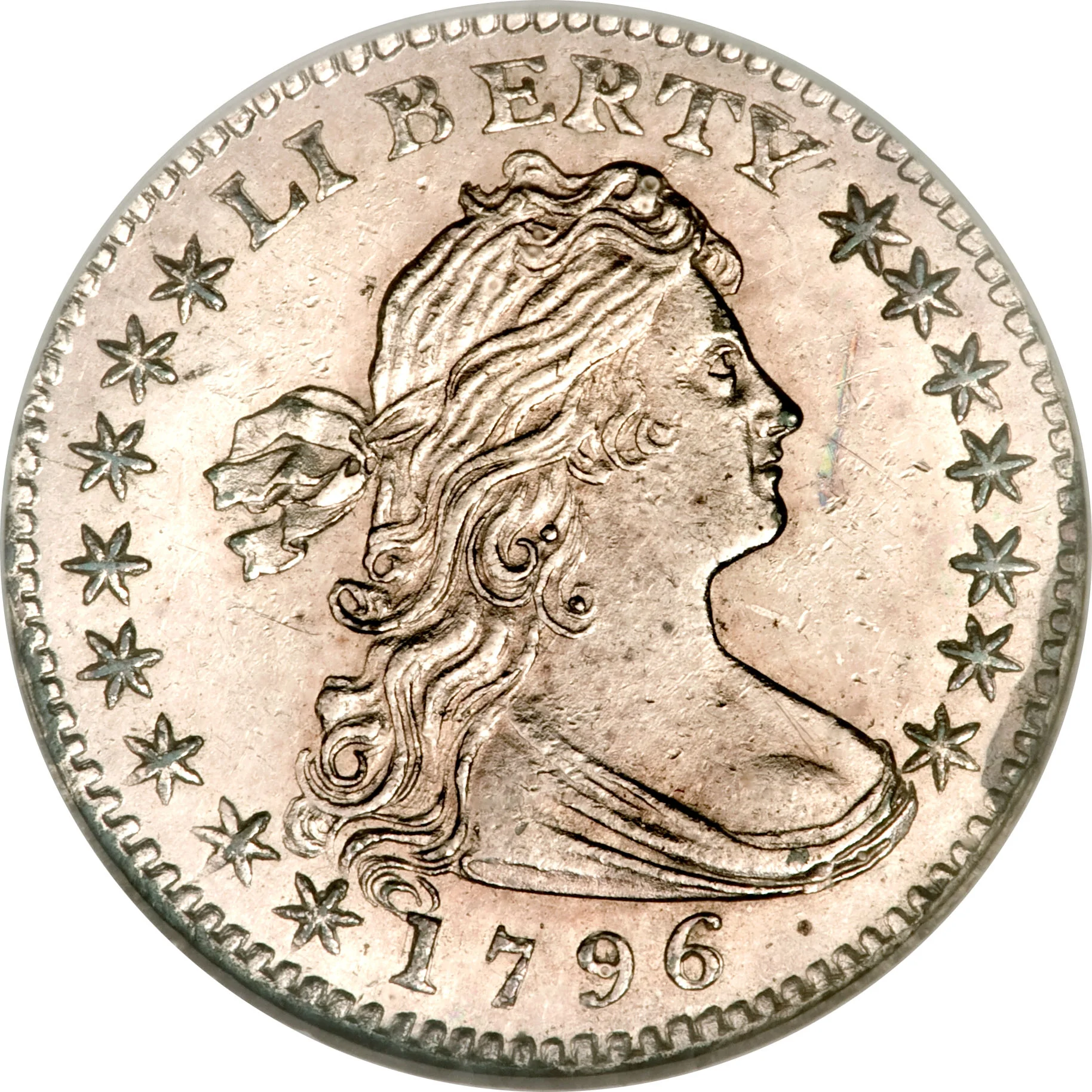
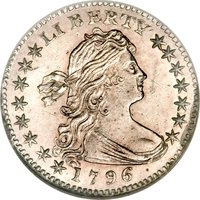
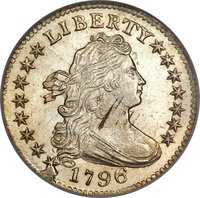
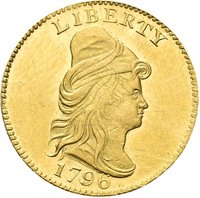
Obverse
Description:
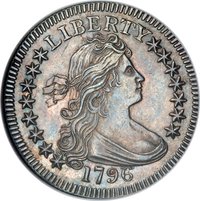
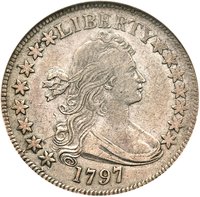
Draped bust right between stars.
Inscription:
LIBERTY
1796
1796
Script: Latin
Engraver: Robert Scot
Designer: Gilbert Stuart
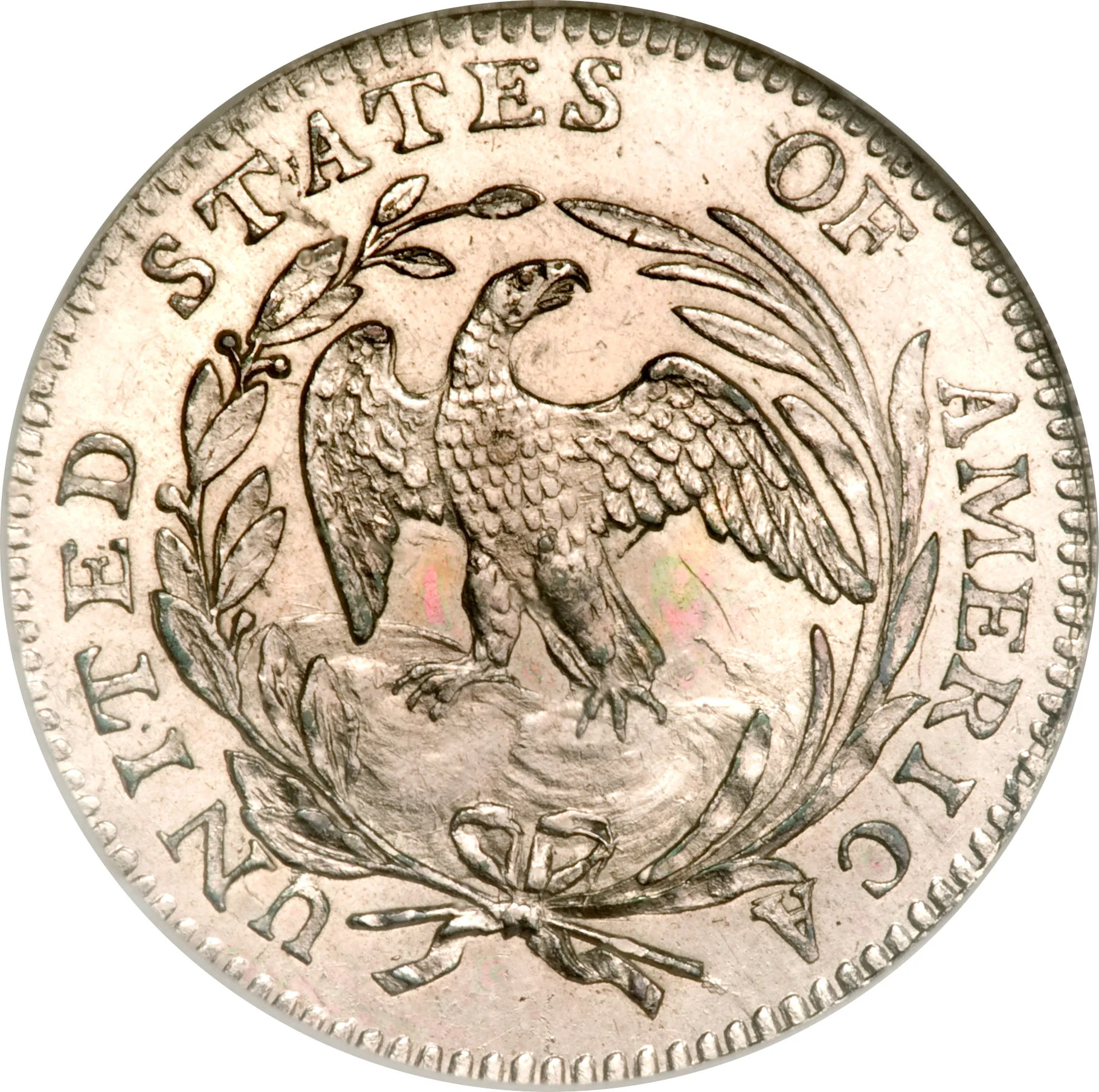
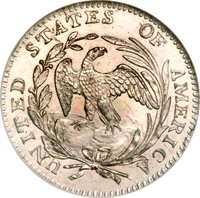
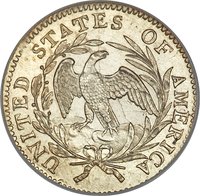
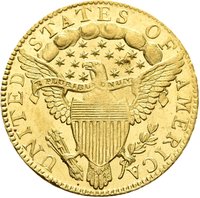
Reverse
Description:
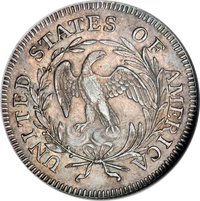
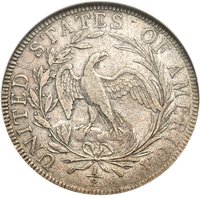
Eagle encircled by a wreath.
Inscription:
UNITED STATES OF AMERICA
Script: Latin
Engraver: Robert Scot
Designer: Gilbert Stuart
Edge
Reeded
Mints
| Name | Mark |
|---|---|
| United States Mint of Philadelphia | — |
Mintings
| Year | Mint Mark | Mintage | Quality | Collection |
|---|---|---|---|---|
| 1796 | — | 10,230 | ||
| 1797 | — | — |
Historical background
In 1796, the United States operated under a complex and often chaotic monetary system inherited from the colonial and Confederation periods. The foundational Coinage Act of 1792 had established a bimetallic standard, defining the U.S. dollar in both silver and gold, and created the Philadelphia Mint. However, the nation's currency in daily use was a confusing mixture of foreign coins (primarily Spanish milled dollars and fractional "bits"), banknotes from a handful of state-chartered banks, and a still-tiny trickle of official federal coinage. The scarcity of U.S.-minted coins was a critical problem; the Mint struggled with technical limitations and a lack of bullion, meaning that the familiar foreign coins, especially Spanish pieces of eight, remained the most common circulating medium.
This period was one of intense political and economic tension regarding money, centered on the role of the First Bank of the United States (BUS). Chartered in 1791, the BUS, headquartered in Philadelphia with branches in major ports, issued its own banknotes which served as a relatively reliable national paper currency. However, it was deeply controversial. Secretary of the Treasury Alexander Hamilton and the Federalists saw it as essential for stabilizing public credit and providing a uniform currency. In contrast, Thomas Jefferson, James Madison, and the emerging Democratic-Republican faction viewed the BUS as an unconstitutional concentration of power that favored commercial elites over agrarian interests, setting the stage for the political battles that would define the early republic's financial landscape.
Consequently, the average American in 1796 faced a practical currency environment fraught with uncertainty. The value of a banknote or a foreign coin depended heavily on public trust in the issuing bank or the coin's weight and metal content, leading to widespread counterfeiting and discounting. While the federal government was attempting to impose order through the Mint and the BUS, the system remained fragmented and localized. This instability underscored the young nation's struggle to assert its financial sovereignty and create a uniform medium of exchange to fuel its growing economy, a challenge that would persist for decades.
This period was one of intense political and economic tension regarding money, centered on the role of the First Bank of the United States (BUS). Chartered in 1791, the BUS, headquartered in Philadelphia with branches in major ports, issued its own banknotes which served as a relatively reliable national paper currency. However, it was deeply controversial. Secretary of the Treasury Alexander Hamilton and the Federalists saw it as essential for stabilizing public credit and providing a uniform currency. In contrast, Thomas Jefferson, James Madison, and the emerging Democratic-Republican faction viewed the BUS as an unconstitutional concentration of power that favored commercial elites over agrarian interests, setting the stage for the political battles that would define the early republic's financial landscape.
Consequently, the average American in 1796 faced a practical currency environment fraught with uncertainty. The value of a banknote or a foreign coin depended heavily on public trust in the issuing bank or the coin's weight and metal content, leading to widespread counterfeiting and discounting. While the federal government was attempting to impose order through the Mint and the BUS, the system remained fragmented and localized. This instability underscored the young nation's struggle to assert its financial sovereignty and create a uniform medium of exchange to fuel its growing economy, a challenge that would persist for decades.
💎 Extremely Rare