

1 Quattrino – Ferrara
Italy
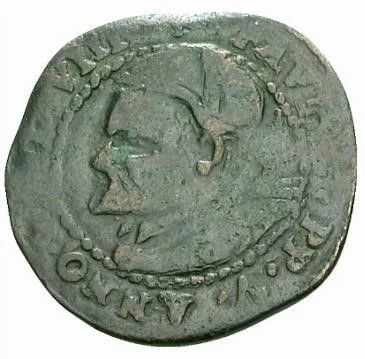
Obverse
Description:
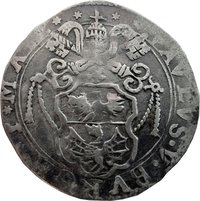
Pope Paul V left, capped bust.
Inscription:
✠ PAVLVS • PP • V • ANNO • PONT • VIII
Script: Latin
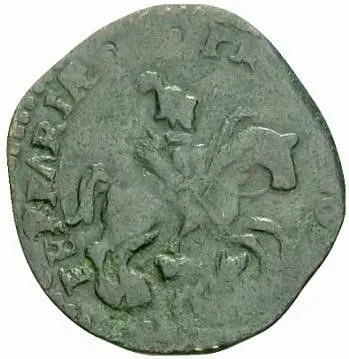
Reverse
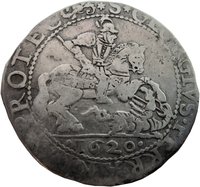
Description:
Saint George slaying dragon on horseback.
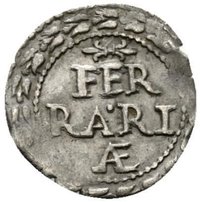
Inscription:
+ PROTECTOR • FERRARIAE
Script: Latin
Edge
Mints
| Name | Mark |
|---|---|
| Ferrara | — |
Mintings
| Year | Mint Mark | Mintage | Quality | Collection |
|---|---|---|---|---|
| 1613 | — | — |
Historical background
In 1613, the currency situation in the Duchy of Ferrara was one of profound instability and transition, directly tied to its recent political annexation. Just two years prior, in 1611, the Este dynasty had failed to produce a legitimate male heir, leading Pope Paul V to formally incorporate Ferrara into the Papal States. This political shift dismantled the independent minting authority of the Este dukes, placing monetary policy under the control of papal administrators. Consequently, the local Ferrarese currency system, which had historically included coins like the lira ferrarese, began a forced integration into the broader and often chaotic monetary landscape of the Papal States.
The circulation in the city was a chaotic jumble of coins from various Italian and European states, a common problem of the era exacerbated by Ferrara's loss of sovereignty. Alongside the fading local issues, coins such as Papal scudi, Venetian ducats, Florentine florins, and Spanish reales all competed in daily commerce. This multiplicity created significant challenges for merchants and citizens, who had to constantly assess the weight, purity, and exchange rates of different coins, leading to frequent disputes and commercial friction. The value of money was not fixed but fluctuated based on metallic content and the perceived authority of the issuing state.
Economically, this monetary confusion occurred against a backdrop of relative decline. Ferrara, once a brilliant Renaissance court, was suffering from the economic drain of papal rule and the siphoning of resources to Rome. The instability of currency directly hampered trade and agriculture, the region's lifeblood, by creating unpredictable costs and unreliable standards of value. Therefore, in 1613, Ferrara's currency situation was not merely a technical financial issue but a daily symbol of its lost autonomy and a practical obstacle to its economic vitality, caught between its illustrious past and an uncertain future under papal administration.
The circulation in the city was a chaotic jumble of coins from various Italian and European states, a common problem of the era exacerbated by Ferrara's loss of sovereignty. Alongside the fading local issues, coins such as Papal scudi, Venetian ducats, Florentine florins, and Spanish reales all competed in daily commerce. This multiplicity created significant challenges for merchants and citizens, who had to constantly assess the weight, purity, and exchange rates of different coins, leading to frequent disputes and commercial friction. The value of money was not fixed but fluctuated based on metallic content and the perceived authority of the issuing state.
Economically, this monetary confusion occurred against a backdrop of relative decline. Ferrara, once a brilliant Renaissance court, was suffering from the economic drain of papal rule and the siphoning of resources to Rome. The instability of currency directly hampered trade and agriculture, the region's lifeblood, by creating unpredictable costs and unreliable standards of value. Therefore, in 1613, Ferrara's currency situation was not merely a technical financial issue but a daily symbol of its lost autonomy and a practical obstacle to its economic vitality, caught between its illustrious past and an uncertain future under papal administration.
💎 Extremely Rare