

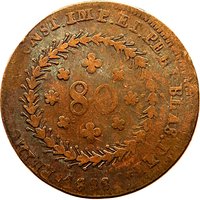
Obverse
Description:
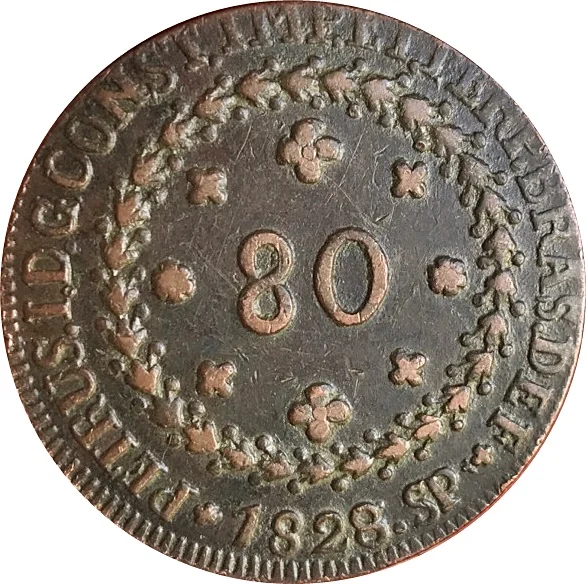
Floral Wreath Value
Inscription:
PETRUS.I.D.G.CONST.IMP.ET.PERP.BRAS.DEF
80
1828 SP
80
1828 SP
Script: Latin
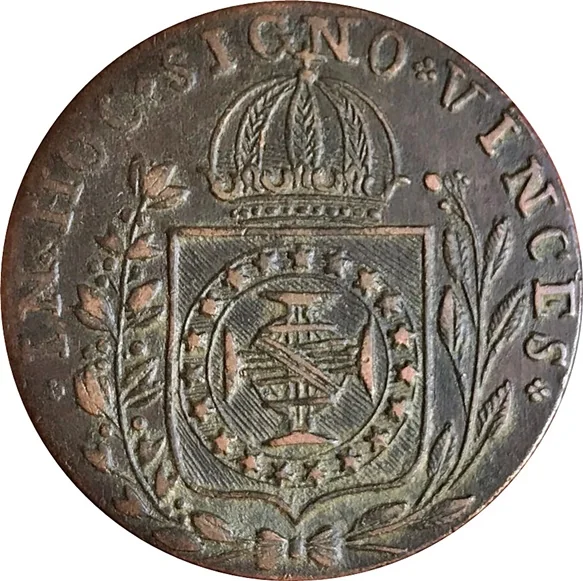
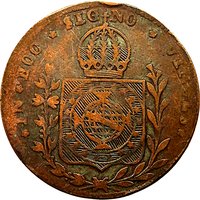
Reverse
Edge
Mints
| Name | Mark |
|---|---|
| São Paulo | SP |
Historical background
In 1825, Brazil’s currency situation was characterized by profound instability and complexity, a direct legacy of its colonial past and the turbulent process of independence (declared in 1822). The monetary system was a chaotic mix of various metallic coins, including Portuguese réis, Spanish-American pesos, and other foreign currencies, all circulating simultaneously. Most critically, the country suffered from a severe shortage of official coinage, leading to widespread use of makeshift solutions like privately issued tokens and heavily clipped or debased coins, which eroded public trust in everyday transactions.
This monetary disorder was exacerbated by the financial strains of the early Imperial period. The costly War of Independence against Portugal had depleted the treasury, and the even more expensive Cisplatine War (1825–1828) against the United Provinces of the Río de la Plata (which would create Uruguay) was just beginning, placing enormous pressure on state finances. To meet these expenses, the government of Emperor Pedro I increasingly relied on inflationary measures, including the issuance of paper money and copper currency with a face value far exceeding its intrinsic metal worth. This led to a sharp divergence between the official value of money and its real market value, causing inflation and economic uncertainty.
Consequently, 1825 represents a point of mounting crisis within a longer period of monetary confusion that would last for decades. There was no unified, trusted national currency, and the government's fiscal policies were primarily reactive, aimed at funding military conflicts rather than establishing monetary stability. The situation underscored the challenges of building a sovereign financial system for the new empire, setting the stage for future reforms and continued struggles with inflation and currency devaluation throughout the 19th century.
This monetary disorder was exacerbated by the financial strains of the early Imperial period. The costly War of Independence against Portugal had depleted the treasury, and the even more expensive Cisplatine War (1825–1828) against the United Provinces of the Río de la Plata (which would create Uruguay) was just beginning, placing enormous pressure on state finances. To meet these expenses, the government of Emperor Pedro I increasingly relied on inflationary measures, including the issuance of paper money and copper currency with a face value far exceeding its intrinsic metal worth. This led to a sharp divergence between the official value of money and its real market value, causing inflation and economic uncertainty.
Consequently, 1825 represents a point of mounting crisis within a longer period of monetary confusion that would last for decades. There was no unified, trusted national currency, and the government's fiscal policies were primarily reactive, aimed at funding military conflicts rather than establishing monetary stability. The situation underscored the challenges of building a sovereign financial system for the new empire, setting the stage for future reforms and continued struggles with inflation and currency devaluation throughout the 19th century.
💎 Very Rare