

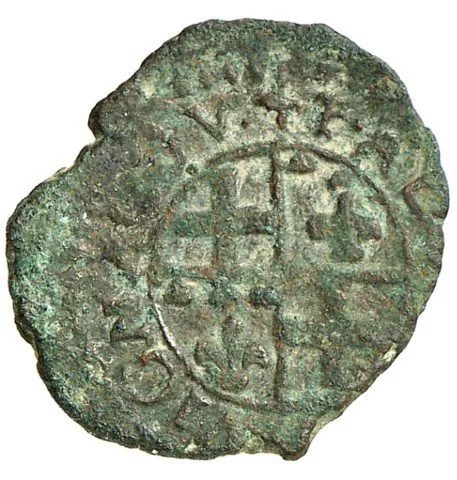
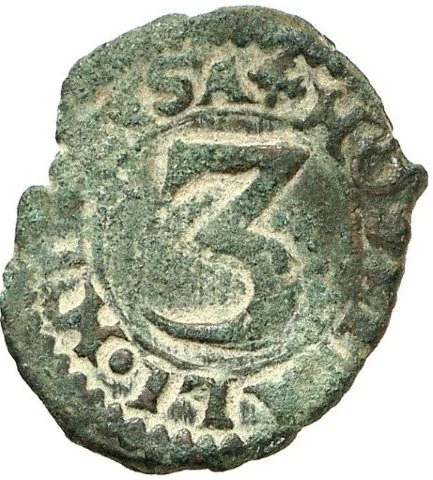
3 Piccioli – Malta
Malta
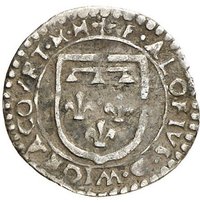
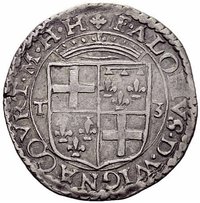
Obverse
Description:
Alof de Wignacourt's circular armor.
Inscription:
☩ F • ALOFIVS • D • WIGNACOV •
Script: Latin
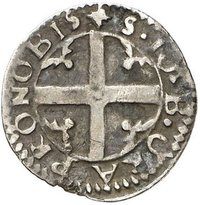
Reverse
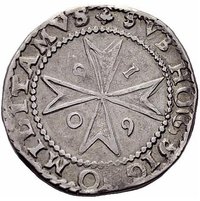
Edge
Mintings
| Year | Mint Mark | Mintage | Quality | Collection |
|---|---|---|---|---|
| — | — | — |
Historical background
In 1602, Malta was a crucial outpost of the Spanish Empire under the Knights Hospitaller (Order of St. John). The island's economy was a complex mosaic of currencies, reflecting its dual role as a monastic military state and a bustling Mediterranean entrepôt. The official unit of account was the scudo, a silver coin, but the reality of daily commerce was dominated by a chaotic mix of physical money. This included Spanish pieces of eight (reales), Ottoman and North African gold coins, Venetian ducats and lire, and a plethora of debased copper and billon coins from Sicily and Italy. This monetary pluralism was typical of Mediterranean trade hubs but created significant challenges for pricing, taxation, and accounting.
The Knights struggled to assert monetary sovereignty. Their own mint, established in 1566, produced primarily copper grani and tari for small-scale local transactions, but these were often insufficient in quantity and prone to counterfeiting. The chronic shortage of reliable small change hampered the local market, while large-scale trade and the Order's own substantial international expenses relied on foreign gold and silver. Furthermore, the widespread circulation of clipped, worn, and counterfeit coins of varying intrinsic values led to constant disputes, with merchants and money-changers assigning different values to the same nominal coin.
This unstable environment prompted the Order to seek reform. In the very year of 1602, Grandmaster Alof de Wignacourt petitioned King Philip III of Spain for permission to issue new, higher-quality silver coins to stabilize the currency. This request underscored the Knights' dependency on Spanish approval and highlighted the central monetary problem: the need to establish a uniform, trustworthy coinage that could simplify commerce, boost the local economy, and enhance the Order's fiscal authority, all while navigating the complex political and economic currents of the early 17th-century Mediterranean.
The Knights struggled to assert monetary sovereignty. Their own mint, established in 1566, produced primarily copper grani and tari for small-scale local transactions, but these were often insufficient in quantity and prone to counterfeiting. The chronic shortage of reliable small change hampered the local market, while large-scale trade and the Order's own substantial international expenses relied on foreign gold and silver. Furthermore, the widespread circulation of clipped, worn, and counterfeit coins of varying intrinsic values led to constant disputes, with merchants and money-changers assigning different values to the same nominal coin.
This unstable environment prompted the Order to seek reform. In the very year of 1602, Grandmaster Alof de Wignacourt petitioned King Philip III of Spain for permission to issue new, higher-quality silver coins to stabilize the currency. This request underscored the Knights' dependency on Spanish approval and highlighted the central monetary problem: the need to establish a uniform, trustworthy coinage that could simplify commerce, boost the local economy, and enhance the Order's fiscal authority, all while navigating the complex political and economic currents of the early 17th-century Mediterranean.
✨ Legendary