

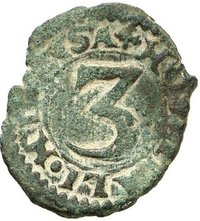
3 Tari – Malta
Malta
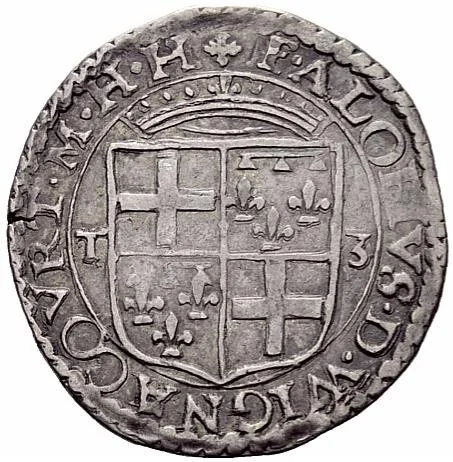
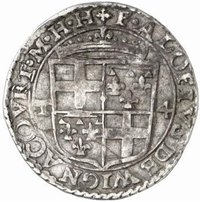
Obverse
Description:
Alof de Wignacourt's coat of arms.
Inscription:
☩ F • ALOFIVS • D • WIGNACOVRT • M • H • H
Script: Latin
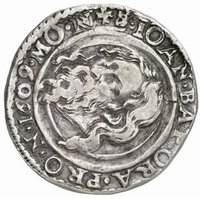
Reverse
Description:
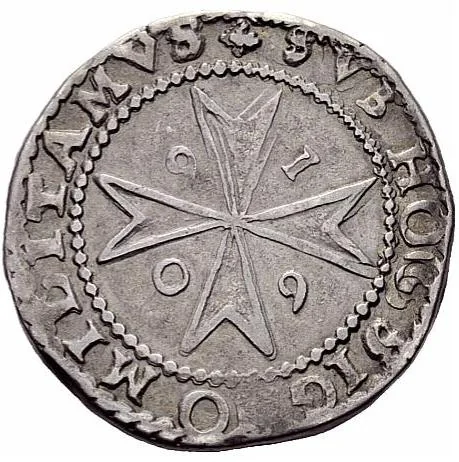
Maltese cross with date in its angles.
Inscription:
☩ SVB HOC SIGNO MILITAMVS
Script: Latin
Edge
Mintings
| Year | Mint Mark | Mintage | Quality | Collection |
|---|---|---|---|---|
| 1609 | — | — | ||
| 1611 | — | — | ||
| 1617 | — | — | ||
| 1620 | — | — | ||
| 1622 | — | — | ||
| 1623 | — | — |
Historical background
In 1609, Malta was a key strategic outpost of the Spanish Empire, governed by the Knights Hospitaller (Order of St. John). The island's currency situation was complex and fragmented, reflecting its role as a bustling Mediterranean crossroads for trade, corsairing, and military activity. The official currency was the scudo, a Spanish silver coin, but in practice, a multitude of foreign coins circulated freely. These included Spanish reales, Italian scudi and ducats, French écus, and Ottoman and Barbary coins, all valued by weight and precious metal content rather than a fixed national exchange rate. This monetary bazaar was essential for commerce and for financing the Knights' galleys and fortifications.
The coexistence of so many currencies led to chronic problems of instability and fraud. Clipping and debasement of coins were common, creating uncertainty in everyday transactions. Furthermore, the Knights' own finances were often strained due to the immense cost of maintaining their fleet and the formidable fortifications of Valletta, leading to periods of debt and liquidity shortages. While the Order minted its own copper grani and tari for small local change, it lacked the silver reserves to issue a dominant, high-value currency that could unify the system.
Consequently, the monetary landscape was one of pragmatic disorder. Major transactions, especially in international trade and military procurement, were conducted in trusted heavyweight silver coins, often Spanish or Italian. The economy effectively functioned on a bimetallic (gold and silver) standard dictated by the international market, with money-changers playing a crucial role in assessing and exchanging the mixed specie. This situation would persist until the 18th century when the Knights began more systematic minting of their own silver scudi, but in 1609, Malta's currency remained as international and turbulent as the sea that surrounded it.
The coexistence of so many currencies led to chronic problems of instability and fraud. Clipping and debasement of coins were common, creating uncertainty in everyday transactions. Furthermore, the Knights' own finances were often strained due to the immense cost of maintaining their fleet and the formidable fortifications of Valletta, leading to periods of debt and liquidity shortages. While the Order minted its own copper grani and tari for small local change, it lacked the silver reserves to issue a dominant, high-value currency that could unify the system.
Consequently, the monetary landscape was one of pragmatic disorder. Major transactions, especially in international trade and military procurement, were conducted in trusted heavyweight silver coins, often Spanish or Italian. The economy effectively functioned on a bimetallic (gold and silver) standard dictated by the international market, with money-changers playing a crucial role in assessing and exchanging the mixed specie. This situation would persist until the 18th century when the Knights began more systematic minting of their own silver scudi, but in 1609, Malta's currency remained as international and turbulent as the sea that surrounded it.
✨ Legendary