

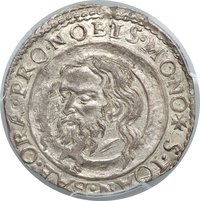
Obverse
Description:
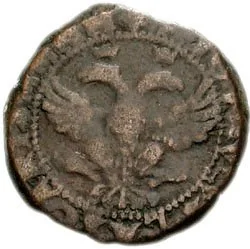
Arms: a crowned double-headed eagle.
Inscription:
☩ F • IO : PAVLVS • LASCARIS • M • M • H • H
Script: Latin
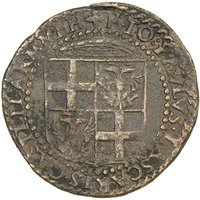
Reverse
Description:
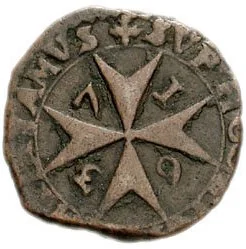
Maltese cross, date between branches.
Inscription:
☩ SVB HOC SIGNO MILITAMVS
Script: Latin
Edge
Mintings
| Year | Mint Mark | Mintage | Quality | Collection |
|---|---|---|---|---|
| 1637 | — | — | ||
| 1638 | — | — |
Historical background
In 1637, Malta, under the rule of the Knights of St. John, was grappling with a severe and complex currency crisis. The islands operated within a fragmented monetary system, where a multitude of foreign coins—primarily Spanish silver reales and their fractional pieces, but also Italian, Ottoman, and French issues—circulated alongside local token coinage. The official unit of account was the scudo, divided into 12 tari or 240 grani, but the actual value of physical coins in relation to this abstract system was highly unstable. This created a chaotic environment for trade and daily transactions, as the intrinsic metal value of a coin often differed significantly from its declared nominal value.
The core of the problem was a chronic shortage of high-quality full-weight coinage. Due to Gresham's Law ("bad money drives out good"), full-weight Spanish silver pieces were often hoarded or exported for international trade, leaving the local economy flooded with underweight, clipped, and worn foreign coins and debased local imitations. The Knights' mint struggled to assert authority, as its own limited issues of copper grani and silver tari were insufficient to anchor the system. Furthermore, the Knights' own financial demands, including the costly fortification of Valletta and maintaining the fleet, often took precedence over monetary reform, exacerbating the drain of good specie.
Consequently, by 1637, the situation was one of practical dysfunction and inflationary pressure. Merchants and the public faced constant uncertainty, requiring money-changers at every major transaction to assess the actual worth of a mixed handful of coins. This monetary confusion hampered commerce, complicated the payment of troops and workers on the extensive fortification projects, and created widespread economic discontent. The crisis would eventually prompt Grand Master Lascaris to initiate a significant, though only partially successful, recoinage in 1638, aiming to recall old money and issue new, standardized coinage to restore public confidence.
The core of the problem was a chronic shortage of high-quality full-weight coinage. Due to Gresham's Law ("bad money drives out good"), full-weight Spanish silver pieces were often hoarded or exported for international trade, leaving the local economy flooded with underweight, clipped, and worn foreign coins and debased local imitations. The Knights' mint struggled to assert authority, as its own limited issues of copper grani and silver tari were insufficient to anchor the system. Furthermore, the Knights' own financial demands, including the costly fortification of Valletta and maintaining the fleet, often took precedence over monetary reform, exacerbating the drain of good specie.
Consequently, by 1637, the situation was one of practical dysfunction and inflationary pressure. Merchants and the public faced constant uncertainty, requiring money-changers at every major transaction to assess the actual worth of a mixed handful of coins. This monetary confusion hampered commerce, complicated the payment of troops and workers on the extensive fortification projects, and created widespread economic discontent. The crisis would eventually prompt Grand Master Lascaris to initiate a significant, though only partially successful, recoinage in 1638, aiming to recall old money and issue new, standardized coinage to restore public confidence.
✨ Legendary