

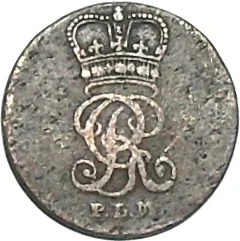
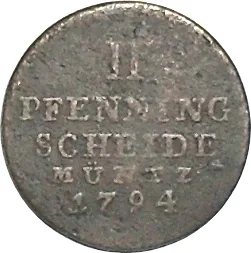
2 pfennigs – Brunswick-Lüneburg-Calenberg-Hannover
Add to wishlist
Germany
Context
Material
References
KM: #
Numista: #29090
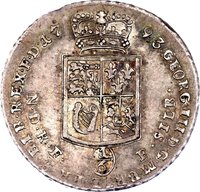
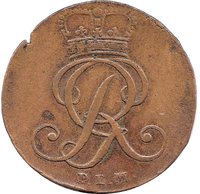
Obverse
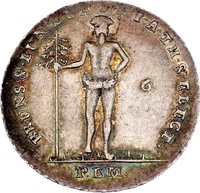
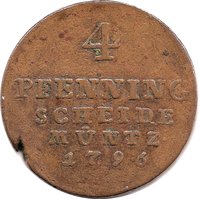
Reverse
Edge
Plain
Mints
| Name | Mark |
|---|---|
| Clausthal | — |
Mintings
| Year | Mint Mark | Mintage | Quality | Collection |
|---|---|---|---|---|
| 1794 | PLM | — | ||
| 1795 | PLM | — | ||
| 1796 | PLM | — | ||
| 1797 | PLM | — | ||
| 1798 | PLM | — | ||
| 1799 | PLM | — | ||
| 1800 | PLM | — | ||
| 1801 | .C. | — | ||
| 1802 | — | — | ||
| 1803 | — | — | ||
| 1804 | — | — | ||
| 1807 | — | — |
Historical background
In 1794, the currency situation in the Duchy of Brunswick-Lüneburg, specifically the Principality of Calenberg (with its capital in Hanover), was characterized by significant complexity and fragmentation. The region operated within the monetary framework of the Holy Roman Empire, which meant its primary accounting unit was the Reichsthaler (Imperial Thaler), divided into 24 Gute Groschen or 288 Pfennige. However, the actual circulating medium was a bewildering array of physical coins, not only from various German states but also from foreign nations, particularly the ubiquitous Spanish Thaler (also known as "Spanish Dollar" or Pistole), which served as a major trade coin. This created a constant need for exchange and conversion, hindering commerce.
This monetary chaos was exacerbated by the practice of individual rulers minting their own debased subsidiary coins to generate seigniorage revenue. While the Reichsthaler provided a theoretical standard, the value of smaller circulating coins like Mariengroschen and Pfennige could vary significantly. Furthermore, the Electorate of Hanover (as it was also known, due to its personal union with Great Britain) was deeply affected by the monetary policies of its larger neighbor, the Kingdom of Prussia, whose Reichsthaler often set a de facto regional standard. The system was inherently unstable, relying on published exchange lists (Kurantzettel) to navigate daily transactions.
The year 1794 fell within a period of growing pressure for reform, as the chaotic system proved inadequate for a modernizing economy and state finance. The looming influence of the French Revolutionary Wars and the economic disruptions they caused would soon intensify these monetary stresses. While a unified, state-controlled currency was still a future aspiration, the situation in 1794 was one of entrenched plurality, inconvenience, and latent economic strain, typical of the Holy Roman Empire's antiquated structures on the eve of its dissolution.
This monetary chaos was exacerbated by the practice of individual rulers minting their own debased subsidiary coins to generate seigniorage revenue. While the Reichsthaler provided a theoretical standard, the value of smaller circulating coins like Mariengroschen and Pfennige could vary significantly. Furthermore, the Electorate of Hanover (as it was also known, due to its personal union with Great Britain) was deeply affected by the monetary policies of its larger neighbor, the Kingdom of Prussia, whose Reichsthaler often set a de facto regional standard. The system was inherently unstable, relying on published exchange lists (Kurantzettel) to navigate daily transactions.
The year 1794 fell within a period of growing pressure for reform, as the chaotic system proved inadequate for a modernizing economy and state finance. The looming influence of the French Revolutionary Wars and the economic disruptions they caused would soon intensify these monetary stresses. While a unified, state-controlled currency was still a future aspiration, the situation in 1794 was one of entrenched plurality, inconvenience, and latent economic strain, typical of the Holy Roman Empire's antiquated structures on the eve of its dissolution.
⭐ Somewhat Rare