

9 Deniers – New France
Canada
Context
Material
References
KM: #Click to copy to clipboard5
Numista: #29089
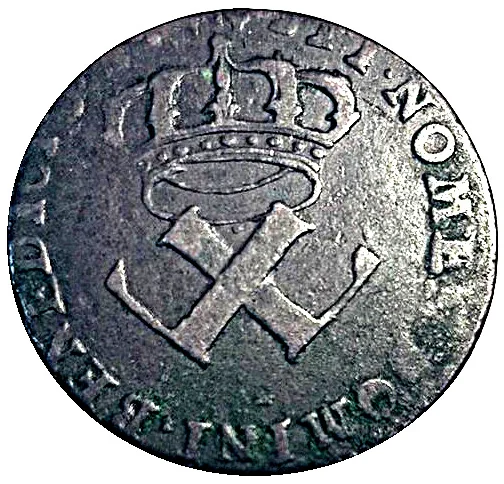
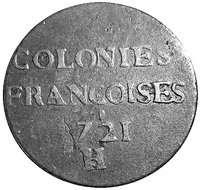
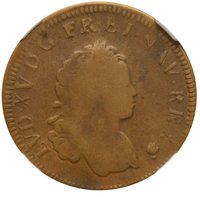
Obverse
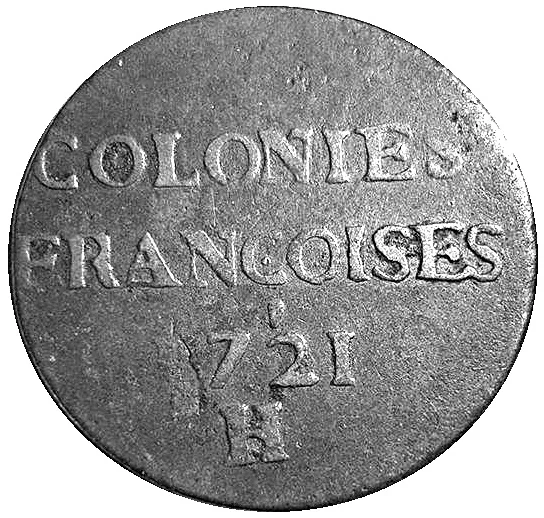
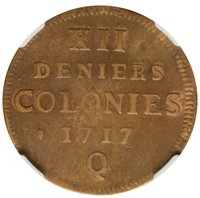
Reverse
Edge
Plain
Mintings
| Year | Mint Mark | Mintage | Quality | Collection |
|---|---|---|---|---|
| 1721 | B | — | ||
| 1721 | H | — | ||
| 1722 | /21H | — | ||
| 1722 | B | — | ||
| 1722 | H | — |
Historical background
In 1721, the currency situation in New France was defined by a severe and chronic shortage of official coinage, leading to a dysfunctional and complex monetary system. The colony operated primarily on a card money system, where handwritten playing cards, signed by the governor and intendant, were issued as promissory notes to pay soldiers and finance government expenses. While intended as temporary IOUs redeemable with shipments of silver coin from the royal treasury in France, these cards had become a permanent, depreciated, and often confusing circulating medium. Their value was unstable, frequently discounted in private transactions, and their over-issuance created persistent inflation.
Compounding this problem was the widespread use of monnoye de carte (card money) alongside a bewildering array of foreign coins, primarily Spanish and Portuguese silver pieces—especially the Spanish silver piastre (piece of eight)—which entered the colony through trade with the French West Indies. The government attempted to fix the value of these foreign coins by official ordinance, but their actual market value fluctuated based on trade demands and scarcity. This created a dual system: a fragile, paper-based domestic currency for local obligations and a more trusted but inconsistent hard currency for larger commerce, particularly the vital fur trade.
The year 1721 fell within a period of attempted reform under the Intendant Michel Bégon. He was actively trying to manage the card money by calling in old issues for burning and reissuing new ones, a process meant to restore confidence and control the money supply. However, these measures were ultimately stopgaps. The fundamental issue remained: New France was a deficit economy, consuming more from France than it exported, leading to a constant drain of specie. The currency crisis of 1721 thus reflected the colony's deeper economic dependence and the French Crown's reluctance to send sufficient hard currency, forcing local authorities to rely on an unstable, paper-based system that hampered economic growth and created constant financial uncertainty.
Compounding this problem was the widespread use of monnoye de carte (card money) alongside a bewildering array of foreign coins, primarily Spanish and Portuguese silver pieces—especially the Spanish silver piastre (piece of eight)—which entered the colony through trade with the French West Indies. The government attempted to fix the value of these foreign coins by official ordinance, but their actual market value fluctuated based on trade demands and scarcity. This created a dual system: a fragile, paper-based domestic currency for local obligations and a more trusted but inconsistent hard currency for larger commerce, particularly the vital fur trade.
The year 1721 fell within a period of attempted reform under the Intendant Michel Bégon. He was actively trying to manage the card money by calling in old issues for burning and reissuing new ones, a process meant to restore confidence and control the money supply. However, these measures were ultimately stopgaps. The fundamental issue remained: New France was a deficit economy, consuming more from France than it exported, leading to a constant drain of specie. The currency crisis of 1721 thus reflected the colony's deeper economic dependence and the French Crown's reluctance to send sufficient hard currency, forcing local authorities to rely on an unstable, paper-based system that hampered economic growth and created constant financial uncertainty.
🌟 Limited