

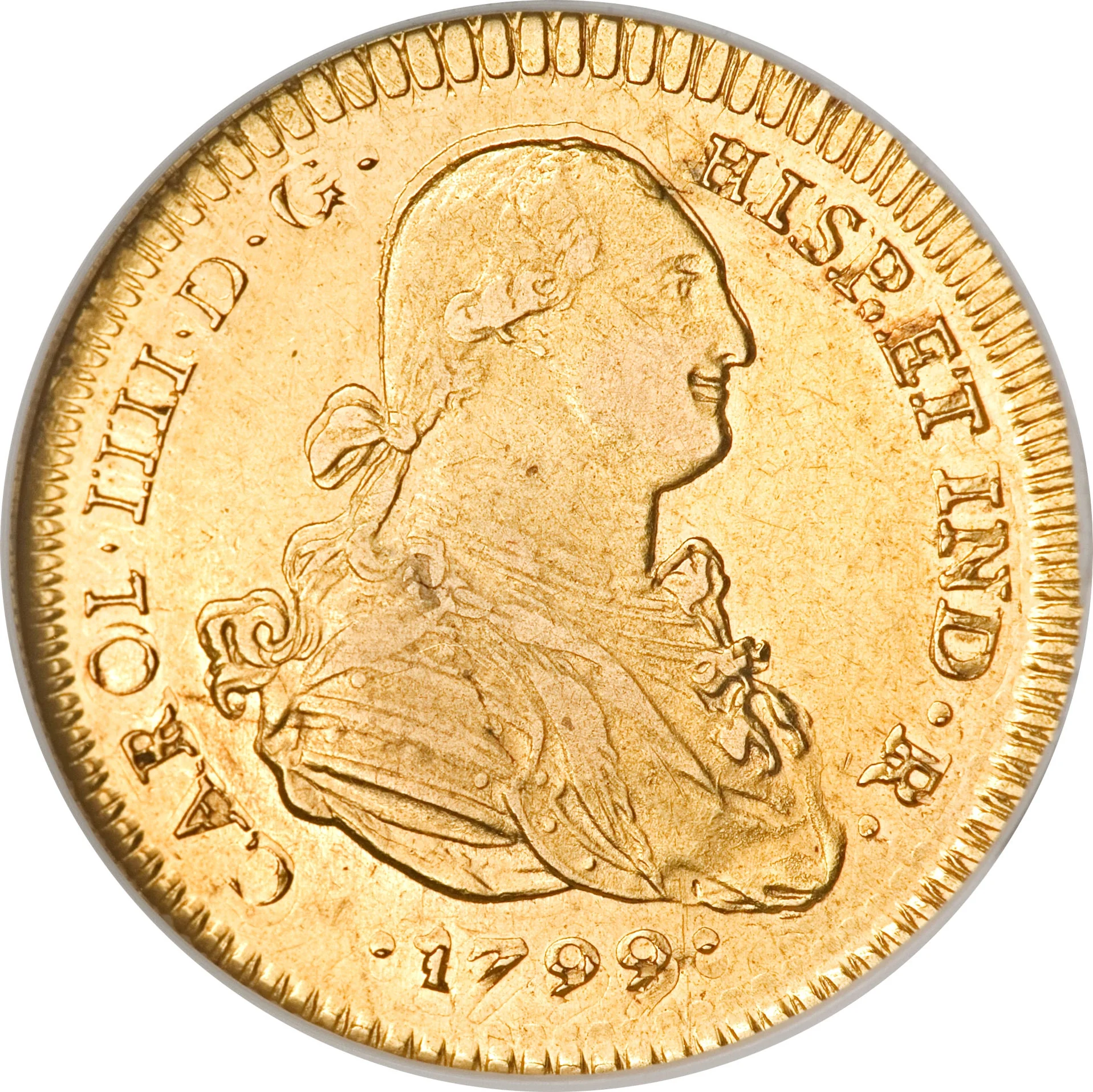
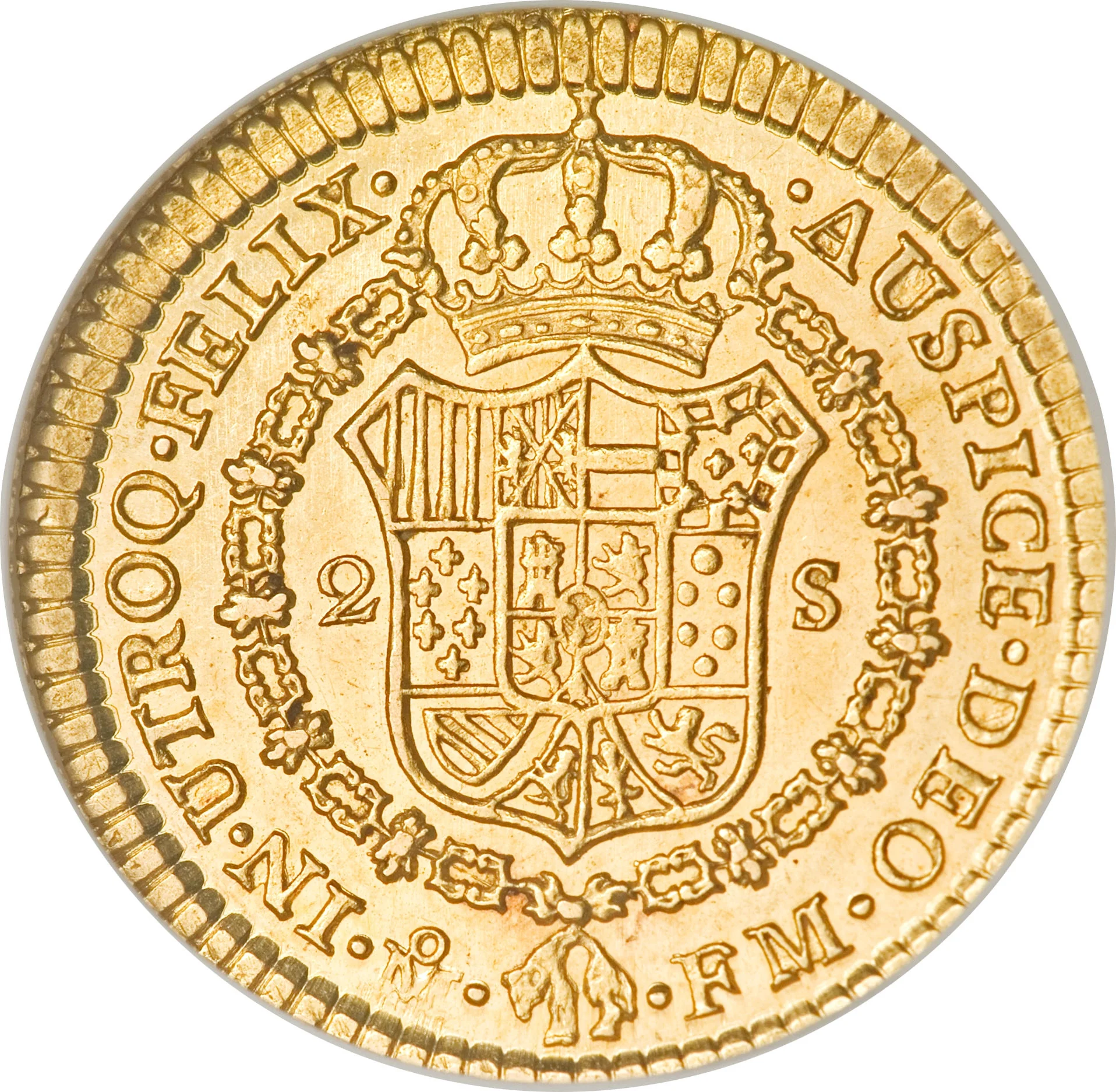
2 escudos – New Spain
Add to wishlist
Mexico
Context
Years: 1791–1808
Country: Mexico
Issuer: New Spain
Ruler: Charles IV
Currency:
(1535—1897)
Demonetized: Yes
Material
References
KM: #
Numista: #28693
Value
Bullion value: $903.11
Obverse
Reverse
Description:
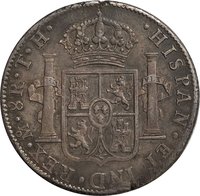
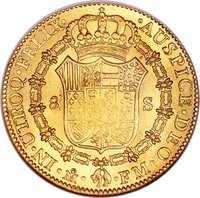
Arms of Spain encircled by chain and legend.
Inscription:
IN•UTROQ•FELIX•
•AUSPICE•DEO•
•Mo• •FM•
•AUSPICE•DEO•
•Mo• •FM•
Script: Latin
Edge
Mints
| Name | Mark |
|---|---|
| Mexican Mint | — |
Mintings
| Year | Mint Mark | Mintage | Quality | Collection |
|---|---|---|---|---|
| 1791 | FM | — | ||
| 1792 | FM | — | ||
| 1793 | FM | — | ||
| 1794 | FM | — | ||
| 1795 | FM | — | ||
| 1796 | FM | — | ||
| 1797 | FM | — | ||
| 1798 | FM | — | ||
| 1799 | FM | — | ||
| 1800 | FM | — | ||
| 1801 | FT | — | ||
| 1802 | FT | — | ||
| 1803 | FT | — | ||
| 1804 | TH | — | ||
| 1805 | TH | — | ||
| 1806 | TH | — | ||
| 1807 | TH | — | ||
| 1808 | TH | — |
Historical background
In 1791, the currency system of New Spain, the wealthiest viceroyalty of the Spanish Empire, was a complex and often problematic bimetallic system based on silver and gold. The backbone of the economy was the silver peso, or "piece of eight," minted primarily at the Mexico City Mint. These coins, renowned for their purity, were a de facto global currency, circulating widely in the Americas and Asia. Alongside silver, gold coins like the escudo were minted, but their volume was far smaller. The official exchange rate between gold and silver was fixed by royal decree, but this often failed to reflect global market values, leading to persistent tensions and incentives for arbitrage.
The system was plagued by chronic shortages of small-denomination coinage for everyday transactions. This scarcity was exacerbated by the "hoarding and export" of silver coins by merchants and the immense outflow of bullion to Spain to fulfill imperial obligations and trade deficits. To fill the void, a plethora of unofficial and often debased tokens, known as tlacos or pilones, circulated locally, issued by merchants, hacienda owners, and even churches. This created a chaotic and unreliable environment for the lower and middle classes, while the Crown struggled to control and standardize the money supply across its vast territory.
Furthermore, the 1790s marked a period of significant financial strain and reform attempts. The Bourbon monarch Charles III had initiated efforts to modernize the colonial economy, but his successor, Charles IV, faced the mounting costs of European wars. In this context, the currency system was not only an economic mechanism but also a fiscal tool. The Crown sought to extract more wealth from New Spain through taxes and mint profits, while also considering proposals to address the small-change crisis. The situation in 1791 was thus one of underlying fragility, setting the stage for the more drastic financial measures and economic pressures that would contribute to the unrest leading to the wars of independence in the following decades.
The system was plagued by chronic shortages of small-denomination coinage for everyday transactions. This scarcity was exacerbated by the "hoarding and export" of silver coins by merchants and the immense outflow of bullion to Spain to fulfill imperial obligations and trade deficits. To fill the void, a plethora of unofficial and often debased tokens, known as tlacos or pilones, circulated locally, issued by merchants, hacienda owners, and even churches. This created a chaotic and unreliable environment for the lower and middle classes, while the Crown struggled to control and standardize the money supply across its vast territory.
Furthermore, the 1790s marked a period of significant financial strain and reform attempts. The Bourbon monarch Charles III had initiated efforts to modernize the colonial economy, but his successor, Charles IV, faced the mounting costs of European wars. In this context, the currency system was not only an economic mechanism but also a fiscal tool. The Crown sought to extract more wealth from New Spain through taxes and mint profits, while also considering proposals to address the small-change crisis. The situation in 1791 was thus one of underlying fragility, setting the stage for the more drastic financial measures and economic pressures that would contribute to the unrest leading to the wars of independence in the following decades.
✨ Legendary