

½ Kronenthaler – Austrian Netherlands
Belgium
Context
Years: 1786–1789
Country: Belgium 
Issuer: Austrian Netherlands
Ruler: Joseph II
Currency:
(1744—1798)
Demonetized: Yes
Total mintage: 13,798
Material
References
KM: #Click to copy to clipboard34
Numista: #28566
Value
Bullion value: $36.78
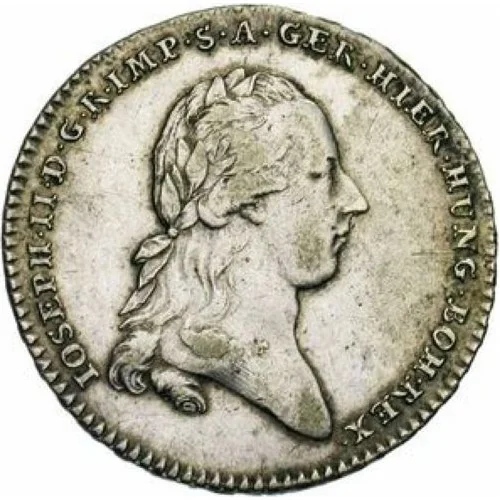
Obverse
Description:
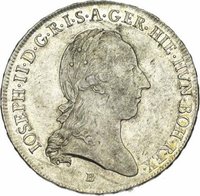
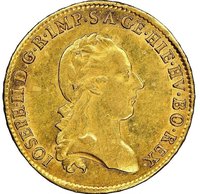
Portrait right. Legend: "Iosephus II Dei Gratia Romanorum Imperator Semper Augustus Germaniae Hierosolymae Hungariae Bohemiaeque Rex."
Inscription:
IOSEPH·II·D·G·R·IMP·S·A·GER·HIER·HUNG·BOH·REX·
Script: Latin
Engraver: Théodore Van Berckel
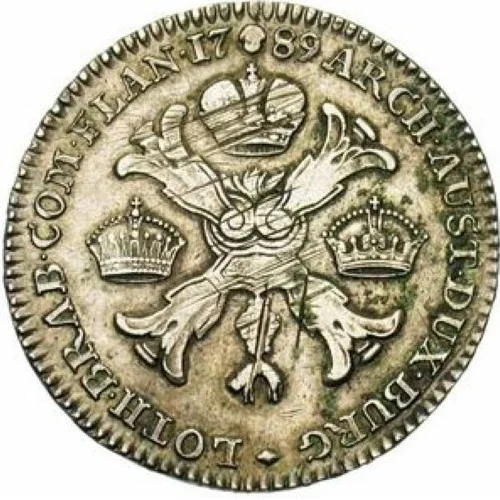
Reverse
Description:
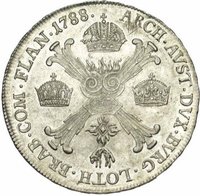
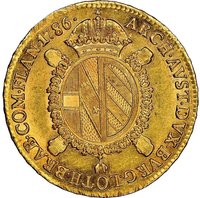
Burgundian cross with three crowns, Golden Fleece collar. Date and mint mark. Legend: "Archidux Austriae Dux Burgundiae Lotharingiae Brabantiae Comes Flandriae."
Inscription:
ARCH·AUST·DUX·BURG - LOTH·BRAB·COM·FLAN·
1789
1789
Script: Latin
Engraver: Théodore Van Berckel
Edge
Embossed text
Legend:
VIRTUTE ET EXEMPLO
Mintings
| Year | Mint Mark | Mintage | Quality | Collection |
|---|---|---|---|---|
| 1786 | — | — | ||
| 1788 | — | 13,798 | ||
| 1789 | — | — |
Historical background
In 1786, the Austrian Netherlands found itself in a precarious monetary situation, characterized by a severe shortage of small-denomination coinage essential for daily commerce. This scarcity stemmed from decades of complex regional and international factors. The region, a patchwork of duchies and counties, had long been a monetary battleground where debased coins from neighboring states, particularly the Dutch Republic and France, flooded the market. These foreign coins, often of inferior silver content, drove the full-valued Austrian specie out of circulation (following Gresham's Law), leaving the populace and merchants struggling with a degraded and unreliable medium of exchange.
The Habsburg government in Vienna, preoccupied with wider imperial concerns, had historically done little to assert monetary control. Attempts at reform, such as the Konventionsfuß standard introduced under Empress Maria Theresa, failed to establish a unified and trusted currency within the Austrian Netherlands. By the mid-1780s, the lack of trustworthy small change crippled local markets, stifled economic activity, and bred public resentment. The crisis was not merely economic but also political, as it highlighted the disconnect between the centralizing ambitions of Emperor Joseph II and the practical realities of governing the distant provinces.
Consequently, the year 1786 fell within a period of mounting frustration that would soon boil over. The currency chaos became a potent symbol of ineffective Habsburg rule and contributed significantly to the growing discontent among all social classes. This economic distress directly fueled the broader opposition to Joseph II's radical centralizing reforms, culminating just two years later in the Brabant Revolution of 1788-89, where monetary grievances were prominently featured among the rebels' complaints against imperial authority.
The Habsburg government in Vienna, preoccupied with wider imperial concerns, had historically done little to assert monetary control. Attempts at reform, such as the Konventionsfuß standard introduced under Empress Maria Theresa, failed to establish a unified and trusted currency within the Austrian Netherlands. By the mid-1780s, the lack of trustworthy small change crippled local markets, stifled economic activity, and bred public resentment. The crisis was not merely economic but also political, as it highlighted the disconnect between the centralizing ambitions of Emperor Joseph II and the practical realities of governing the distant provinces.
Consequently, the year 1786 fell within a period of mounting frustration that would soon boil over. The currency chaos became a potent symbol of ineffective Habsburg rule and contributed significantly to the growing discontent among all social classes. This economic distress directly fueled the broader opposition to Joseph II's radical centralizing reforms, culminating just two years later in the Brabant Revolution of 1788-89, where monetary grievances were prominently featured among the rebels' complaints against imperial authority.
✨ Legendary