

5 Reales – Principality of Catalonia
Spain
Context
Year: 1644
Country: Spain 
Issuer: Principality of Catalonia 
Ruler: Louis XIV of France
Currency:
Demonetized: Yes
Material
Diameter: 32 mm
Weight: 12 g
Silver weight: 11.00 g
Shape: Irregular round
Composition: 91.7% Silver
Magnetic: No
Technique: Hammered
References
KM: #Click to copy to clipboard103
Numista: #110708
Value
Bullion value: $31.13
Obverse
Description:
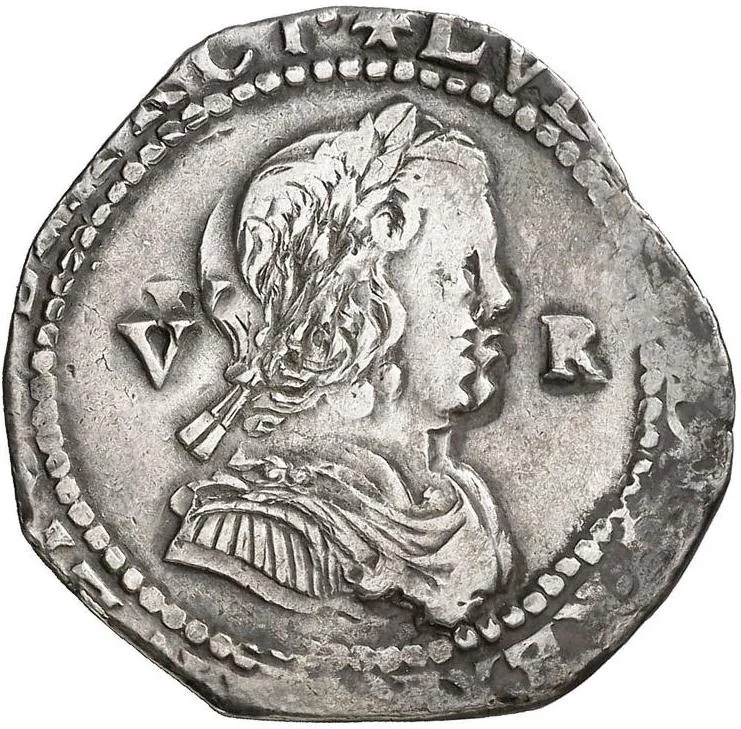
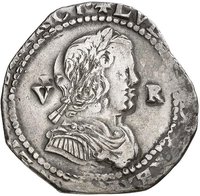
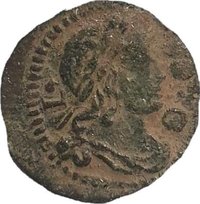
Bust right. Value divides legend within beaded circles.
Inscription:
V R
LVD·XIIII D·G·REX·FRAN·ET CO·BAR·
LVD·XIIII D·G·REX·FRAN·ET CO·BAR·
Script: Latin
Reverse
Description:
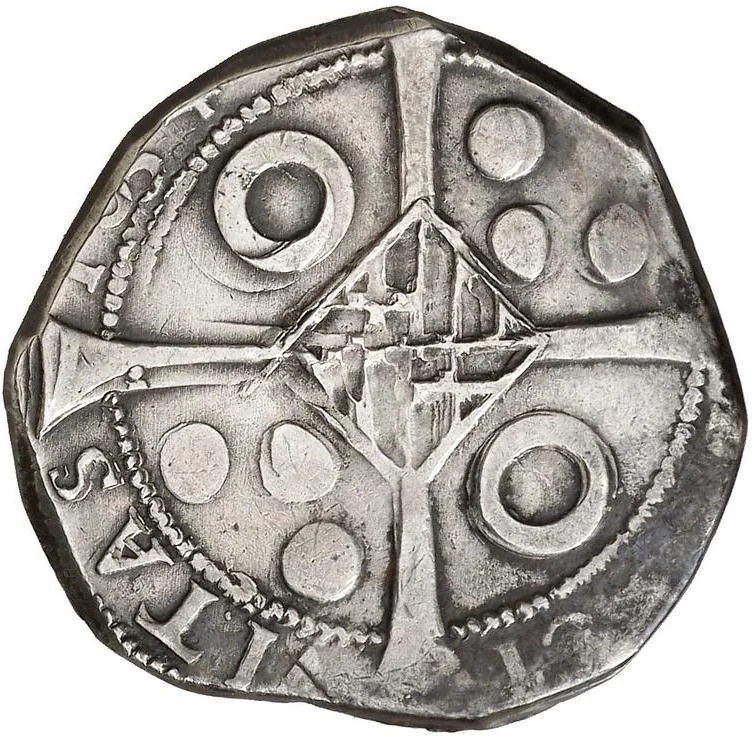
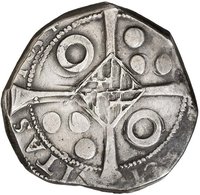
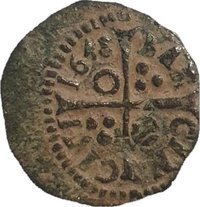
Cross divides legend, annulets at angles one and four, three bezants at two and three. Central lozenge shield. Legend between beaded circles.
Inscription:
BARCINO CIVITAS 1644
Script: Latin
Edge
Mints
| Name | Mark |
|---|---|
| Barcelona Mint / La Seca | — |
Mintings
| Year | Mint Mark | Mintage | Quality | Collection |
|---|---|---|---|---|
| 1644 | — | — |
Historical background
In 1644, the Principality of Catalonia was in a state of profound monetary instability, deeply entangled in the geopolitical conflict of the Reapers' War (Guerra dels Segadors). This conflict, which began in 1640, saw Catalonia rebel against the Crown of Castile, initially proclaiming Louis XIII of France as Count of Barcelona. The war had shattered the existing financial and monetary systems, as the competing authorities—the Generalitat of Catalonia (loyal to the Republic and France) and the exiled Royal administration of Philip IV—both issued currency to fund their military efforts, leading to a chaotic oversupply of coinage.
The primary currency in circulation was the silver lliura (pound), divided into 20 sous, each of 12 diners. However, the intense fiscal demands of the war led both sides to engage in severe currency manipulation. The Generalitat, facing empty coffers, repeatedly debased the coinage by reducing the silver content in coins like the tòvia and croat, while also issuing vast quantities of low-value billon (base metal) and copper coins, such as the ardit. This caused rampant inflation, a collapse in public trust, and the hoarding of older, purer coins, which disappeared from circulation (Gresham's Law).
This monetary chaos was both a cause and a symptom of the broader social and economic devastation of the war. By 1644, prices were volatile and unpredictable, trade was severely disrupted, and the local economy was crippled. The situation reflected the principality's precarious position, caught between two major powers and lacking the sovereign authority to establish a stable and unified monetary policy, leaving its currency system in a state of near collapse.
The primary currency in circulation was the silver lliura (pound), divided into 20 sous, each of 12 diners. However, the intense fiscal demands of the war led both sides to engage in severe currency manipulation. The Generalitat, facing empty coffers, repeatedly debased the coinage by reducing the silver content in coins like the tòvia and croat, while also issuing vast quantities of low-value billon (base metal) and copper coins, such as the ardit. This caused rampant inflation, a collapse in public trust, and the hoarding of older, purer coins, which disappeared from circulation (Gresham's Law).
This monetary chaos was both a cause and a symptom of the broader social and economic devastation of the war. By 1644, prices were volatile and unpredictable, trade was severely disrupted, and the local economy was crippled. The situation reflected the principality's precarious position, caught between two major powers and lacking the sovereign authority to establish a stable and unified monetary policy, leaving its currency system in a state of near collapse.
✨ Legendary