

5 Ducats – Hungary
Hungary

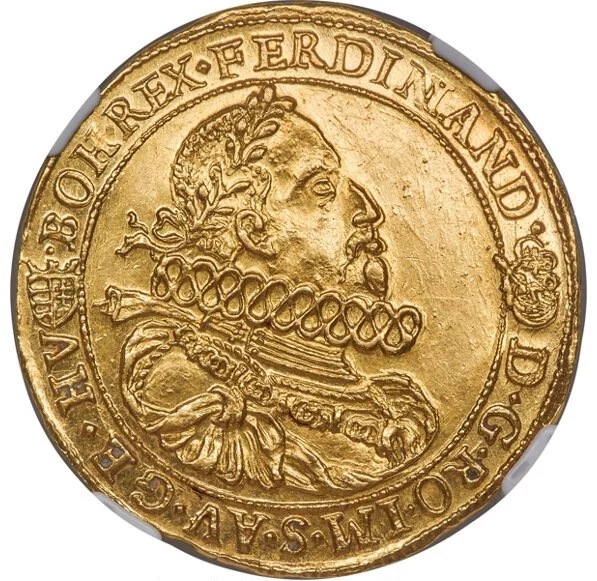
Obverse
Description:
Right-facing laureate bust with curls, necklace, and Golden Fleece ring; behind neck, crowned double Hungarian shield; on right, Madonna on crescent.
Inscription:
FERDINAND • D • G • RO • IM • S • AV • GE • HV • BOH • REX
Script: Latin
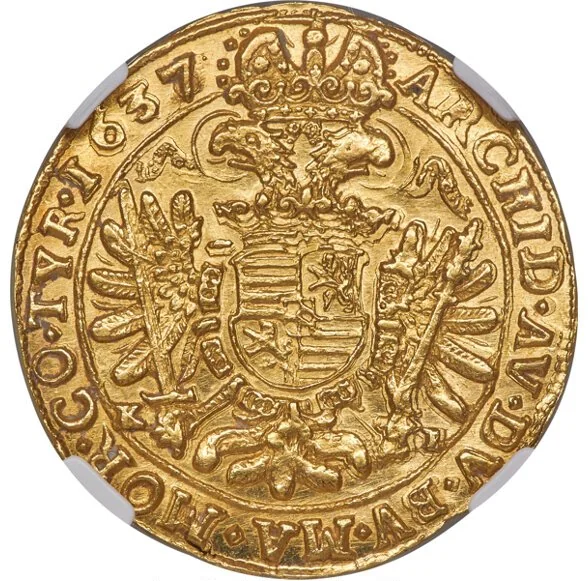
Reverse
Description:
Imperial double-headed eagle with sword and scepter, holding a quartered shield (Árpád stripes, Bohemian lion twice, Árpád stripes) with an inescutcheon of Austrian and Burgundian arms. Mintmark below.
Inscription:
ARCHID•AV•DV•BV•MA•MOR•CO•TYR•1637
Script: Latin
Edge
Mints
| Name | Mark |
|---|---|
| Kremnica | KB |
Mintings
| Year | Mint Mark | Mintage | Quality | Collection |
|---|---|---|---|---|
| 1634 | K-B | — | ||
| 1637 | K-B | — |
Historical background
In 1634, Hungary existed as a divided realm, a critical factor shaping its currency situation. The central and western regions were under Habsburg control (Royal Hungary), the east was the semi-independent Principality of Transylvania, and the central plains were occupied by the Ottoman Empire. This political fragmentation meant no single, unified monetary authority existed. The Habsburgs minted coins for their territory, primarily in Kremnica (Körmöcbánya), while Transylvania operated its own mints, and Ottoman coins also circulated in their zones, creating a complex multi-currency environment.
The period was characterized by severe currency debasement, a common problem across war-torn 17th-century Europe. To finance continuous warfare against the Ottomans and internal conflicts, the Habsburg treasury frequently reduced the silver content of coins, particularly the denarius (denár). This led to a classic "bad money drives out good" scenario, where older, purer coins were hoarded or melted down, leaving the economy flooded with unstable, low-value currency. Prices rose sharply, causing hardship for soldiers paid in debased coin and peasants required to pay taxes in higher-quality currency.
Furthermore, a vast array of foreign coins circulated due to Hungary's position at the crossroads of empires and its active trade. Alongside domestic issues, German thalers, Dutch leeuwendaalders, Ottoman akçe, and various Polish and Italian coins were all in use, their values fluctuating based on metal content and local demand. This monetary chaos stifled commerce and created uncertainty, as exchange rates were unstable and the real value of money was constantly in question. Thus, Hungary's currency situation in 1634 was one of fragmentation, debasement, and complexity, mirroring the kingdom's fractured political state and the economic pressures of perpetual conflict.
The period was characterized by severe currency debasement, a common problem across war-torn 17th-century Europe. To finance continuous warfare against the Ottomans and internal conflicts, the Habsburg treasury frequently reduced the silver content of coins, particularly the denarius (denár). This led to a classic "bad money drives out good" scenario, where older, purer coins were hoarded or melted down, leaving the economy flooded with unstable, low-value currency. Prices rose sharply, causing hardship for soldiers paid in debased coin and peasants required to pay taxes in higher-quality currency.
Furthermore, a vast array of foreign coins circulated due to Hungary's position at the crossroads of empires and its active trade. Alongside domestic issues, German thalers, Dutch leeuwendaalders, Ottoman akçe, and various Polish and Italian coins were all in use, their values fluctuating based on metal content and local demand. This monetary chaos stifled commerce and created uncertainty, as exchange rates were unstable and the real value of money was constantly in question. Thus, Hungary's currency situation in 1634 was one of fragmentation, debasement, and complexity, mirroring the kingdom's fractured political state and the economic pressures of perpetual conflict.

✨ Legendary