

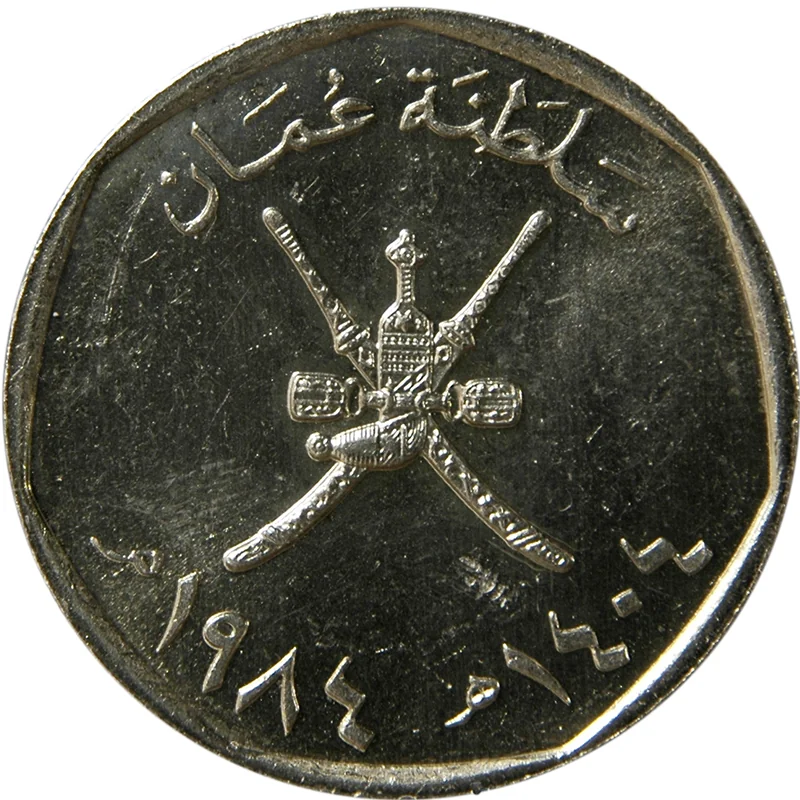
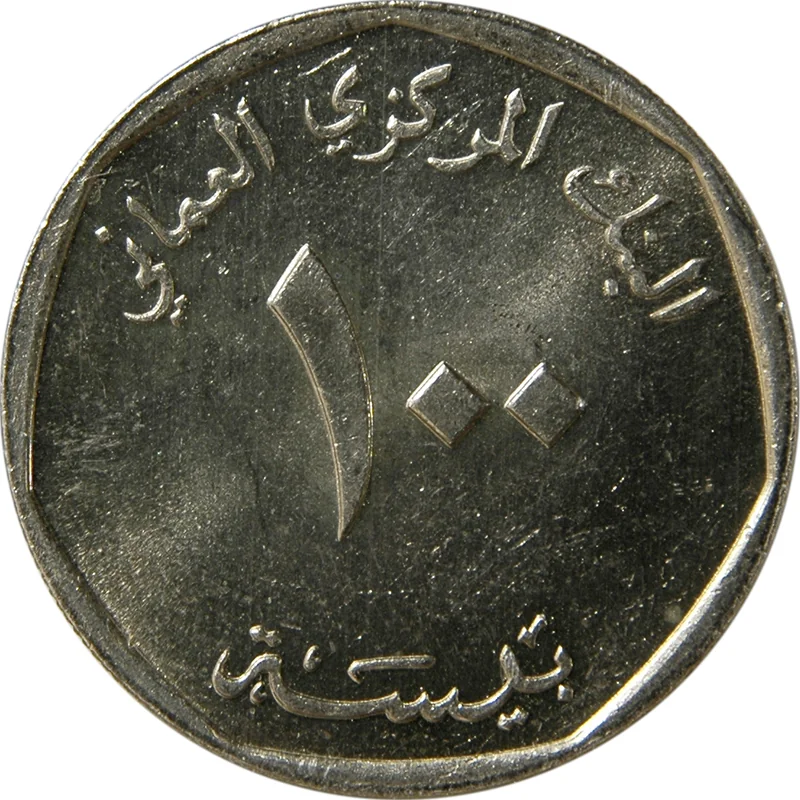
100 baisa – Oman
Add to wishlist
Oman
Context
Year: 1984
Islamic (Hijri) Year:: 1404
Issuer: Oman
Issuing organization: Central Bank of Oman
Ruler: Qaboos bin Said
Currency:
(since 1972)
Demonetization: 20 May 2020
Total mintage: 4,000,000
Material
Diameter: 21.5 mm
Weight: 4.2 g
Thickness: 1.55 mm
Shape: Round
Composition: Copper-nickel
Technique: Milled
Alignment: Medal alignment
flip
References
KM: #
Numista: #11626
Value
Exchange value: 0.1 OMR
Obverse
Reverse
Edge
Reeded
Categories
| Symbols> Coat of Arms |
| Object> Cold weapons |
Mints
| Name | Mark |
|---|---|
| Royal Mint | — |
Mintings
| Year | Mint Mark | Mintage | Quality | Collection |
|---|---|---|---|---|
| 1984 | — | 4,000,000 |
Historical background
In 1984, Oman's currency situation was defined by the stability of the Omani rial (OMR), which was firmly pegged to the U.S. dollar. This peg, established in 1973 following the country's modernization under Sultan Qaboos bin Said, provided crucial monetary stability and predictability for an economy heavily reliant on oil exports. With petroleum revenues constituting the vast majority of government income, the dollar peg helped manage inflation and facilitated international trade and investment, insulating the rial from the volatility of oil price fluctuations on the foreign exchange market.
However, this stability existed against a backdrop of regional economic strain. The early 1980s saw a significant decline in global oil prices, which reduced government revenues and led to Oman's first budget deficits. While the currency peg itself was not in doubt, the broader economic context forced the government to begin drawing down its financial reserves and to cautiously implement austerity measures. This period highlighted the inherent vulnerability of a petrocurrency, as the rial's strength was ultimately underpinned by hydrocarbon revenues that were subject to external market forces.
Consequently, the monetary policy focus in 1984 was less on the exchange rate mechanism—which functioned reliably—and more on managing the fiscal pressures caused by lower oil income. The Central Bank of Oman maintained the fixed peg as a cornerstone of economic policy, ensuring confidence in the currency. The challenges of that year underscored the long-term necessity, which Oman would later pursue, of diversifying the economy to reduce its dependence on oil and thereby reinforce the foundation of its strong and stable currency.
However, this stability existed against a backdrop of regional economic strain. The early 1980s saw a significant decline in global oil prices, which reduced government revenues and led to Oman's first budget deficits. While the currency peg itself was not in doubt, the broader economic context forced the government to begin drawing down its financial reserves and to cautiously implement austerity measures. This period highlighted the inherent vulnerability of a petrocurrency, as the rial's strength was ultimately underpinned by hydrocarbon revenues that were subject to external market forces.
Consequently, the monetary policy focus in 1984 was less on the exchange rate mechanism—which functioned reliably—and more on managing the fiscal pressures caused by lower oil income. The Central Bank of Oman maintained the fixed peg as a cornerstone of economic policy, ensuring confidence in the currency. The challenges of that year underscored the long-term necessity, which Oman would later pursue, of diversifying the economy to reduce its dependence on oil and thereby reinforce the foundation of its strong and stable currency.
🌱 Common